

Climate, Energy & Environment:
“Over the last decade, India has begun a serious push toward electric vehicles (EVs). The Government of India and most state governments have implemented a range of demand- and supply-side support policies, and the early momentum has come from below. Start-ups and established automakers have begun to make real gains, primarily driven by the rapid adoption of electric two- and three-wheelers… Yet the transition is far from settled. EVs still cost more than their internal combustion engine vehicle (ICEV) equivalents, which keeps a capable EV beyond the reach of much of the mass market… The industrial stakes are just as high. India is the world’s fourth-largest automaker, and vehicle manufacturing accounts for roughly half of its manufacturing GDP. The ICEV industry rests on two pillars: large manufacturers and a base of more than 35,000 component makers, most of whom are small and medium-sized firms. EV manufacturing has not yet reached the same maturity, and India risks falling behind its competitors. Because China dominates EV manufacturing, there is a particular worry lurking beneath the transition: India could trade its dependence on imported fossil fuels for a new dependence on imported EVs and their components… Past industrial policy helped India catch up in conventional vehicles and build a strong automotive base, even if that base has struggled to produce globally competitive cars… The strategic questions, therefore, remain. Can India strengthen its automobile sector in the EV era? What would success in EV manufacturing look like? What obstacles lie in the way? Moreover, does India’s current research, development and demonstration (RD&D) ecosystem possess the capabilities required to support that ambition?” Read more: Arunesh Karkun, Kashmeera Patel, Aman Srivastava, and Easwaran J Narassimhan, Sustainable Futures Collaborative
“Indian demand for night-time air conditioning to cope with sweltering temperatures is pushing up after-dark electricity use, testing the limits of the country’s renewable power push. Summer night-time temperatures in the world’s most populous country have risen about twice as fast as those in the day, according to the International Energy Agency, with temperatures that can approach 30C across the country… India’s peak night-time electricity demand had climbed by about 40 per cent to 252 gigawatts since 2019, the IEA said, with air conditioning accounting for as much as one-third of night demand. While the surge in night-time temperatures due to climate change and the urban “heat island” effect is a problem across many countries, the scale of the challenge in India — with its vast population of 1.4bn and extreme temperatures that linger long into the night — is particularly acute… India is rapidly installing solar panels and, helped in part by investment from large groups such as Adani and Tata, now has the world’s third-largest solar capacity… This has helped to meet rising power demand during the day, driven in part by air conditioning as people try to cope with summer temperatures that reach well above 40C. But the country’s combined wind, nuclear, hydropower and battery storage resources are not enough to cover night-time demand, meaning that once the sun fades more coal-fired power stations have to kick back in.” Read more: Rachel Millard, Andres Schipani and Jyotsna Singh, Financial Times
“India has directed refiners to boost cooking gas production, seeking to bolster domestic supplies ahead of the upcoming festival season as uncertainty over the Strait of Hormuz threatens imports. Private and state-owned refiners, as well as oil and gas producers, have been ordered to “implement all technically and economically feasible measures” to maximize liquefied petroleum gas output, according to an Aug. 13 government notification… India relies on imports for about two-thirds of its LPG consumption, with nearly 90% of those supplies passing through the Persian Gulf chokepoint before the Middle East war disrupted flows… Domestic refiners, which produced about 36,000 tons of LPG a day before the war, have already lifted output to as much as 54,000 tons a day to help meet higher demand during the traditional festival season that starts in September and peaks in November with Diwali, the Hindu festival of lights… Refiners have additionally been told to expand infrastructure for LPG storage, evacuation and transportation. The government will review the targets every January and July… The South Asian nation had traditionally relied on LPG imports rather than domestic production because the fuel is less profitable than gasoline and petrochemical feedstocks.” Read more: Rakesh Sharma and Rajesh Roy, Bloomberg
“Every summer evening, Gulshan follows the same routine. She washes the floor of her one-room home several times so it cools a little for her four children to sleep on. Last summer, the family saved enough to buy a desert cooler, which uses evaporation as a cheaper alternative to air conditioning… This summer, Gulshan started jotting down these coping strategies in a garmi khata, or heat registry. “I feel relieved that at least somebody might read my family’s experiences,” she says. They are one of 40 households in Sunder Nagri, a slum in north-east Delhi, documenting their experiences of surviving the city’s increasingly longer and more frequent heatwaves… Aravind Unni, an urban planner and researcher in Delhi, says: “Experiences of heat are vastly different depending on geography, income, occupation, gender, caste, class. While we have some meteorological data on heat, what’s absolutely missing is people, community – what they feel, what they experience.”… Most data collated in heat planning is usually just meteorological, such as air temperatures and heatwave thresholds.. The idea for the heat diaries was to “move beyond just the numbers”, says Nibedita Saha, a Greenpeace India researcher who worked on the project. Aakiz Farooq, a senior campaigner at the group, says the team contemplated how best to encapsulate experiences and thought: “What if they become their own storytellers, they write their own evidence, they write their own testimonies?” Read more: Suchitra, The Guardian
Economy:
“Nearly four-fifths of the corporate bad loans offered for sale by public sector banks in the June quarter had been taken to the market previously, according to industry data, highlighting the difficulty lenders face in finding buyers for large legacy accounts at acceptable valuations. State-owned banks initiated 36 sale processes involving loans with principal outstanding of ₹49,746 crore during the first quarter of this financial year, as per the data. Of this, ₹39,671 crore, or 79.7%, comprised repeat sale attempts. Seventeen of the 36 processes involved accounts that had been offered earlier but remained unresolved… Indian Overseas Bank and Indian Bank accounted for nearly 89% of the repeatedly offered public sector bank loans. The entire ₹19,523-crore pool offered by Indian Overseas Bank comprised repeat accounts, while ₹15,730 crore of Indian Bank’s ₹15,880-crore pool had been taken to the market earlier… Private sector banks presented a sharp contrast. They offered corporate and retail loans with principal outstanding of ₹10,734 crore during the quarter, of which only ₹369 crore, or 3.4%, involved repeat processes. Across public sector banks, private banks and non-bank lenders, bad loans with combined principal outstanding of ₹63,472 crore were offered during the quarter. Repeat processes accounted for ₹40,221 crore, or 63.4%, with public sector banks contributing almost the entire repeated pool.” Read more: Saloni Shukla, Economic Times
“Uneven demand, commodity price volatility, trade related uncertainty due to heightened geopolitical tensions and cheap imports are impacting capex decisions of the corporate sector as the investment confidence is still “catching up”, said a paper prepared for the two-day banking conclave this week, which was attended by FM Nirmala Sitharaman. “Large capital projects require confidence not only in current demand but also in future cash flow visibility. When pricing, input costs and end-market demand remain uncertain, companies often choose to defer investment,” the paper prepared by SBI Caps said as it explained the reasons for low private capex seen in recent years. It said while most large companies today possess both the borrowing capability and internal resources required for expansion, the question is whether management teams are “sufficiently confident”. For the next investment cycle spanning over FY27-FY31, which will see average annual expenditure demand rise to Rs 30 lakh crore from approx Rs 20 lakh crore during FY22 to FY26, the paper highlighted how demand for funds will be “uneven”, based on an analysis of the current cash deployment by NSE 200 companies. “Many companies have prioritised dividends, acquisitions and retaining on balance sheets over greenfield expansion,” it said… It also said that for the next phase of private capex cycle, sustained public sector investment continues to provide an important foundation, as govt spending on transport, power, logistics and urban infra is creating demand for private suppliers, while improving the infra required for broader industrial growth.” Read more: Shiva Rajora, Times of India
“Homegrown private credit firms are wresting a growing share of India’s lending deals from global funds, armed with larger pools of capital and an increasing appetite for bigger transactions. Domestic funds accounted for 74% of private credit deal value in the first half of 2026, more than double their 32% share in the corresponding period in the previous year, according to EY. The firm tracked 102 transactions of more than $10 million totaling about $3.5 billion during the period. The shift is intensifying competition for global managers including Bain Capital and Davidson Kempner as Indian firms build deeper pools of capital and push beyond their traditional mid-market turf. Bain provided $176 million to Kalpataru Properties Ltd. and $150 million to GMR Group during the period, while Davidson Kempner lent $156 million to HyFun Foods, according to the report. India’s private credit market is also relatively insulated from liquidity strains emerging elsewhere in the industry because its funds are largely closed-ended, according to EY. With capital typically locked up for the life of a fund and leverage limited, managers face less risk of investor withdrawals forcing asset sales during market turmoil. US private credit funds faced more than $20 billion of withdrawal requests in early 2026, while India has avoided comparable redemption pressure, EY said… Local managers continue to add dry powder. Kotak Alternate Assets Management secured $691 million for its real estate fund and $496 million for its Yield & Growth Fund, while Avendus raised $290 million for a structured credit fund, the report showed.” Read more: Saikat Das, Bloomberg
Foreign Policy & National Security:
“Parliamentary affairs minister Kiren Rijiju on Wednesday said people living on either side of the Line of Actual Control (LAC) in some areas of Arunachal Pradesh have differing perceptions of the boundary because it is not demarcated, leading to some confusion. He trashed reports suggesting that China had intruded 60 km into Indian territory. “It is not like they (China) came and captured our village. That is not the case. On certain land, they have cast an eye because there is no demarcation. Our people believe that our land extends further ahead, while the villages situated on the China side, including Tibetan and local people, claim that their land extends deep inside here. So, there is confusion,” he said in an interview to news agency IANS… There is no clarity on the current status of the standoff in the Arunachal Pradesh sector, though people familiar with the situation earlier said on condition of anonymity that the problems first emerged in the remote Taksin area of Upper Subansiri district in early July. There were a few face-offs between Indian and Chinese troops in July and matters took a more serious turn towards the end of last month, the people said.” Read more: Hindustan Times
“Despite the visible tensions between the two countries, Bangladesh Prime Minister Tarique Rahman’s long-awaited visit to India is likely to take place very soon, with Dhaka viewing the visit as strategically important to restoring momentum in bilateral relations and addressing a range of trade and energy issues. Relations between the two countries deteriorated after ousted Prime Minister Sheikh Hasina’s press conference in Delhi. Even so, Bangladesh is still weighing the visit, since engagement with India is seen as critical to renewing the water-sharing agreement on the Ganges, which is nearing its expiry, a senior official of Bangladesh’s Ministry of Foreign Affairs told The Wire… The Wire has also confirmed, through multiple sources including foreign diplomats and officials in Bangladesh’s Ministry of Foreign Affairs and Bangladesh Prime Minister’s Office, that the visit may take place in the last week of August if no major issue arises. Foreign ministry sources said Tarique Rahman is unlikely to attend the BRICS summit and would instead prefer a bilateral visit even if it gets pushed to September… Business communities in both India and Bangladesh are also optimistic about Rahman’s visit, viewing the recent visit of a business delegation from the Confederation of Indian Industry (CII) as an icebreaker.” Read more: Jebun Nesa Alo, The Wire
“India’s share of exports to the US remained largely unchanged despite a year of President Donald Trump’s punitive tariffs and New Delhi’s efforts to diversify its trade with a raft of new deals with other countries. An analysis of trade ministry data for the 12 months through July shows the US continues to account for about 20% of India’s exports. Over that period, Trump slapped tariffs as high as 50% on Indian goods at one point, before dropping it to 18% in February this year. The goods now carry a 10% tariff rate… While that diversification push has continued, with exporters scouting newer markets to reduce risk, the US share has remained resilient, underscoring the difficulty of replacing the world’s largest economy. It will take at least two to three years for market diversification to show meaningful results, said Ajay Sahai, director general of the Federation of Indian Export Organizations, adding that the US continues to be the most attractive market. The share of exports to the US has grown to nearly 20% from 17.4% in 2022-23, official data show… The sheer scale and appetite of the US for a broad range of Indian goods make it a uniquely important market, particularly for electronics, engineering goods, pharmaceuticals, gems and jewelry and textiles. The two countries have yet to sign a trade deal, despite months of high-level talks.” Read more: Shruti Srivastava, Bloomberg
People & Politics:
“The controversial PM-CARES fund collected Rs 1,162.92 crore as donation from within and outside the country in 2023-24 and 2024-25 but spent just Rs 16.47 crore during this period, according to audit reports. In 2024-25, the fund collected Rs 479.97 crore as donations while it spent just Rs 87.85 lakh on children who lost their parents to Covid-19. In 2023-24, it collected Rs 682.94 crore and spent Rs 15.59 crore. According to the ‘Receipts and Payments Account for the Year Ended 31 March, 2025, the fund has Rs 8,452.06 crore in its accounts. Of this, 7,846.65 crore was in fixed deposits. Altogether, the fund collected Rs 14,766.95 crore as donations since its inception in March 2020 and has spent 8,133.29 crore till 2024-25, the bulk of the expenditure happening during the Covid-19 pandemic… Transparency activist Anjali Bhardwaj posted on 'X', "finally the audit statement of PMCARES Fund for 2024-25 has been made public! Key highlights- Utilised only 0.01% of available Rs 8,452 crore! Why is the PMCARES Fund keeping such large sums of money idle?”… In 2022-23, the fund had collected Rs 912.21 crore as donations while spending Rs 439.38 crore – Rs 346 crore for children whose parents died during the pandemic and Rs 91.87 crore for procuring nearly 1 lakh oxygen concentrators. Since the pandemic, the donations to the fund have declined. In 2020-21, the fund saw the highest collection at Rs 7,678.68 crore and a spending of Rs 3,976.17 crore.” Read more: Shemin Joy, Deccan Herald
“In its first major organisational rejig since Nitin Nabin took over as the national president of the Bharatiya Janata Party (BJP) in January, the party on Monday (August 17) announced several national office bearers for various positions in the organisation, including the powerful posts of national general secretaries. An analysis of the names of national vice presidents and national general secretaries appointed by the party on Monday shows that the list is dominated by upper-castes, with leaders from backward classes and marginalised communities being just a footnote. In the list of 13 national vice presidents announced by the BJP, only two names – Rekha Verma, a two-time former MP from the Dhaurahra Lok Sabha constituency in Uttar Pradesh, and incumbent Rajya Sabha MP from Karnataka M. Nagaraja are from Other Backward Castes (OBC)… Ram Madhav, who once the played an important role as the BJP’s general secretary in-charge of Jammu and Kashmir, before being removed from the post of national general secretary in September 2020, has now made a comeback as a national vice president of the party… The saffron party has also relied on upper-caste leaders for the important post of national general secretary, with six of the eight names announced on Monday being from upper-castes… One of the most significant changes made in the latest list is replacing Amit Malviya as the BJP’s social media convener with Deepak Mhaskey.” Read more: Deep Mukherjee, The Wire
“In February 2021, the nephew of the mayor of Ayodhya, Rishikesh Upadhyaya of the Bharatiya Janata Party, bought a plot of land in the town for Rs 20 lakh. Three months later, as I reported with another journalist, the nephew sold the plot to the Ram temple trust for Rs 2.5 crore – 12 times the original price. Soon, other reports surfaced of similar land transactions in which relatives of politicians and officials had made windfall gains by buying land cheaply and selling it to the temple trust at significantly higher prices, often within days. The reports prompted the BJP government in Uttar Pradesh to set up a one-man committee headed by the state revenue secretary to investigate the transactions. The committee’s findings are yet to be made public. But an examination of land records of one village in Ayodhya shows the pattern remains intact – politically-influential people and individuals associated with them continue to buy land cheaply and sell it to the temple trust at higher prices… Among those who have profited from land deals with the temple trust is a leader of the Akhil Bharatiya Vidyarthi Parishad, a ward candidate of the Samajwadi Party and associates of the former BJP mayor.” Read more: Ayush Tiwari, Scroll
Tech:
“Members of the Union Council of Ministers received an analysis of their engagement on four major social media platforms during Wednesday’s cabinet meeting chaired by Prime Minister Narendra Modi and were also given instructions to expand their footprint across networks and scale up outreach, said people aware of the matter. The PM is also learnt to have told the ministers to visit public schools and universities for “freewheeling chats” with students, with Union ministers Pralhad Joshi and Mansukh Mandaviya set to coordinate the outreach. The analysis evaluated their posts and interactions on Facebook, LinkedIn, X and Instagram between May and August 15, said one person. Wednesday’s instruction comes amid efforts by the Centre to counter the anger and criticism it faced on social media during and after recent protests over paper leaks led by the Cockroach Janata Party (CJP). The PM has been vocal about using social media platforms to disseminate government plans and programmes, to forge a direct link between the electorate and elected representatives and to shape the narrative. In recent meetings with the Bharatiya Janata Party-led National Democratic Alliance lawmakers, he had reiterated the need to improve social media outreach.” Read more: Smriti Kak Ramachandran, Hindustan Times
“On June 25, 2026, 35 countries assembled in Washington, D.C., for the second Pax Silica Summit, the United States (US)’s flagship effort to secure the AI stack. The summit took place less than two weeks after the US restricted two of the most advanced AI models, Fable 5 and Mythos 5, for the rest of the world. On the sidelines, US Under Secretary of State Jacob Helberg sought to address concerns by assuring the Indian delegation that technology access, once extended to trusted partners, would not be cut off. Secretary Krishnan, who led the Indian delegation, concluded his Washington visit by stressing the importance of cooperation for resilience and global good. Yet, whether Helberg’s assurances convinced Indian officials is unclear. Pax Silica is a useful platform to discuss questions of technology and access, and India has good reason to participate. However, it is not neutral… New Delhi can build on existing foundations, both bilateral and domestic… India is, however, participating with its eyes open. Washington has been candid about the fact that Pax Silica is designed to advance American economic and strategic interests. The concierge service points only to American manufacturers, and the Edge AI Package mandates the utilisation of American operating systems… In an increasingly fraught trade environment, where access to minerals and models can be suspended overnight, partnerships that trade dependence for interdependence are essential to achieving India’s strategic goals. Pax Silica offers India a voice in shaping the supply chains that underpin the AI economy. But if pursued carelessly, a coalition meant to hedge against overdependence risks swapping dependence on China for dependence on the US.” Read more: Amoha Basrur, Observer Research Foundation
Chart of the Week:
Concentration of occupational tasks that use Claude.ai
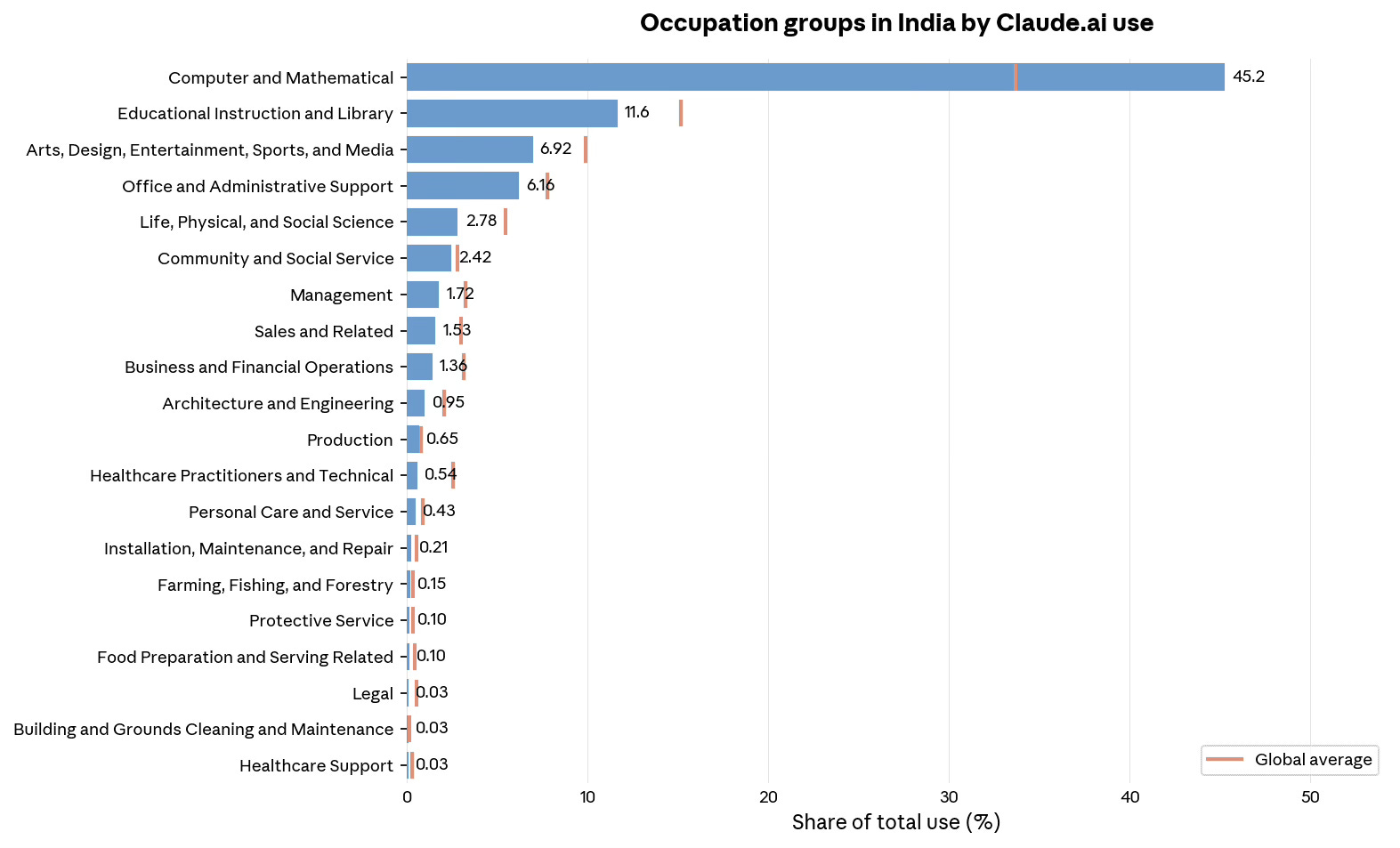
Source: India Country Brief - The Anthropic Economic Index [2026], Anthropic
Watch/Listen:
Investigating the tall claims India’s food companies make | Scroll India
Why India’s mineral rich states are fighting back | The Daily Brief Hindi | Markets by Zerodha [in Hindi]
The point which you mentioned ''India's swelterint nights presents...' is a typical duck curve our economy is going through. Presently, 11% of solar energy harnessed in India is wasted.