
India Last Week #97
A round-up of research & reportage on India across climate, energy, foreign policy, politics & more over the last week

Climate, Energy & Environment:
“After building one of the world’s largest renewable energy bases, India must now turn its attention to ensuring that the electricity generated from clean sources is effectively integrated into the power system, exports said on Wednesday. They said the country has reached a stage where the focus should move beyond adding generation capacity to improving how clean power is transmitted, stored, procured, and utilised across sectors… The issue was discussed at the seminar, “New Energy: From Evaluation to Adoption”, organized by Think Change Forum in partnership with Delhi Research Implementation and Innovation (DRIIV), Office of the Principal Scientific Adviser to the Government of India, which was the knowledge partner. Experts at the seminar said that expanding renewable capacity alone would not be enough unless supporting infrastructure keeps pace. They pointed to transmission constraints, limited energy-storage capacity and uncertain procurement pathways as key hurdles preventing the productive use of clean energy… Former MNRE Secretary Upendra Tripathy said practical and commercially viable transition pathways were needed for legacy sectors, adding that implementation should now be the priority.” Read more: Times of India
“Oil and Natural Gas Corp.’s first-quarter profit exceeded estimates as higher crude oil and natural gas prices, along with a weaker rupee, offset lower production. The New Delhi-based explorer’s net income more than doubled in the quarter ended June to 170.34 billion rupees ($1.8 billion), according to a stock exchange filing. That compares with 152.67 billion rupees average of estimates compiled by Bloomberg. Revenue jumped 45% from a year earlier to 464.60 billion rupees. The state-run oil and gas producer’s earnings mirror bumper profits posted by global energy supermajors as they reaped gains from the biggest supply disruption in history caused by the US-Iran war… Stronger earnings are crucial for ONGC as it needs to ramp up spending on high-risk exploration to help reverse India’s declining domestic oil and gas production… The firm, which accounts for two-thirds of India’s oil and over half of gas output, has been struggling to stem the decline in production from its ageing fields, while new assets have been slow to contribute… ONGC is investing more than 400 billion rupees ($4.2 billion) in projects across its Western Offshore assets to reverse the production decline, it said in a statement.” Read more: Rakesh Sharma, Bloomberg
“Just a day after details emerged of India’s plans to expand strategic crude oil storage, new reports claim New Delhi is considering a new funding mechanism that would shift part of the cost of a far larger, $42-billion strategic fuel reserve program onto gas consumers. According to Business Standard, the government is considering levies on both liquefied petroleum gas (LPG) and natural gas consumption that would raise about $1.5 billion annually to finance new storage infrastructure. The proposal includes a levy of 1.29 rupees ($0.0136) per kilogram of LPG, expected to generate roughly $460 million a year, and another of 1.43 rupees per standard cubic meter of natural gas, raising about $1 billion annually at current consumption levels. Unlike India’s existing strategic petroleum reserve system, the new plan would create dedicated emergency stockpiles for liquefied natural gas (LNG) and LPG alongside additional crude oil storage. The decade-long program foresees having enough capacity to cover roughly two months of crude oil and LNG demand and about six weeks of LPG consumption… If adopted, the levies would increase household gas bills by about 2%, making the proposal politically sensitive for Prime Minister Narendra Modi’s government. However, Modi has previously pushed through fuel subsidy reforms and LPG pricing changes that were considerably larger.” Read more: Charles Kennedy, Oil Price
“On July 9, heavy rain gave Delhi its first “good” air day in nearly three years. Three days later, its air-quality index had jumped from 48 to 261—back into the “poor” category—and remained there the following day. The reversal is a reminder that clean air cannot be left to rainfall, wind direction or episodic emergency measures… India Inc. has the resources to help. In FY 2023–24, India spent ~INR 3,500 crore in corporate social responsibility (CSR) funds under the environmental sector. This is comparable to the annual budget of the Ministry of Environment, Forest and Climate Change for that year and about five times the allocation for the National Clean Air Programme, India’s flagship clean air programme for the same year. Yet, clean air remains one of the least prioritised areas when it comes to India Inc.’s CSR spending. That makes air pollution a prime CSR opportunity, sitting at the intersection of public welfare and health, economic productivity, and truly measurable impact… First, CSR programmes must measure clean-air gains, not just visible outputs. Existing initiatives, if aligned with air pollution reduction data, highlight co-benefits, define social impact and encourage innovative interventions… Second, CSR funding must follow pollution burdens, without being constrained by corporate geography… Third, companies must back technical solutions premised on research that addresses pollutants… Finally, CSR could help build India’s clean-air data backbone. Effective air-quality management depends on monitoring networks, source apportionment, emissions inventories, exposure mapping, transparent outcome measurement, and public disclosure.” Read more: Prarthana Borah and Arpan Patra, CEEW
Economy:
“A panel of Indian lawmakers has proposed allowing companies registered overseas to transfer their registration to an International Financial Services Centre in India. The proposal would allow companies to register in an IFSC — special financial zones designed for international financial businesses — without winding up their existing entity and incorporating a new one. India currently has one operational IFSC, GIFT City in Gujarat. The parliamentary panel, reviewing the Corporate Laws (Amendment) Bill, 2026, said the government should put in place a framework covering taxation, capital gains, and the transfer and vesting of assets and liabilities to support such a shift… The proposal aligns with Prime Minister Narendra Modi’s broader push to simplify corporate laws, reduce compliance burdens and attract investment. But the government is not bound by law to incorporate these recommendations in the bill, which was introduced earlier this year and then sent to the panel for a detailed scrutiny… The panel has also recommended reducing the minimum age for appointment of managing director, whole-time director and manager to 18 years from 21 years while raising the maximum age from 70 to 75 years. It has also backed proposals to decriminalize some procedural violations by replacing jail terms with fines.” Read more: Rajesh Roy and Shruti Srivastava, Bloomberg
“The Reserve Bank of India (RBI) on Wednesday lowered its consumer price inflation (CPI) forecast for FY27 to 5 per cent, citing easing underlying inflationary pressures even as it flagged risks from volatile crude oil prices, uneven monsoon rainfall and geopolitical tensions. Announcing the Monetary Policy Committee’s (MPC) decision, RBI Governor Sanjay Malhotra said headline inflation, after remaining below the target for 16 consecutive months, edged higher in June, primarily due to rising food and fuel prices, including fuel-induced inflation in select services such as restaurant prices…. “Core inflation, excluding food and fuel, remained unchanged at 3.9 per cent in May and June, while core inflation excluding precious metals was even lower at 2.3-2.5 per cent during the period,” he said… Quarter-wise, the RBI has projected inflation at 5.3 per cent for Q1, 4.7 per cent for Q2, 5.9 per cent for Q3 and 5.5 per cent for Q4. The Governor said the risks to the inflation outlook are assessed to be evenly balanced… The RBI also highlighted continued volatility in global crude oil prices, driven by geopolitical developments, as a major source of uncertainty for the inflation outlook.” Read more: Economic Times
“The Reserve Bank of India (RBI), in its latest monetary policy review, raised its FY27 GDP growth forecast to 6.7% from 6.6% while keeping the repo rate unchanged at 5.25% and maintaining a neutral policy stance. It also lowered its inflation projection to 5%, signalling confidence that current price pressures are largely driven by temporary supply-side factors. Leading economists believe India's economy is likely to grow faster than the Reserve Bank of India's revised FY27 forecast of 6.7%, citing resilient domestic demand, improving agricultural prospects and strong economic activity. Samiran Chakraborty, Chief Economist at Citi India, said his team expects the economy to grow by 6.9% this financial year, above the RBI's estimate… Shailendra Jhingan, Head of Treasury and Economic Research at ICICI Bank, also expects 6.9% growth but believes there is potential for the economy to perform even better… Former RBI Executive Director and IIM Kozhikode professor Mridul Saggar also believes there is upside to the RBI's growth forecast, although he cautioned that inflation risks remain elevated and could eventually require policy tightening if price pressures become more broad-based. Despite their optimism on growth, the economists differed on the timing of the next rate hike.” Read more: Latha Venkatesh, CNBC TV18
Foreign Policy & Security:
“India and China do not think about each other with equivalent intensity. To China, the U.S. is the only player on the world stage with any real trump cards; the rest of the world, India included, is a supporting cast. It views India as a significant regional actor, a nuclear-armed neighbor, a potential irritant — but not a strategic equal. In contrast, Beijing exerts gravitational force on strategic thinking in New Delhi. It is present in every military procurement decision, every infrastructure project in the border regions, every calculation about Pakistan. The asymmetry is not, of course, merely psychological… In my many years reporting on India-China relations, I’ve realized that the greatest barrier between them is not economic disparity or border disputes, but a decades-old communication problem: Each side has learned to interpret the other through a partial historical memory, and mistakes that incomplete view for the whole picture… To help address India and China’s miscommunication problem, it is critical to consider the source of each population’s information about the other. Between 2016 and 2023, a series of tit-for-tat exchanges culminated in both countries removing nearly all of each other’s foreign correspondents. By 2024, when the ongoing bilateral thaw got underway, there was only a single Indian journalist for the Press Trust of India based in China, and no Chinese journalists in India at all… Only direct contact, sustained over years, can begin to fill in the historical and communication gaps that plague and distort bilateral dialogue.” Read more: Pallavi Aiyar, Noema
“An Indian-flagged vessel capsized and sunk after it was hit by a projectile off the coast of Yemen, officials say. All 14 people on board the MSV Faize Noore Oliya - 13 of which were Indian nationals - were safely rescued, India’s Shipping Minister Sarbananda Sonowal said. Sonowal condemned the “unprovoked attack” and said steps would be taken to ensure the safety of seafarers in the region. It is not clear who struck the ship. It is the latest in a spate of attacks on vessels in the Red Sea, an alternative waterway that some tankers had been using since Iran blocked the Strait of Hormuz in February. India’s ministry of external affairs later released a statement calling attacks on commercial shipping in the region “deeply worrisome”… Much of the region’s shipping routes have been disrupted since the US and Israeli strikes on Iran in late February. Since then, Iran has blocked the Strait of Hormuz, one of the world’s busiest oil shipping channels, hugely impacting global oil prices. Some ships carrying oil from Saudi Arabia had instead passed through an alternative shipping lane in the Red Sea, but a recent spate of attacks by Yemen’s Houthi fighters on Saudi tankers has further heightened risks in the region.” Read more: Sofia Ferreira Santos, BBC
“The India–Middle East–Europe Economic Corridor was unveiled at the G20 summit in New Delhi three years ago amid much fanfare… IMEC was billed as a rival to China’s Belt and Road Initiative and an alternative to the maritime chokepoints of the Strait of Hormuz and Bab al-Mandab. Yet progress has slowed due to war, the crown prince’s reticence towards Israel and his efforts to promote alternative routes through Egypt. Even a deal between the US and Iran may not revive India’s dream to play in the big leagues if Riyadh is determined to delink regional connectivity from Israel… But a trade, tech and energy route under the US’s umbrella, designed to spread prosperity and peace in the region, was always a gamble. After all, three years is a long time in a restive region. Israel’s military response to Hamas’s attack on October 7 2023 has made it difficult for Riyadh to pursue normalisation… Additionally, a growing rift between Prince Mohammed and the UAE’s leader, Sheikh Mohamed bin Zayed al-Nahyan, has pushed the Gulf powers apart… Indian officials seem to believe that the EU still wants IMEC to run through Israel. Italy, France, Germany and the European Commission are all foundational partners of the project. “Europe is very, very keen on IMEC,” an Indian diplomat said… Any decisive intervention to make IMEC a reality and preserve the Israeli connection will probably have to come from the US… If the US doesn’t sway the Saudis to come back on board, IMEC risks becoming a patchwork of bilateral digital transport and energy links, not the grand rival to China’s BRI that Modi once imagined.” Read more: Anchal Vohra, Financial Times
“Bangladesh has asked India to clarify its stance on exiled former prime minister Sheikh Hasina’s planned virtual address from New Delhi, warning that allowing political activities by a fugitive could hurt improving bilateral relations. The remarks were Bangladesh’s first official response to Hasina’s planned appearance at Wednesday’s event hosted by the Foreign Correspondents’ Club of South Asia (FCCSA) in Delhi, marking the second anniversary of the student-led uprising that toppled her government. The issue comes as Dhaka continues to seek Hasina’s extradition from India, where she has lived since fleeing Bangladesh in August 2024… “We are moving forward with India with a forward-looking approach. We don’t want that progress to be affected,” Bangladesh’s State Minister for Foreign Affairs Shama Obaed Islam told reporters late on Monday. “India has to be clear about its stance.”… Islam said Bangladesh had repeatedly conveyed its concerns to India over Hasina and other Awami League leaders making political statements from Indian soil. “We do not want India-Bangladesh relations to be harmed by statements from fugitive accused individuals,” she said, adding that India had previously indicated it did not expect fugitives to engage in political activities from its territory.” Read more: Reuters via South China Morning Post
People & Politics:
“Unlike the Left activist circles in urban spaces that struggle to form meaningful connections with ordinary people due to their abstruse language and lack of organisational outreach, Dipke spoke in a language everyone understood. He also went against commonsensical, mainstream Ambedkarite politics by emphasising the need for demands that are not caste-based so that a wider range of people could be brought together… Urban commentators in Delhi were casting aspersions on Dipke and the protest for not having an ideology nor radical demands for structural overhaul. But Dipke, by not being bogged down by the tiny, urban section of politically-defeated puritans, decided to imagine a broad politics that enabled a space and a moment for so many young Indians from small towns, slums in cities and rural areas from lower-income and lower-caste backgrounds… There were sporadic, unconnected protests in various parts of India and simmering discontent among young Indians – Dipke became an anchor in highlighting the broad, shared character of these events. Rather than electoral politics, civil society discussions or legal activism, he emphasised agonistic politics, which has a natural potential to be expanded and broadened… What made the Jantar Mantar protest unique was also the emergence of a new political expression rooted in jokes, mockery, humor and memes already circulating among the Gen Z on Instagram.” Read more: Sumit Samos, Scroll
“Over the past 12 years, Prime Minister Narendra Modi of India has single-mindedly gone about building an extensive machinery of control to tame India’s raucous democracy. He has gradually managed to bring the entire architecture of normal, institutional politics under his sway… Considering his hegemonic control over power and institutions, one can presume that when Modi first watched hundreds of disaffected young people, describing themselves as cockroaches, trickle into Jantar Mantar, a traditional site of protest in New Delhi, a few miles from his residence, the 75-year-old strongman would have felt fairly confident of squashing them like bugs. The reality turned out to be wholly different—uplifting the spirits of democratically minded Indians and no doubt surprising the country’s longtime leader… The success of India’s Gen Z protests revealed a paradox: while Modi has effectively domesticated institutional politics, his control breaks down when confronted with eruptions of extraordinary, extra-institutional politics. He is forced into a corner when political mobilization originates from the ignored margins, erupts in waves of collective action, and thrives in its own irregular, informal public spaces… In the end, the young cockroaches proved so resilient because Modi’s regime of control had no punishment or humiliation to threaten them with beyond what the system already inflicts on them every day. These young men and women had reached a point where they felt they had no voice in the existing order—and nothing left to lose.” Read more: Asim Ali, TIME
“The Comptroller and Auditor General (CAG) of India has flagged that 33,973 Utilisation Certificates (UCs) amounting to Rs 54,282.32 crores were outstanding from 15 Union government ministries or departments, in violation of the rules that govern public finances which require submitting such utilisation certificates, thus raising serious concerns about whether the funds have been utilised for their intended purpose. The CAG’s financial audit report of the Union ministry of finance titled Report of the Comptroller and Auditor General of India on Accounts of the Union Government for the year 2024-2025, tabled in parliament in April has noted that from the information furnished by 15 departments/ministries, 33,973 UCs aggregating to Rs 54,282.32 crore were outstanding as on March 31, 2025… “This violated provisions of rule 238 (1) & (2) of GFR 2017,” the report said. Rule 238(1) and (2) of the General Financial Rules, 2017, provide that for non-recurring grants to institutions or organisations, a certificate of actual utilisation of the Grants received for the purpose for which it was sanctioned should be insisted upon in the order sanctioning the Grants-in-aid… The report shows that the highest amounts were incurred by the Ministry of Housing and Urban Affairs that did not provide UCs amounting to Rs 18,272.91 cr and the Department of Higher Education that did not provide UCs for Rs 14,359.76 cr.” Read more: The Wire
“The Cockroach movement had called for a march to parliament on 20 July, demanding the resignation of the education minister, Dharmendra Pradhan, over a recent examination paper leak. Thousands of people converged on the capital, and law enforcement authorities carried out a violent crackdown, deploying teargas and pellet guns against them, and beating back protesters with batons… Television channels, however, framed the crackdown as simply “clashes”. Using the term “agitators”, New Delhi Television (NDTV) questioned whether those on the streets were “mobilised ‘mobs’”… ANI, India’s influential news agency and a major supplier of video footage to channels, shared no posts on X on 20 July about the police action or injuries sustained by protesters, according to an analysis published by factchecking outlet Alt News. This coverage was not an aberration, but part of the profound transformation of mainstream media, especially television news, during Modi’s 12 years as prime minister. As the government consolidated its hold on power, prime-time shows came to be seen as an extension of the ruling party’s agenda, rather than spaces where those in power could be questioned… The Cockroach protesters, however, managed to flip the script. The social currency and instant virality enjoyed by gen Z creators and influencers have been unmatched. Young people documented the consequential moments on the streets with their signature humour and irreverence.” Read more: Niha Masih, The Guardian
Tech:
“A senior global executive at Meta met Indian officials on Wednesday and apologised for a video message by Prime Minister Narendra Modi on Facebook being taken down for five hours, according to a statement by the company that owns the social media website. The apology was tendered by Meta’s chief global officer Joel Kaplan to Union minister for electronics and IT Ashwini Vaishnaw during a meeting earlier in the day. “I apologised to the minister on behalf of Meta for error restricting PM Modi’s post,” a statement from Meta cited Kaplan as saying… The meeting and the apology came after Bharatiya Janata Party MP Nishikant Dubey, who heads the parliamentary committee on IT, said Meta chief Mark Zuckerberg had three days to apologise for the removal of PM Modi’s video and threatened to withdraw statutory immunity if it was not done… The Union government had summoned Meta’s top global executives after Modi’s Facebook post addressing Indian youth on July 28 and promising stringent action against paper leaks was briefly restricted on the platform. Dubey had said the post was unavailable between 12.30am and 5.30am… While the US-headquartered social media giant had attributed the incident to a technical glitch and apologised, MeitY said it had found the explanation “inadequate”. The company, which owns Facebook, said that the content was removed “in error” and was subsequently restored on the platform.” Read more: Sejal Sharma, Hindustan Times
Chart of the Week:
India’s import dependence on helium
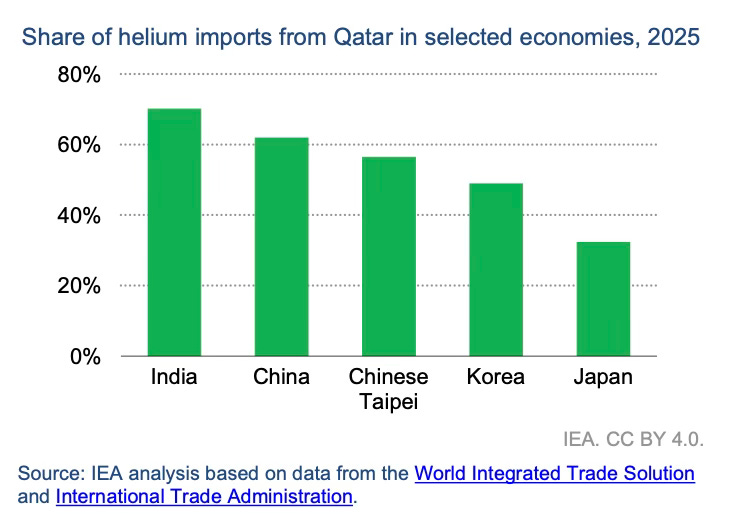
Source: World Integrated Trade Solution and International Trade Administration data via IEA
Watch/listen: