
India Last Week #96
A round-up of research & reportage on India across climate, energy, foreign policy, politics & more over the last week

Climate, Energy & Environment:
“India’s national grid wasted about 11% of its solar power during the hottest months of the year, even as air-conditioning use sent electricity demand soaring to record levels. The grid failed to absorb more than 8 billion kilowatt-hours of solar from April to June, according to Deputy Minister for Renewable Energy and Power Shripad Yesso Naik. That compares with the 63 billion kilowatt-hours that actually reached the grid during the period… The curtailments were ordered to ensure “reliable and secure operation of the grid,” Naik said in a written reply to a lawmaker’s questions in parliament. In India, curtailment can involve either temporarily halting or under-utilizing commissioned projects or keeping completed projects awaiting grid connectivity offline. Power transmission networks globally have failed to keep pace with the rapid expansion of solar and wind fleets, creating periods of excess electricity that force grids to shut down some generators to protect equipment and prevent blackouts… To accommodate more solar during the day, the government is pushing coal-fired power plants to operate flexibly — ramping down during the day and ramping back up after sunset to meet the evening demand. India is aiming for nearly 70% expansion in clean power capacity to 500 gigawatts by 2030, a goal that would need to be backed by timely connectivity to the grid network.” Read more: Azman Usmani and Rajesh Kumar Singh, Bloomberg
“India’s Approved List of Models and Manufacturers (ALMM) didn’t just add a compliance step to solar procurement — it rewrote who gets to sell into the market at all. Government-funded projects, PSU tenders, open-access installations, and net-metering schemes can now draw panels only from ALMM-listed manufacturers, and getting listed requires verified domestic manufacturing capacity, not just a recognisable brand. That isn’t a tariff nudging prices upward. It’s an eligibility filter that removes imported panels from a large slice of demand outright, regardless of what they cost — and it is working exactly as designed: module imports fell from roughly USD 4.35 billion in FY2024 to USD 2.15 billion in FY2025, even as domestic manufacturing capacity scaled up more than twelvefold over the same broader window. But one segment of that same supply chain is moving in the opposite direction. The autonomous robots that keep those panels clean once they’re installed face no equivalent policy. There is no approved list for cleaning robots, no eligibility filter, no domestic-manufacturing mandate — and demand is climbing fast off a genuinely low base… It would be reasonable to assume that as one segment cools and another heats up, the compliance burden might ease somewhere in the mix. It hasn’t. If anything, the opposite is true — customs scrutiny on renewable equipment, across every category, is only getting tighter, and customs is no longer a post-shipment formality.” Read more: Uttam Kumar, PV Magazine
“The familiar case for electric mobility in India is built on energy security, and there is nothing wrong with it except its modesty. It asks what the country stands to lose and how barrels are priced in other capitals. Instead of focusing on a trade balance shaped by distant conflicts, we should concern ourselves with what we stand to build. A transition on this scale is not just a defence against the oil price; it is a decision about which industries India will own, whose supply chains it will sit inside, and what its roads, grid, and labour force will look like once the century’s energy order has settled… While energy security is vital, the more consequential argument is about what the same transition builds, and it begins with an observation about the money itself. Of all the things an economy can spend a dollar on, imported oil is among the least rewarding — a barrel is bought, burned, and gone, employing almost no one and leaving nothing behind. A battery and a motor are its opposite, among the most employment-intensive things a modern economy makes… The ambition can also extend beyond borders, and this is the part the domestic debate tends to miss. The next great expansion of electric demand is coming not from the wealthy markets but from the emerging ones, where sales across Southeast Asia, Latin America, and India are set to approach 3 million units this year.” Read more: Amit Kapoor, Financial Express
Economy:
“On July 27, the government said while answering a parliament question that number of Indians with an annual income of ₹100 crore or more had increased from 142 to 576 between the assessment years (AY) 2021-22 and 2025-26. ₹100 crore is a lot of money in India, and a four-fold increase in the number of billionaires in such a short time span is a big deal. It is unlikely that such money has been made in salary incomes. While the government has not released income tax return data beyond 2023-24 (AY 2024-25), only 19 people reported salary incomes of ₹100 crore or more in 2023-24. What is also interesting that the government has repeatedly been criticising the private sector for not doing enough to boost investment in the economy in the post-pandemic period. An HT analysis of available Income Tax Return (ITR) data and corporate India’s financials suggests that more and more corporates are exploiting the rentier and not the entrepreneur way to become rich… A long-term comparison of total corporate incomes and its sub-components shows that industrial sales have been losing share in total corporate earnings. This shows in the falling share of industrial sales in total incomes of corporates. Income from rentier activities on the other hand — they have been defined as the sum of dividends, interest income and income from treasury operations here - have seen a rise in their share in total incomes as well as their importance vis-a-vis industrial sales.” Read more: Roshan Kishore, Hindustan Times
“Will the government’s policy response to last week’s developments at Jantar Mantar in New Delhi yield the desired results? Will it prevent any more such protests by young Indians?… It is likely that more reforms in the education system will be introduced as the government begins to assess the unrest among young people in the country. More visible steps may also be taken to address the demand for salaried jobs for young people. Remember that it was largely an electoral setback that pushed the government to initiate a few schemes for jobs. The Bharatiya Janata Party (BJP) did not win enough seats in the 2024 elections to form a government on its own and it had to rely on its alliance partners to retain power in New Delhi for a third consecutive term. Unsurprisingly, the government’s first Budget, presented in July 2024, unveiled an ambitious package of schemes to facilitate employment, skilling and other opportunities for 41 million young people at a financial outlay of INR 2 trillion… Till April 30, companies had posted only 297,000 internship opportunities, which was just about 10 per cent of the two-year target. Actual offers were even lower at 173,000… Less than one per cent of what was initially allocated for five years of the internship scheme was spent till March 2026. Almost half of what was spent went towards promoting and advertising the scheme.” Read more: A. K. Bhattacharya, Business Standard
“Net foreign direct investment (FDI) inflows to India dipped to $0.96 billion in 2024-25 and remained low at $6.95 billion in the year ended March 2026 due to higher repatriation by foreign investors and rising investments by Indian businesses abroad, the central government said on Tuesday. As per data shared by Minister of State for Finance Pankaj Chaudhary in Rajya Sabha, net FDI equity investment in India stood at $27.99 billion in 2022-23. It fell to $10.13 billion in 2023-24 and dipped below a billion dollar mark in 2024-25… The ODI outflow on account of liberalised ODI rules notified in 2022 is helping Indian entities to enhance their business footprints abroad enabling them to compete in the global market, adding to the strength of the Indian economy in long-run, he said… Rajya Sabha MP John Brittas, who asked the question, said the government's explanation on the FDI trend is unconvincing. “It argues that rising repatriation reflects India's success in delivering strong returns to foreign investors. If that were the whole story, investors would ordinarily retain and expand their investments in India while repatriating only their profits,” Brittas said… Foreign investors have repatriated or disinvested nearly $180 billion from India over four years. FDI outflows increased from $29.35 billion in 2022-23 to $44.47 billion in 2023-24. It rose further to $51.49 billion in 2024-25 and to $54.04 billion in 2025-26.” Read more: Gyanendra Keshri, Deccan Herald
Foreign Policy & Security:
“For 20 years, Western governments have described India as indispensable to the 21st-century order… But the West treated the breakthrough as diplomatic realignment, not the beginning of an industrial rebalancing. The political pivot occurred. The capital pivot did not… For more than three decades – accelerating after China entered the World Trade Organisation in 2001 – Western capital helped compound China’s industrial advantage… What served Western commercial optimisation has come to align with Chinese strategy… Modi has spent more than a decade trying to convert India’s demographic and geopolitical scale into industrial power, with promising but uneven results. But India cannot become a second centre of industrial gravity through domestic reform alone. The West is trying to correct a compounded strategic error by relying on incremental corporate decisions. Companies are encouraged to adopt “China plus one”, but they face incentives that favour China… The policy failure is to mistake the accumulation of fragmented corporate decisions for strategic rebalancing. Governments now ask firms to bear the cost of reversing a concentration created by decades of collective investment and reinforced by Western policy… The West is demanding greater alignment from the country it needs to strengthen than it demanded from the adversary it allowed itself to depend upon. That is not prudence. It is a failure to distinguish control from advantage… India is not yet the anchor of an industrial alternative capable of balancing China. But it is the only country with the scale to become one.” Read more: Stephanie Campbell, Lowy Institute
“Foreign Secretary Vikram Misri has engaged with senior Chinese officials in Beijing over the past two days eyeing to stabilise the relationship amid geopolitical flux and prepare for NSA AK Doval’s proposed visit to China for the next round of Special Representative (SR) talks and Chinese President Xi Jinping’s planned visit here for the BRICS Summit in September. On Monday, Misri met with Hua Chunying, vice-minister of foreign affairs of China and both officials acknowledged the importance of maintaining peace and tranquility in the India-China border areas. Misri discussed ways to enhance bilateral exchanges between India and China at the political and people-to-people levels during his meeting with Hong Liang, Deputy Secretary General of the 14th National Committee of the Chinese People’s Political Consultative Conference. On Tuesday, Misri also met Li Wentang, Vice-President of the Central Party School (National Academy of Governance) of the Communist Party of China, and discussed opportunities for future cooperation and academic exchanges between the two sides.” Read more: Dipanjan Roy Chaudhury, Economic Times
“In January, Canadian Prime Minister Mark Carney won widespread praise when he called for middle powers to stand up to Washington and help resuscitate liberal internationalism. But leaders seeking to build a constructive order for the mid-21st century must be clear-eyed about the political realities they face… Populist Movements often revolve around the persona of a dominant leader, whether Trump, former Hungarian Prime Minister Viktor Orban, Argentine President Javier Milei, Turkish President Recep Tayyip Erdogan, or Indian Prime Minister Narendra Modi. In domestic politics, this type of personalism tends toward the centralization of power and increasingly authoritarian decision-making… In foreign policy, personalism reshapes how decisions are made and the policies that follow. Most right-wing populist leaders are quick, for example, to marginalize their foreign-policy bureaucracies… The Modi government has clashed with Bangladesh over the ouster of pro-India leader Sheikh Hasina, and, amid a crisis with Pakistan in 2025, Modi became embroiled in a duel of egos with Trump that deepened tensions between Washington and New Delhi… So how far can this transnational cooperation go in building a coherent alternative to liberal internationalism? There are certainly limits. Populists’ elevation of national sovereignty as a political ideal will hamper any efforts to build cooperative international structures that would by necessity constrain that very sovereignty.” Read more: Christopher Chivvis, Milan Vaishnav, and Rohan Mukherjee, Foreign Policy
“Championed by late US Senator Lindsey Graham, the bipartisan Sanctioning Russia Act is gaining new momentum in Congress, where more than sixty US senators have cosponsored a newly revised version. The legislation aims to reduce the Kremlin’s oil revenues by placing tougher sanctions on Russia’s energy and financial sectors… If passed, the Senate bill would require the US president to impose mandatory sanctions on certain financial institutions affiliated with the Russian government within thirty days of enactment… By most estimates, India is currently the second-largest buyer of Russian crude oil, and it would likely face higher US tariffs under the bill, unless it significantly reduces those imports. This would not be the first time Washington has used tariffs to pressure New Delhi over Russian oil imports. While the Trump administration’s April 2025 tariffs on India strained bilateral relations, it was the subsequent US sanctions on Rosneft and Lukoil in October 2025 that prompted Indian refiners to secure alternative crude supplies from the Middle East… For Middle Eastern suppliers to regain lost market share in India and other Asian markets, they would need the Strait of Hormuz to reopen in the near term and, for additional resiliency, to develop alternative shipping routes over the longer term. Otherwise, India will face a trade-off between maintaining energy security and managing the risk of US tariffs, potentially prompting it to again seek waivers and exemptions.” Read more: Maia Nikoladze, Atlantic Council
People & Politics:
“At least two rounds of pellets were used on July 20 on the orders of a deputy commissioner of the Delhi Police, according to the statement of a deputy commander of the Rapid Action Force (RAF) recorded in a general diary entry at the Parliament Street police station. The diary entry – filed at 1.24am on July 22 by a Delhi Police sub-inspector and seen by HT – is the first document that shows the usage of pellets during a sprawling student march to Parliament on July 20… CRPF has already instituted an inquiry into the allegations. To be sure, the DCP North is Raja Banthia. He was unavailable for comment. Both Delhi Police and CRPF refused to comment on the record. Plastic pellets are different from metal pellets and are intended to cause less serious injuries. Metallic pellets have controversially been used in Jammu and Kashmir. HT has reported that five people – Sheikh Irshad Mansuri, a 25-year-old employee with a private firm, Nootan Toppo, a 32-year-old woman from Gurugram, a 28-year-old reporter, Prashant Singh, a 25-year-old Bihar resident, and 19-year-old Sahil Lochab, a student aspiring to join the police force – have alleged (in Lochab’s case the allegations were made by the family) that they were hit with pellets on July 20… The developments come a day after a petition was filed in the Supreme Court by Yashovardhan Azad, Prashant Singh and Sheikh Irshad Mansuri, seeking direction for decommissioning or banning the use of wholly or partly metallic kinetic projectiles/ pellets fired from pump action rifles or projectile action guns (PAG) for crowd dispersal of civilian assemblies by law enforcement agencies.” Read more: Prawesh Lama, Hindustan Times
“A large part of National Eligibility cum Entrance Test (Undergraduate) or Neet-UG takers are from lower-income homes, with parents who are poorly educated and employed in low and unpredictable income, occupations, and are first-generation college goers… This is the “belly” of “aspirational India”, aspiring not just to buy cell phones and bikes and go to concerts but also to become middle class — have a predictable steady income with a regular job, have a qualification and credentials that provide income and social mobility over time and all the good things that come with it… Another young man in UP has spent four years after graduation appearing for a government job examination. Twice the exam was not held, twice he failed. When his father was asked why he supported four years of Neet, which according to one Insta meme, stands for “not in education, employment or training”, he said that his son was the first college-educated person in the family, and he wanted to support his ambition… In our ethnographic study of lower-income “mass” young India, “Drivers of Destiny” (written about earlier in this column and others), we found that young people did not blame the government for the lack of jobs. They attributed that to “the market”. But in this case, the destruction of even the few avenues of status-blind opportunity is clearly laid at the government’s door. More so, as the government centralises education access.” Read more: Rama Bijapurkar, Business Standard
“The Supreme Court’s brief order of 28 July in the context of the recently concluded nationwide protests against educational malpractices [“the CJP protests,” after the Cockroach Janta Party] is no doubt the prelude to a more protracted set of judicial proceedings, especially around allegations of violent policing at various sites, including the use of spiked sticks (lathis), pellet guns and – in one instance in Bihar – an AK-47 rifle… Brief though it is, the order raises two questions that need to be considered. First, as part of its interim orders, the Court directs that with respect to the FIRs registered by the police during the protest, no coercive action may be taken against protesters except those with “criminal antecedents”, and that all minors who have been detained are to be released forthwith, except those with criminal antecedents. To start with, this order is in the nature of a general amnesty, which is in the nature of a political settlement, not a judicial decree… Secondly, with respect to the fair and impartial probe, there are questions about the nature, shape, and form that such a probe might take. Based on past history, one would expect that this would be a SIT [“Special Investigation Team”] probe that would be headed by a retired judge, and which would periodically report to the Court… What happens, however, in a case which is of a distinctively adverserial nature – that is, where individuals have accused State functionaries (in this case, the police) of violating their rights, accusations that are naturally denied by the State functionaries?” Read more: Gautam Bhatia, Constitutional Law and Philosophy
Tech:
“Protestors in Delhi, currently raising their voices against the litany of incompetence in the Indian state’s management of key competitive examinations, are experiencing the outcomes of the routine deployment of mobile internet suspensions and signal jammers around protest sites. Framed by law enforcement as precautionary measures to maintain public order, these disruptions cut off the vital flow of live updates, citizen journalism, and emergency communication. In the 2020 Anuradha Bhasin v. Union of India judgment, India’s Supreme Court held that internet access is constitutionally protected, establishing that any suspension must satisfy strict tests of necessity and proportionality accompanied by publicly reasoned, published orders. In practice, telecom suspensions frequently lapse into procedural minimalism… These protests, much like those in the last few years, highlight a crucial evolution in civic resistance. Recognizing that cellular networks and centralized platforms are vulnerable to administrative kill-switches, student demonstrators have pivoted toward offline, Bluetooth-aided mesh messaging protocols (such as Briar and Bitchat)… Deployment of automated facial recognition systems (AFRS) in New Delhi, highlighted by a Public Interest Litigation (PIL) currently before the Delhi High Court, illustrate the use of facial recognition technology with chilling clarity, particularly concerning the ongoing CJP protests.” Read more: Amber Sinha, Tech Policy Press
“The Ministry of Electronics and Information Technology (MeitY) has summoned Meta’s President of Global Affairs Joel Kaplan to appear in person over the company’s content moderation practices, calling its explanation for briefly removing a reel posted by Prime Minister Narendra Modi “not reasonable,” ThePrint reported. Government sources said the matter is far from settled. The summons escalates the matter beyond Meta’s India representatives to its global leadership, after MeitY concluded that the local policy team failed to convey the seriousness of India’s concerns to headquarters… What happened with the reel? Meta removed the reel, posted on July 23, during nationwide protests over the National Eligibility cum Entrance Test (NEET-UG) paper leak. In it, Modi addressed students and promised fast-track courts and stricter penalties… What else is on the agenda? Two disputes predate the reel takedown: CSEAM ads: MeitY has directed Instagram to disable all advertisements and content promoting or facilitating access to Child Sexual Exploitative and Abuse Material (CSEAM), after a BBC Eye investigation found paid ads using terms such as “rape video” and linking to Telegram channels selling the material for as little as Rs 99… WhatsApp usernames: The government has questioned the proposed username feature, warning it could increase impersonation, phishing, digital arrest scams, and identity theft.” Read more: Aakriti Bansal, Medianama
Chart of the Week:
India’s workforce & employment opportunities
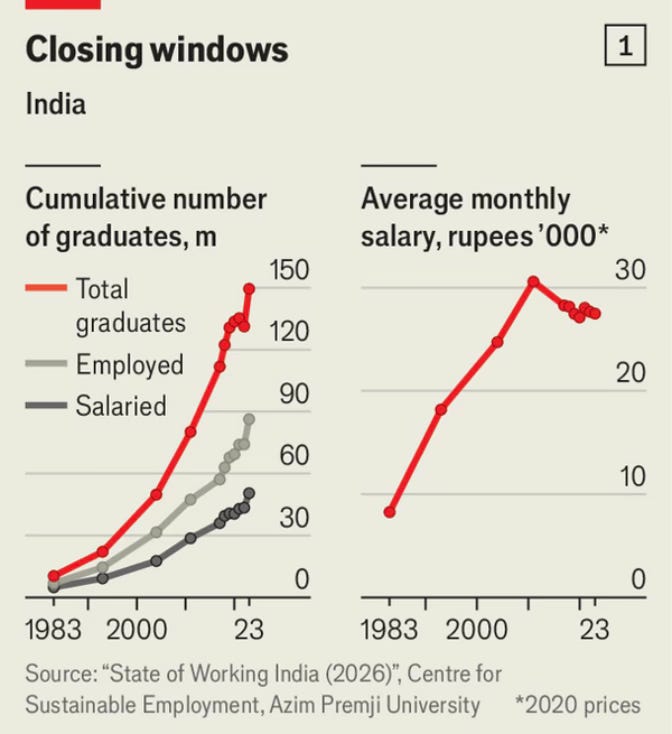
Source: State of Working India 2026 Report (Azim Premji University) via The Economist
Watch/Listen: