
India Last Week #95
A round-up of research & reportage on India across climate, energy, foreign policy, politics & more over the last week

Climate, Energy & Environment:
“Even as India’s solar power sector has expanded aggressively over the past few years, two key factors could hinder its growth: Rising regional disparity and consolidation in the domestic solar equipment manufacturing space. India currently has 157 Gigawatt (GW) of installed generation capacity in solar power, which has grown exponentially from a paltry 2.8 GW in 2014, thanks to improvements in technology and a support policy environment. In fact, 2025-26 was a watershed year for India’s solar growth, recording the highest-ever annual solar addition of 44.61 GW, exceeding a target of 34 GW and nearly twice the previous record of 23.83 GW in 2024-25…. While India is poised to become the world’s second-largest solar market in 2026 in terms of annual installations, geographical diversification remains a key challenge, with seven states accounting for nearly 85 per cent of the total installed solar capacity… A key reason for the concentration is variation in the state policies on land acquisition, say experts… According to Amit Manohar, secretary general, Indian Solar Manufacturers Association (Isma), India’s solar capacity has clustered in a few states because of superior resource availability, lower land costs, and stronger project economics.” Read more: Sudheer Pal Singh, Business Standard
“Climate disruptions have now become a near-constant presence in India. Heatwaves have become longer and more frequent, rainfall arrives in erratic, short bursts, and ecological disasters, once considered rare, are now routine… In 2025 alone, the country faced 331 days’ worth of climate extreme events that led to 4,419 deaths and damaged 17.4 million hectares of crop… While policy is more focused on infrastructure and long-term development, locals are no longer waiting for the government to rebuild. They are doing it themselves… As climate extremes become more frequent, many communities are no longer waiting for governments to rebuild. Across the country, local groups are restoring livelihoods, reviving traditional skills, and drawing on indigenous knowledge to adapt to an increasingly uncertain future… Few places illustrate this shift more clearly than Wayanad… In 2024, Wayanad faced one of the deadliest landslides, within a span of hours, Mundakkai and Chooralmala settlements of Meppadi panchayat were completely wiped out, killing more than 420 people, with 397 injured, and at least 118 missing due to excess rainfall… It is within this atmosphere that some community-based efforts began to take shape, and one such effort focused on rebuilding the larger infrastructure of the area with the help of bamboo, and now it has begun to emerge as an alternative sustainable model for the people. It all started when a 2.5-acre abandoned quarry was developed into what is now called the Bamboo Grove by Uravu Eco Links. In the grove, bamboo was planted, and ponds were created for cultivation. Now, this bamboo grove acts as an eco-tourism hub that is completely sustainable and is run by the local community.” Read more: Paridhi Choudhary, CarbonCopy
“A year after taking charge as prime minister, Narendra Modi announced a dramatic jump in India’s renewable energy ambitions. Junking the National Solar Mission’s target of boosting India’s solar power capacity to 20 GW by 2022, he said his government would hit 100 GW instead. As announcements went, this one was welcome. Twenty GW had been an underwhelming target, far below the rate at which India could add solar power… The rising cost of rural land was making solar parks costlier. The slowdown in the economy – hit first by demonetisation and the Goods and Services Tax, and then by COVID-19 – had depressed demand. The grid’s limited capacity to absorb renewable energy power was a third factor… India had opened solar generation to private firms but left discoms’ financial model untouched. Not only did they give free (or cheap) power to farmers and below-poverty-line families and try to recoup these losses through higher tariffs to industrial customers, they also subsidised renewable power producers… By 2021, cracks were visible in this arrangement. Not only were solar developers participating in bids without knowing if discoms would sign PPAs, it also meant the rate at which India added solar capacity was not determined by supply (investment coming into the sector) or demand (consumers seeking renewable power) but by discoms’ capacity to pay and the rate at which SECI floated new tenders.” Read more: M. Rajshekhar, The Wire
“India’s electric vehicle sector is entering a broader scale-up phase, with EV penetration likely increasing to 10-12 per cent of the overall vehicle sales in this fiscal from 8.5 per cent in the last year, driven by e-two-wheelers, ratings agency Ind-Ra said. The agency said it expects EV adoption to remain strongest in segments where the economics of electrification are already compelling. The two-wheeler EV penetration is estimated to increase to 8-10 per cent in FY27 compared to 6.6 per cent in the previous year, supported by lower operating costs, convenient home-charging options, and a growing product portfolio from incumbent automakers, the agency said… Adoption is expected to remain concentrated in metropolitan markets and higher-income consumer segments, Ind-Ra said, adding that it expects e-bus penetration to rise to 6-8 per cent in FY27 as against 4.37 per cent in FY26, aided by strong order books and government procurement programmes, although deployment still depends on infrastructure readiness across state transport undertakings.” Read more: Economic Times
Economy:
“When the rupee fell sharply in the wake of the Iran war-induced energy shock, India’s policymakers concluded that the economy’s fundamentals were sound, the problem was temporary and foreign-exchange related, and the best response was to attract financing rather than make policy changes. Accordingly, in June the Reserve Bank of India announced a scheme to guarantee favourable dollar returns for foreign investors, especially the diaspora, with the aim of attracting $50bn-$70bn by September. But now, after some initial enthusiasm, the rupee is once again under pressure amid anxiety that the target may not be met. Why so? The answer may be a misdiagnosis of the rupee’s problem. Rather than being shortlived and related to foreign exchange, it could reflect structural challenges for macroeconomic stability and growth. First, despite the Modi government’s commendable push on renewables, India’s energy dependence is unusually high, which makes it vulnerable to shocks… Two long-term technological shifts also cast a pall. One is robots substituting unskilled labour, the other is AI substituting skilled labour. India was hoping to be an alternative manufacturing base to China. The entry of Apple and other multinationals was encouraging but proved an exception: India’s global market share in labour-intensive manufacturing has been declining steadily since a peak of about 2.5 per cent in 2011… More fundamentally, the government has been unable to reassure investors about the predictability of the business environment. It has at times acted in an apparently arbitrary way to tilt the playing field in favour of a few large companies.” Read more: Arvind Subramanian, Financial Times
“Net foreign direct investment (FDI) inflows turned negative once again in May with outflows exceeding inflows by $74 million, according to the latest Reserve Bank of India data. This snapped a three-month streak of positive net inflows and was driven by a sharp drop in direct investment entering India. That is, even though outflows fell, inflows fell by a larger amount. As per the data, the total direct investment entering the country, or gross inflows, stood at about $6.07 billion in May 2026. This was 60% lower than in April and nearly 23% lower than in May last year… Total outflows stood at $6.14 billion in May 2026, lower than in April 2026 and May of last year. But total outflows exceeded total inflows by $74 million. Within the outflows, outward investment by Indian firms stood at $2.4 billion in May this year, 49% lower than in April and 9.6% lower than May 2025. “Of the outward FDI, around 74% of the flows were directed towards the U.S., Cayman Islands and the Netherlands; the major sectors included financial, insurance and business services and manufacturing, accounting for more than 85% of the outward flows during April-May 2026,” the RBI said.” Read more: T. C. A. Sharad Raghavan, The Hindu
“India has turned to its 35 million-strong diaspora to help stem a sharp decline in the rupee. The country’s central bank is giving local banks an incentive to attract foreign-currency deposits and potentially draw in billions of dollars from Indians living overseas. It last deployed the strategy during the “taper tantrum” of 2013 that led to massive outflows of capital from emerging markets. Banks mobilized about $26 billion at the time, helping to limit the hit to India’s foreign reserves. Indian bankers are hoping to draw in at least $50 billion this time around. The money won’t come solely from the deposits themselves… Indian banks take a risk when they handle foreign-currency deposits as swings in exchange rates can expose them to losses. The central bank, the Reserve Bank of India, has offered to take on that risk, bearing the currency-hedging costs for so-called Foreign Currency Non-Resident (FCNR) deposits made before Sept. 30… If an Indian living abroad deposits $100,000 in a foreign-currency account at a bank in India, they can then borrow a much larger amount at a bank overseas using the deposit as collateral. The borrowed money can then be transferred to the account in India… Some lenders are offering loans amounting to several times the original deposit placed at a participating bank. The initiative had already drawn more than $17 billion in deposits as of July 17, the RBI said.” Read more: Siddhi Nayak and Divya Patil, Bloomberg
Foreign Policy & Security:
“It’s the first significant Chinese auto investment in India since 2017. The colourfully named Horse Powertrain, a joint-venture backed by China’s Geely, will invest up to $370 million to manufacture hybrid powertrains in Chennai. After years of near-freeze, Chinese participation in India’s auto sector may finally be restarting. For a very different China-India auto story, turn to the June 8 edition of China’s English-language Global Times. Days earlier, Tata Motors announced it would use Chinese automaker Chery’s platform for its premium Avinya EV, fuelling speculation the partnership could deepen. The state-run Global Times quickly shut that down. Chery stressed the agreement was limited to “vehicle-related parts supply, including providing auto components.” It denied any plans for direct investment or technology transfer in India. The two announcements capture the changing dynamic in China-India economic times. India is cautiously reopening to Chinese investment just as China is becoming more restrictive about technology transfers and overseas investment… China’s tougher stance is not aimed primarily at India. It reflects Beijing’s response to growing US and other Western restrictions on Chinese investment and technology exports… Despite political tensions and regulatory hurdles, many Chinese companies remain eager to enter India, seeing it as one of the biggest long-term growth markets across automobiles, renewable energy, electronics and advanced manufacturing. The question is whether commercial logic will ultimately outweigh geopolitical caution.” Read more: Paran Balakrishnan, The Hindu Businessline
Ransomware Group Leaks 19,000 Kudankulam Files From Reliance Server, NPCIL Denies ‘Sensitive’ Breach
“A ransomware group World Leaks has posted thousands of highly sensitive files linked to India’s largest nuclear power plant on the dark web, labelling the data as coming from the Reliance Group, prompting the Nuclear Power Corporation of India Limited (NPCIL) on Wednesday (July 15) to publicly deny that any sensitive information had been compromised. The files, pertaining to the Kudankulam Nuclear Power Plant (KKNPP) in Tamil Nadu, are tied to an expansion of the plant with four additional reactor units under construction with Russian technical assistance, into what is set to become India’s largest nuclear park with a combined capacity of 6,000 MW… Independent cybersecurity researcher Rakesh Krishnan, who first alerted Reuters of the leak, said close to 19,000 files totalling 14.3 gigabytes, which appear when the term “KKNP” is searched, have been online since June 11. Reuters reviewed the documents, dated between 2016 and mid-2025, however, it could not verify their authenticity. Nevertheless, according to the news agency’s report, the files appeared to be “most sensitive” of a much larger set of 858,000 Reliance-related files posted on World Leaks’ website… Reliance Group, in a statement to Reuters, confirmed that there was a “partial breach” of data on a server hosted by a third-party data centre service provider Yotta and said the incident had been reported to the government. It did not disclose what data had been accessed.” Read more: The Wire
“Last month, leaders from 20 European countries gathered in Brussels for a three-day high-level regional meeting of the International Solar Alliance. The grand outcome was a single document on battery recycling guidelines, according to the press release. For India’s first ambitious multilateral climate organisation, such modest outputs seem to have become the norm. A decade after Prime Minister Narendra Modi and then French President François Hollande launched the International Solar Alliance (ISA) on the sidelines of the United Nations COP in Paris, its role remains largely unclear. Announced with massive fanfare as the first treaty-based global body headquartered in India, the country’s marquee climate vehicle is still mostly powered by New Delhi… But even as the world’s solar energy adoption soars, ISA is struggling to raise the money it had hoped for. It is falling woefully short of its own ambitious imagination and scope. Since 2015, the latest documents show it has mobilised around $20 million for its programmes, from member countries and international organisations... Some of its flagship programmes, such as Solar Technology & Application Resource Centres (STAR-C), have managed to pull in financial support from other member states. But many other ISA ventures are struggling to find their footing… Its flagship ‘catalytic financing’ plan for solar projects in Africa has mobilised only $74 million toward a $200 million target since it was launched in 2024.” Read more: Akanksha Mishra, ThePrint
“President Donald Trump said generic drugs imported into the U.S. will face zero tariffs for two years starting August 1, before a 100% levy takes effect in August 2028 and rises to 200% a year later… The stakes are high for India, as the country’s pharmaceutical companies supply nearly 50% of all generic medicines consumed in America. The U.S. accounts for about a third of India’s pharma exports, mostly cheaper versions of popular drugs, annually. Chinese firms dominate the upstream supply of active pharmaceutical ingredients, such as amoxicillin and heparin. The announcement substantially raises long-term risk for Indian drugmakers even with the two-year reprieve, according to Arpit Chaturvedi, South Asia advisor at Teneo. The pharmaceutical sector is among the country’s largest net export earners, and full implementation of Trump’s stated tariffs would deal a serious blow to India’s trade balance, Chaturvedi said. Meanwhile, Washington will find it hard to simply displace India as a supplier, he said… The two-year runway, however, offers a critical negotiating window for New Delhi to push for tariff relief in its ongoing talks with the U.S., including by pledging corporate investment commitments in America, he said. With the stated tariffs not biting until 2028 — an election year in the U.S.— “New Delhi would hope that this rule will not be implemented,” Chaturvedi said.” Read more: Anniek Bao, CNBC
People & Politics:
“Sahil Lochab, a resident of Najafgarh in southwest Delhi, underwent a surgery to remove pellets at the AIIMS Jai Prakash Narayan Apex Trauma Centre on Tuesday (July 21, 2026). Doctors have informed that there is only a “1% chance” of vision returning in the injured eye as the pupil was damaged, his family said. Mr. Lochab, who wants to join the police, is a student of Delhi University’s School of Open Learning… Parvesh, a childhood friend of Mr. Lochab, said, “Sahil said he was hit directly in his eye. From what we have been told, a second operation for his pupils will determine whether his vision will return to normal.” He added that Mr. Lochab is not yet able to see and is in a lot of pain… Though Delhi Police had denied the use of pellet guns, Mr. Lochab’s family said it was told that the injuries were caused by pellets. A hospital source confirmed it. On Wednesday, The Hindu reported that how pellet guns, technically known as pump action guns, were likely used against protesters on July 20. This was the first known instance of security forces using pellet guns on civilians in Delhi. One of the 80 injured protesters, identified as Shaikh Irshad Mansoori, underwent surgery at Lady Hardinge Medical College (LHMC) on Tuesday to remove a metal pellet lodged under his eye… There has been no response from the CRPF on the use of pellet guns.” Read more: Ashna Butani, The Hindu
““Hit me, sir, hit me!” yelled Bharat, a young protester, as around a dozen riot police surrounded him and beat his head and body with truncheons. His defiance in the face of overwhelming force, filmed during Monday’s big student protests in Delhi, went viral in India. Dozens of other reels on social media showed protesters, some as young as 16, sobbing as they were beaten and tear-gassed by police… A hitherto popular leader fresh from a string of election victories, Modi is now faced with an unexpectedly strong youth protest movement which has emerged from his middle-class voter base… The protests, led by the upstart “Cockroach” movement, began after the leak in May of exam papers for a national entrance exam to medical college, which forced the exam to be cancelled. They continued at a low level for weeks but escalated at the weekend when Sonam Wangchuk, a popular activist on hunger strike in support of the students, was forcibly removed by police from the main protest site and taken to hospital. Tension rose further on Tuesday, when national opposition parties weighed in to support Monday’s protests… Coverage of Monday’s protests in India’s mainstream media, mostly controlled by government-friendly business tycoons, has focused on injuries to police and violence allegedly committed by protesters rather than on the demonstration itself.” Read more: Michael Stott, Financial Times
“Amid the ongoing youth movement demanding Union education minister Dharmendra Pradhan’s resignation over repeated instances of paper leaks, among other issues, Prime Minister Narendra Modi on Thursday (July 23) broke his silence and issued his first statement on the issue by promising to set up “fast track courts to ensure swift and stringent punishment for those involved in paper leaks”, and saying “nothing is more important than the welfare and future of the youth” and “those who harm the future of our youth will not be spared.”… Modi did not make any mention of the protests underway at Jantar Mantar, or the demands for Pradhan’s resignation or the police brutality unleashed on students. Moreover, his statement promising action is also not new. These very same words have been used and the same promises have been made by the prime minister several times in recent years both in parliament and on the election trail… Just two years ago, Modi made the same promise in almost the same words while speaking in parliament. In his reply to the Motion of Thanks to the President’s Address on July 2, 2024, Modi said in the Lok Sabha that the “government is not going to spare” those who cheated the youth… In February 2024, while addressing the last sitting of the 17th Lok Sabha, Modi said his government had passed the Public Examinations (Prevention of Unfair Means) Bill, 2024, that month because paper leaks had made the youth angry.” Read more: Sravasti Dasgupta, The Wire
“On Monday, social media was filled with images of the march to Parliament called by the Cockroach Janta Party political campaign. The Delhi Police said it had not given permission for the march. Some participants crossed barricades and allegedly threw stones. The police and Rapid Action Force appear to be responding with disproportionate force. Videos show the men in uniform firing tear gas and raining baton blows upon protesters, many of whom were retreating, surrounded by the police and visibly not attacking anyone. These accounts require verification, but the imbalance is apparent. In the Supreme Court on Wednesday, Chief Justice Surya Kant refused to urgently hear a petition alleging that the police had used excessive force against protesters. “Don’t waste our time and don’t waste your time,” Live Law quoted Chief Justice Surya Kant as saying… A day earlier, on Tuesday, a public interest litigation alleging excessive force by the police forces was urgently mentioned before the Delhi High Court. “Don’t drag the court into all this,” the bench reportedly remarked. The next day, however, the court sought the Delhi Police’s response on the allegations of “brutalities”… The response of the Supreme Court is unsettling because the Constitution tasks the judiciary with checking the abuse of power by the other branches of the government. The public interest litigation had merely asked the court to examine the constitutional limits on coercion exercised in the name of the Republic.” Read more: Shubham Kumar, Scroll
“At one level, these student protests are a localised Indian response to shared social and economic precarities, compounded by the administrative arbitrariness of an arrogant ruling regime. At another, they are symptomatic of a broader generational churn that is unfolding not just in India but across South Asia. Gen Z cohorts, raised in the shadow of both democratic aspiration and institutional decay, are increasingly unwilling to accept the status quo. What distinguishes the Indian case is not the presence of dissent but the political ecosystem within which it is being articulated. Narendra Modi’s decade-plus-long dominance over the national imagination, realised by a systematic weakening of democratic institutions, has reshaped India’s political grammar… When tens of thousands of young people marched toward Parliament, they ostensibly did so to expose the structural rot of India’s educational bureaucracy under the current regime. But they achieved, perhaps inadvertently, a deep and irreversible fracturing of Modi’s hegemony over the country’s mind space… The collapse of the education system, where board examinations and entrance exams have been regularly compromised, is exemplified by the case of the National Eligibility cum Entrance Test-Undergraduate. In a country where public investment in higher education has been systematically cannibalised by the private coaching industry, the integrity of an entrance exam is a socio-economic lifeline out of rural stagnation or urban underemployment for a young Indian. When the government can’t hold these exams and shields the Union education minister from being held accountable, it is a betrayal of the foundational meritocratic idea of modern India.” Read more: Sushant Singh, The Telegraph
Tech:
“Mobile Internet services were shut down in parts of Central Delhi during the Chalo Sansad protest organised by the Cockroach Janta Party (CJP). Thousands of people, led by the CJP, gathered on the opening day of the Monsoon Session of Parliament to demand the resignation of Union Education Minister Dharmendra Pradhan following repeated instances of examination paper leaks in connection with the administration of the National Eligibility and Entrance Test (NEET), among other demands… Under Section 20(2)(b) of the Telecommunications Act, 2023, telecommunications services may be suspended only on the occurrence of a public emergency or in the interest of public safety, on the grounds specified in that provision, and for reasons recorded in writing… India continues to record one of the highest numbers of internet shutdowns in the world. Access Now’s 2025 report recorded 65 shutdowns across 12 States and Union Territories. Jammu & Kashmir has recorded the highest number of internet shutdowns in the country, with about 449 since 2012, followed by Rajasthan (115) and Manipur (62), as per the SFLC Internet Shutdown Tracker. India has recorded about 24 shutdowns in 2026 (as of July 22).” Read more: Rizmi Lia M., The Hindu
Chart of the Week:
India’s Youth & a Growing Crisis
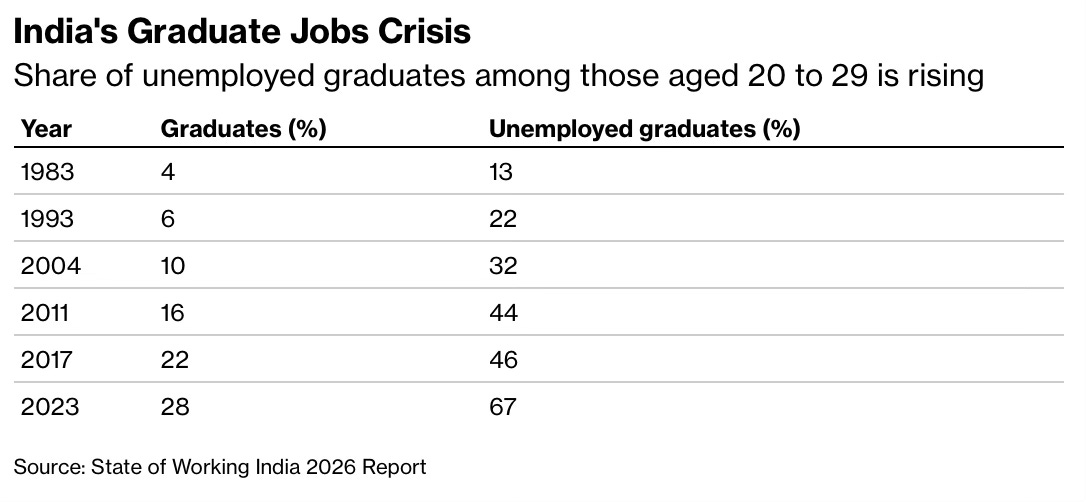
Source: State of Working India 2026 Report (Azim Premji University) via Bloomberg
Watch/Listen:
Good Morning India - Dekh Lo Humaara ‘Naya Bharat’ - FYI The Protest is Still On | Ground reporting on the CJP protests in Delhi | Unfiltered by Samdish [in Hindi & English]
एक महिला ने Mumbai Police को रोक दिया! मुंबई की सड़कों पर दिखा युवा शक्ति की ताकत! Shivaji Park | Ground reporting on the CJP protests in Mumbai | Sohit Mishra [in Hindi]
The law says ‘minimum force’. What did Delhi Police do? | Let Me Explain | Newslaundry