
India Last Week #94
A round-up of research & reportage on India across climate, energy, foreign policy, politics & more over the last week

Climate, Energy & Environment:
“India is assembling electric vehicles (EVs) at record pace, but the technologies that power them remain overwhelmingly dependent on China. Even as the country pushes to build a domestic EV ecosystem through production-linked incentives and critical mineral programmes, industry estimates suggest about 66% of component imports still come from China. The dependence has grown alongside the market. India sold about 2.27 million EVs in 2025, up 16.4% from 1.95 million units a year earlier, while demand for advanced chemistry cells (ACC) touched around 28 GWh. Against this, only 1.4 GWh of domestic cell manufacturing capacity had been commissioned under the government’s Rs 18,100-crore ACC production-linked incentive (PLI) scheme by October 2025… Only 30-40% of the EV value chain is estimated to have been localised, with the highest-value technologies continuing to come from overseas… The distinction is increasingly defining India’s EV industry. The country has made significant progress in making chassis, wiring harnesses, battery packs, vehicle bodies and final assembly, but the technologies that determine an EV’s cost, performance and production continuity continue to be sourced largely from China… The dependence extends well beyond finished battery cells. China today dominates virtually every upstream layer of the EV supply chain, accounting for more than 80% of global battery-cell production, around 85% of cathode active materials and over 90% of anode materials.” Read more: Saurav Anand, Financial Express
“The share of renewable energy in India’s electricity mix rose to a record high this summer, highlighting the increasing importance of solar and wind in the world’s third-largest emitter. Renewables accounted for almost 19% of electricity production in the quarter through June, Bloomberg calculations based on power ministry data show, when scorching heat waves resulted in a surge in the country’s peak demand. Coal’s contribution remained flat at nearly 70%. India has been busily adding renewables to its grid over the past decade, and is increasingly using coal plants flexibly to accommodate more solar power during the day… “There’s still a long way to go and the share can grow much, much faster with the inclusion of storage,” said Ashwin Gambhir, a fellow at Prayas, a Pune-based non-profit research group that focuses on energy. “We’ve reached a stage where integration of renewables with storage has become critical and should be made mandatory”.” Read more: Rajesh Kumar Singh, Bloomberg
“The Union Ministry of Heavy Industries (MHI) plans to expand policy support for battery recycling and advanced chemistry cells (ACC), signalling a broader push to strengthen India’s domestic battery manufacturing ecosystem beyond cell production. “There have been repeated requests for creating specific policies for niche battery technologies, and going forward, we also see the need to expand the existing incentive system for advanced chemistry cells so that more operators and partners in the field can be covered,” Vijay Mittal, Joint Secretary, MHI, said at the 12th India Energy Storage Week (IESW) 2026 in New Delhi… The announcement comes as India looks to reduce import dependence for battery materials while scaling up domestic manufacturing to support electric mobility and renewable energy storage. It also comes amid concerns that India’s battery manufacturing programme has progressed slower than envisaged. According to a January 2026 report by the Institute for Energy Economics and Financial Analysis (IEEFA), only 1.4 gigawatt hour (GWh) of the 50 GWh capacity targeted under the Advanced Chemistry Cell (ACC) battery storage production linked incentive (PLI) scheme had been commissioned by October 2025 because of supply-chain bottlenecks, implementation delays and domestic value-addition requirements… ACC PLI scheme complements incentives for electric vehicles under the PM E-Drive programme and critical mineral initiatives led by the Union Ministry of Mines.” Read more: Puja Das, Down to Earth
“Urban greening is widely promoted as a solution to rising temperatures. But can planting more trees actually make people feel hotter in some cities? A new study published in Nature Communications by researchers from IIT Gandhinagar and Northeastern University, USA examines this paradox. Instead of looking only at air temperature or land surface temperature, the study focused on the Heat Index (HI) which is the “feels like” temperature that combines heat and humidity because humans respond to both temperature and moisture in the air. The study finds that while urban trees generally help cool cities by providing shade, reducing incoming solar radiation, and lowering surface temperatures, these benefits vary in different cities. In humid cities, dense tree canopies can inadvertently increase heat stress by boosting evapotranspiration, which releases more moisture into the air… The study’s first author, Angana Borah, says the same tree can produce very different thermal comfort outcomes depending on where it is planted, the surrounding urban density and the local climate. As cities warm faster than their rural surroundings, climate-responsive greening is important, the study notes… Mohammad Rahman, a senior lecturer of urban horticulture at University of Melbourne, who is not part of the study, says the findings are significant but not entirely surprising from an urban climatology perspective.” Read more: Deepa Padmanabhan, Mongabay India
Economy:
“India’s automotive component industry recorded a turnover of INR 7.6 lakh crore ($85.9 billion) in FY2025-26, registering a 12.7 per cent year-on-year growth, driven by robust domestic vehicle production, steady export demand and continued investments in manufacturing capacity and technology, according to data released by the Automotive Component Manufacturers Association of India (ACMA). Supplies to original equipment manufacturers (OEMs) rose 16.3 per cent to INR 6.63 lakh crore ($75 billion) during the fiscal, supported by higher vehicle production across segments… Auto component exports increased 5 per cent to $24 billion (INR 2.12 lakh crore) with Europe emerging as the fastest-growing market… Imports, meanwhile, rose 13 per cent to $25.4 billion (INR 2.24 lakh crore), driven by demand for advanced technology products and specialised components, with China, Japan, and Germany remaining the largest sourcing markets… The industry has more than doubled in size over the past five years, growing at a compound annual growth rate (CAGR) of 17 per cent between FY21 and FY26, according to the report… The report also noted that electric vehicle components accounted for 4.6 per cent of domestic OEM supplies, excluding lithium-ion batteries, highlighting the gradual expansion of India’s EV component ecosystem.” Read more: Economic Times
“As India’s merchandise trade deficit with Japan nearly tripled from $5.18 billion in 2015-16 to $15.4 billion in 2025-26, the government is reviewing the existing free trade agreement (FTA) with the island nation. While officials acknowledge that it is difficult for Indian exporters to make significant inroads into the Japanese market, they believe the pact can be better leveraged to attract higher Japanese investments into India. According to government sources, stringent non-tariff barriers, particularly Japan's quality and sanitary standards, make it challenging for Indian exporters to expand their presence in the Japanese market… Over the past decade, India’s imports from Japan more than doubled from $9.8 billion in 2015-16 to $21.43 billion in 2025-26, while exports increased only modestly from $4.6 billion to $6 billion during the same period. India’s merchandise exports to Japan have largely remained subdued over the last decade, with only a couple of years registering positive growth. In 2025-26, exports to Japan declined 3.36%, following a sharp 21.2% increase in 2024-25. The steepest decline was recorded in 2016-17, when exports fell by more than 17%… Japanese foreign direct investment (FDI) in India has increased in recent years, although it remains modest compared with Japan's total outward FDI. Japanese FDI into India stood at $3.1 billion in 2023-24 and $2.48 billion in 2024-25, while it reached $3.2 billion in 2025-26 (up to December 2025).” Read more: Pushpita Dey, New Indian Express
“The government’s Goods and Services Tax (GST) revenue grew 13.9% to ₹1.95 lakh crore in June 2026, the highest growth rate in 13 months. However, the bulk of this growth came from imports, with the tax collected from domestic transactions growing far slower. Further, as GST marked nine years of implementation on July 1, tax experts point to several aspects — such as input tax credits, dispute resolution, multiple registrations, and the inverted duty structure — as issues that still need to be addressed. However, they do acknowledge that the system has been steadily improving over the years… According to Saurabh Agarwal, tax partner at EY India, a possible reason could be that India is importing what it should be manufacturing. “The rising share of collections from imports warrants closer structural analysis,” Mr. Agarwal said. He pointed out that one way to mitigate this reliance is to redeploy unutilised outlays from the Production Linked Incentive (PLI) schemes to strategically attract and scale high-value manufacturing within India. Mahesh Jaising, partner and indirect tax leader at Deloitte India largely echoed these views, saying that the growth in import revenues suggest an increase in the import of raw materials and intermediate goods, which reflects sustained manufacturing activity.” Read more: T. C. A. Sharad Raghavan, The Hindu
“State Bank of India has so far raised more than $1.5 billion from foreign-currency deposits under a special facility launched last month for overseas citizens, people familiar with the matter said. The demand reflects the program’s attractive returns. Since the Reserve Bank of India is subsidizing the plan, lenders are offering depositors high interest rates — about 7.5% in some cases. In June, the RBI offered full hedging-cost support for banks raising three- to five-year foreign currency deposits, as part of broader efforts to shore up reserves amid the US-Iran war… Banks have stepped up efforts to garner deposits from India’s 35 million-strong diaspora. They’re also expanding marketing efforts and deploying relationship managers in key expatriate markets such as the Middle East, Singapore and London. Lenders are likely to cast a wider net to attract depositors beyond wealthy clients, Jefferies analyst Prakhar Sharma wrote in a report last month. That could boost the deposits banks are able to garner, he wrote.” Read more: Siddhi Nayak and Saikat Das, Bloomberg
Foreign Policy & Security:
“India’s Prime Minister Narendra Modi and Indonesia’s President Prabowo Subianto sealed a major defense deal on Tuesday, allowing Jakarta to acquire the Indian BrahMos supersonic cruise missiles. The agreement, part of over a dozen, was reached during Modi’s three-day visit to Indonesia, the first stop of his overseas visit to Indo-Pacific nations. The deal, reached a day after China test-launched a long-range ballistic missile, is expected to boost India’s defense exports and strategic cooperation between Jakarta and New Delhi… “We are two of the world’s largest democracies. Cooperation between our countries will certainly bring benefits to the region,” Prabowo said… Modi said ties between India and Indonesia have gained “new energy” in recent years, with the Comprehensive Strategic Partnership established in 2018 continuing to grow… The Indian missiles are manufactured by BrahMos Aerospace Private Limited, a joint venture between India’s Defence Research and Development Organization and Russia’s NPO Mashinostroyeniya. It can be launched from land-based batteries, naval ships, submarines, and aircraft, at speeds up to three times the speed of sound. Indonesia is the third foreign buyer of the missiles after the Philippines and Vietnam, local media said, as the BrahMos offers powerful coastal defense and anti-ship capabilities.” Read more: Niniek Karmini and Achmad Ibrahim, Associated Press
“Whether U.S.-India relations are truly thawing remains uncertain. Ties are unsettled because the mutual trust that the two sides nurtured over decades is waning amid Trump’s second-term policy shifts… There is little question that Trump’s mercurial policies and ham-fisted tactics have done significant damage to the bilateral relationship… Still, it is possible to point to a series of Indian foreign-policy choices over the years that either contributed to the U.S. approach or worsened its effects. To begin with, for decades, India was oblivious to U.S. concerns about both tariff and nontariff barriers… Another bugbear for Washington is the obstacles to investing in the Indian market. India has made significant progress in this area since it fitfully embraced market-oriented reforms after an unprecedented fiscal crisis in 1991. Despite significant policy changes and a more favorable investment climate, though, hidden barriers remained… If Indian governments hadn’t adopted a lackadaisical approach to these issues, New Delhi could have had a better hand when faced with Trump’s abrupt policy shift. India’s approach was halting mostly because of the power of domestic corporate lobbies that remained hostile to foreign competition… The downturn in U.S.-India ties is not in the interest of either country, and the relationship need not remain stalled indefinitely. For all the difficulties, India remains the United States’ 10th-largest trading partner… Unlike during the Cold War years, the U.S.-India relationship today has considerable substance. Both the United States and India share a democratic ethos—and this political culture should enable them to find common ground despite their currently strained ties.” Read more: Sumit Ganguly, Foreign Policy
“India has allowed four Chinese power equipment manufacturers with factories in the country to participate in government tenders for critical power projects, according to a government order. TBEA Energy, Nanjing Electric India, New Northeast Electric India and Taikai Electric (India) will be allowed to participate in the tenders, the order from India’s Ministry of Finance dated June 24 and reviewed by Reuters said. India’s power ministry had sought the exemption in January for entities with manufacturing units in India involved in critical power projects, the document said… Since a 2020 border clash, New Delhi has required Chinese bidders to register with a government panel and secure political and security clearances before competing for any state contract. The exemption comes as India accelerates expansion of its transmission network to support rising electricity demand and renewable energy additions.” Read more: Reuters
“New Delhi and Washington are moving to repair their relationship after months of tense diplomatic crisis over tariffs. The two sides reached an interim trade framework in February 2026 and have announced that a final trade deal is close to conclusion… The reconciliation is unsurprising. Since the beginning of the crisis, most stakeholders operated under the assumption that the relationship would bounce back sooner rather than later. The India-US partnership has demonstrated durability in the past… There are three reasons for the endurance of the India-US relationship. First, China’s perceived threat has crossed a critical threshold in New Delhi… Second, the India-US economic relationship has become too central in New Delhi’s economic thinking. The US is India’s biggest trading partner and the source of its biggest trade surplus… Finally, India is unwilling to make a go of it alone in the international system. The current establishment thinking views India’s Cold-War-era nonalignment policy as a mistake that often left India isolated in the world… Throughout the crisis, New Delhi has demonstrated its commitment to preserving the strategic partnership. While Washington has also signalled its intention to repair the relationship, the episode has nevertheless raised questions in India about the depth of the US’ long-term commitment to the partnership.” Read more: Sandeep Bhardwaj, ISAS Briefs
People & Politics:
“Ayodhya police is now probing allegations that bribes were accepted for appointments in the Ram temple. The latest line of investigation emerged during the interrogation of arrested accused, Avinash Shukla, whose statements led investigators to examine the role of a Trust member whose name surfaced repeatedly during questioning. Sources said police are probing allegations that nearly 125 employees were recruited for various positions in the Ram temple establishment after candidates allegedly paid bribes to secure appointments… The findings of this probe are expected to form a key part of the detailed investigation report being prepared by the Special Investigation Team. Sources said during scrutiny of records, policy have so far not found appointment letters, formal service contracts or other employment-related documents for several of the recruits… The probe has expanded to include examination of properties allegedly linked to the Trust member under scrutiny.” Read more: Pathikrit Chakraborty, Times of India
“Satluj is inspired by the life of human rights activist Jaswant Singh Khalra, who investigated allegations of enforced disappearances and extrajudicial killings during Punjab’s separatist insurgency - and then he himself disappeared. He was later found to have been abducted and murdered. Several Punjab police officers were eventually convicted for their role in the killing. Satluj was released on the ZEE5 platform on Friday but removed two days later. ZEE5 said in a statement the film would be unavailable in India “until further notice” because of “current developments” but did not explain what they were… Completed in 2022, the film never made it to cinemas because of a prolonged dispute with India’s film certification board. Despite its brief availability, Satluj received strong reviews. The Hollywood Reporter described it as “one of the finest Indian films of the year“. The Indian Express quoted a spokesperson for RSVP Movies, the film’s producer, as saying it was removed on government orders. The government has not publicly commented on the decision. The BBC has contacted the federal information and broadcasting ministry for a response… Dosanjh said the uncertainty surrounding the film’s release was why its makers had kept promotions to a minimum. “If we had promoted it, the film would definitely not have been released at all,” he said. Despite its removal, Dosanjh said he was glad audiences had finally been able to watch the film after years of delays.” Read more: Abhishek Dey, BBC
“Outside the walls of Tihar prison, there are few in India who do not know Khalid’s name. He rose to prominence over the past decade, first as a fiery student activist and then the face of anti-government protests that swept the country in 2019, the first major challenge to the government of Narendra Modi. By September 2020, he had been arrested and jailed as a terrorist, accused of being a “key conspirator” in deadly religious riots in Delhi and of conspiring to bring about “violent regime change”… For rights groups and activists, Khalid has come to epitomise the crackdown on dissent under Modi, whose Bharatiya Janata party (BJP) has ruled for 12 years and stands accused of weaponising the judicial system to go after opponents… After years facing allegations that he denies and dealing with a propaganda machine far beyond his control, the 38-year-old admits that it has been hard to not unravel completely… Yet his years in jail have not softened his position on the Modi government. As Hindu nationalism has become the dominant political force in India, Khalid describes his horror at the “normalisation and glorification of hate speech and genocidal language”… Khalid does not hold back his frustration at the failures of the diminishing opposition to Modi to stand up for the rights of the growing number of political prisoners incarcerated in India’s jails since the BJP came to power. Some, including the activist Father Stan Swamy, have died behind bars.” Read more: Hannah Ellis-Petersen, The Guardian
“India’s temples have been in the spotlight for all the wrong reasons. Tirupati and Sabarimala rocked by scandals, a Rathayatra tragedy at Jagannath Puri - and now, the Ayodhya Ram Mandir is embroiled in allegations of theft by insiders… Scarce energy is spent on how these institutions, handling crowds and cash flows on industrial scale, and sponsored by the state itself, are governed. Three temples and three scandals, with similar pattern, within a year, make the cost of that neglect impossible to ignore… What connects these cases is the absence of the accounting architecture enacted to prevent malfeasance in corporate world - independent directors, mandated audit trails and audit committees, segregated duties between those who collect money, those who count it, those in treasury and risk management, and whistleblower channels that don’t depend on a scandal reaching the press before anyone investigates. Large temples are run more like family fiefdoms, than as the financial and hospitality operations they have become. Since state is developing infra that enables them to benefit from such large footfalls and donations, it is state’s right and responsibly to ensure effective management systems… Give doctrinal and ritual autonomy to priests, but subject finances and management to strict govt oversight. Treat temples as religious corporations.” Read more: Raghav Chandra, Times of India
Tech:
“Before you read beyond this paragraph, grab a glass of water and 1,000mg of paracetamol. Walk over to your laptop—the supercomputer in your hand is not up to the task—and make yourself comfortable. Now navigate to indianvisaonline.gov.in and see if you can figure out how to apply for a visa… The answer to the first is no, the government of India does not hate foreign visitors. Its online services for Indian citizens—railway ticketing, voter registration, income-tax filings—are just as hostile. Those are among the better ones. Many are worse. They feature a sadistic mix of pop-ups, moving text, flashing graphics, ministerial portraits and antique elements like text-based Captchas, a bot-prevention tool that these days only thwarts humans. If a citizen does find the useful section of a site, she encounters obstacles such as broken links or the railways’ infuriating 16-character limit for names. Things are no better in the backend. In May a 19-year-old “ethical hacker” exposed critical flaws in an important school-leavers’ exam system, causing a national uproar… For projects beyond NIC’s capabilities, officials look to the private sector. A mid-level bureaucrat is usually put in charge of procurement. Most have no technical knowledge. Their solution is to hire the best the market has to offer… Few governments can afford to pay their best techies what the private sector can. They may, though, lure talent with prestige, power and patriotism, as India did with Aadhaar. Yet it has failed to apply the lessons of what made that project a success. It is not the rules around building it that need overhauling but the culture under which they are applied.” Read more: The Economist
“Nearly one in five industrial control systems (ICS) computers in India encountered cyber threats during the first quarter of 2026, according to a report by Kaspersky ICS CERT. The cybersecurity company said malicious objects were blocked on 18.62 per cent of ICS computers in India during the January-March period, compared with a global average of 19.6 per cent of ICS systems… Among sectors in India, building automation recorded the highest share of ICS computers on which malicious objects were blocked at 20.7 per cent, followed by oil and gas at 20.1 per cent. Manufacturing reported 18.6 per cent, engineering and ICS integration 18.5 per cent, biometrics 18.2 per cent, electric power 15.3 per cent and construction 12.4 per cent. According to the report, the higher levels of threat activity in building automation and energy-related sectors indicate that critical infrastructure continues to be a target for cybercriminals because of its strategic importance and the operational impact of disruptions.” Read more: Economic Times
“Google Cloud has announced that it is making a major change in its artificial intelligence (AI) operations in India. Indian companies have already been using Gemini and other Google AI services through the cloud, with their data staying within India. What is changing is where Google’s latest AI models run… Kurian said in his interview with ET during his ongoing visit that the company is bringing its latest AI offerings “to serve from machines in India.” Until now, an Indian company could access Gemini through Google Cloud, but the actual AI inference process may not always have occurred inside India. In many cases, requests could be processed in another Google Cloud region depending on how the service was deployed and where the model was available… Google is deploying its latest Gemini models and Gemini enterprise, its platform for building AI agents, on infrastructure physically located in India… In practical terms, this means an Indian bank, telecom operator, healthcare provider or government department can not only keep its data in India, as it already happens, but also have AI requests processed in India rather than being routed overseas.” Read more: Economic Times
Chart of the Week:
Clean energy & electricity generation
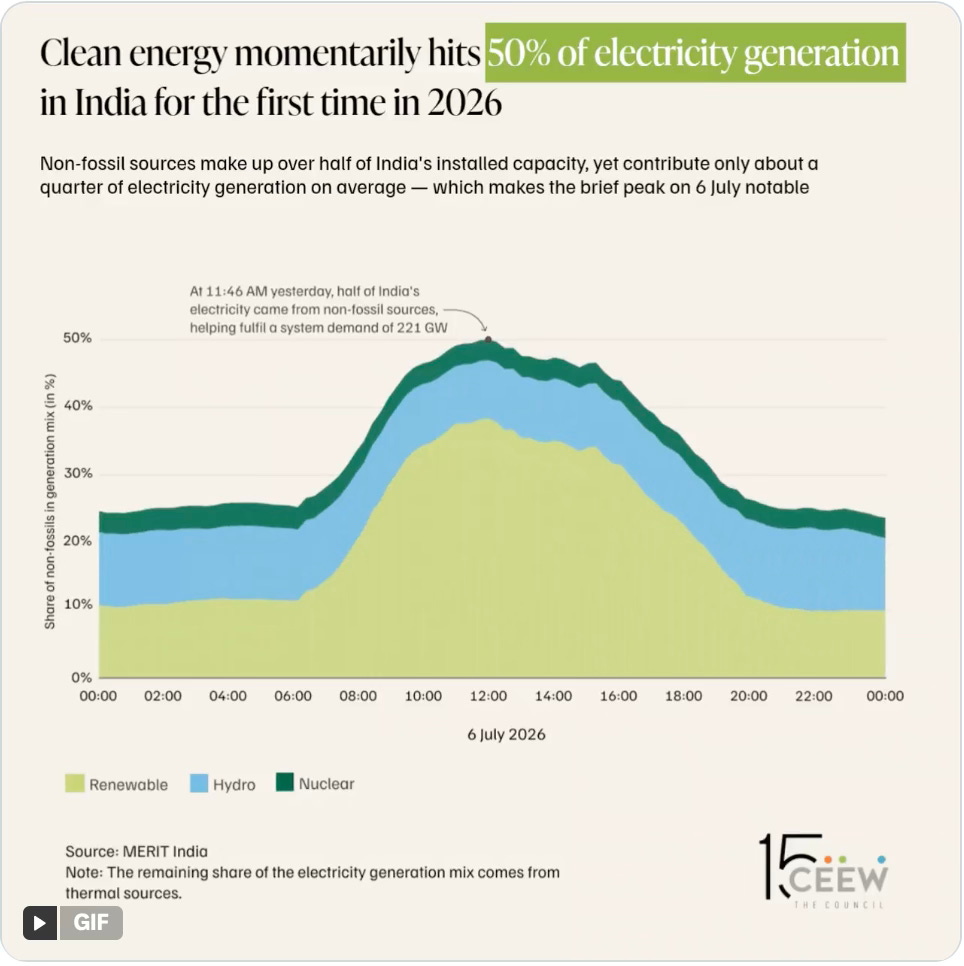
Source: Council on Energy, Environment and Water
Listen/Watch:
Sajjid Chinoy on Whether India Faces Another 1991 Moment | Sajjid Chinoy in conversation with Shruti Rajagopalan | Ideas of India podcast
Instagram running ads promoting child abuse material in India | BBC World Service Documentaries