
India Last Week #93
A round-up of research & reportage on India across climate, energy, foreign policy, politics & more over the last week

Climate, Energy & Environment:
“In the past four months, India’s energy sector has lived through a stress test. The country was getting 40% of its oil imports through the Strait of Hormuz. In addition, it sourced over 50% of its oil, 60% of its LNG, and 80% of its LPG from West Asia. On February 28, when the US and Israel attacked Iran, the country lost access to these supplies… Strangely, despite the magnitude of the disruption, its full economic and social costs have remained unknown. One reason has to do with the NDA government’s response. And another, with India’s newsrooms… Given the centrality of energy to the functioning of society, newsrooms needed to fan out across the country and track the energy crisis from week to week. This didn’t happen. And so, even compared to demonetisation, the botched rollout of GST or Covid-19, Indian newsrooms’ coverage of the energy shock was neither comprehensive nor sustained… Why is India’s energy resilience limited to short-term curtailments, as Arun put it? The answer goes beyond import dependence and strategic energy reserves. There is also misgovernance. Take import dependence. For decades now, it has been flagged as a strategic vulnerability for India. And yet, since 2014, India’s import dependence on energy has risen. For instance, even though imported natural gas is costlier than the fuels it seeks to replace, the NDA decided to treble the share of the fuel in India’s energy mix.” Read more: M. Rajshekhar, Carboncopy
“India plans to build strategic reserves of crude, liquefied petroleum gas and liquefied natural gas large enough to meet as much as a month of domestic demand, as the country seeks to avoid a repeat of the supply shock created by the war in the Persian Gulf… New Delhi currently has strategic crude reserves of about 39 million barrels, enough to cover around eight days of imports. That’s a fraction of the amount held by Asia’s other energy-consuming powerhouse — China — though inventories held by refiners and fuel retailers can together meet more than 70 days of oil demand. Strategic crude storage capacity is already being expanded with underground caverns on the country’s east and west coasts that will add more than double existing reserves, the people said, citing a plan that is expected to be achieved in about five years. The aim is to eventually have at least 120 million barrels, they added… India’s long-term LPG storage capacity is just about 140,000 tons, primarily in underground rock caverns on its east and west coasts and enough to meet roughly two days of national consumption, according to Bengaluru-based think tank Takshashila Institution… For gas, the picture is even more challenging, as there are currently no strategic reserves. Last year, the government had floated a draft policy that would push terminal operators to maintain an LNG storage capacity equivalent to 10% more than their normal operational requirement — volumes which would be requisitioned by the government as needed.” Read more: Rajesh Roy and Rakesh Sharma, Bloomberg
“This month is set to end as the third driest June India has seen in last 100 years. With just a day to go in the month, the countrywide rainfall deficit stands at 42%, indicating that El Niño may already be playing a role in depressing the monsoon in India. The average rainfall recorded across the country in June so far stands at 92.2mm, against a normal of 157.7mm… In the past 100 years (1927-2026), only two years have seen lower overall rainfall in June - 2009 (87.5mm) and 2014 (92.1mm) both within the past 20 years… Central India has a massive rainfall deficit of 54% so far this month, followed by east & northeast at 41%, northwest at 30% and south 28%… As per an update released last week by US agency International Research Institute for Climate and Society, the El Niño was already close to reaching moderate strength amid rapid warming in the equatorial Pacific. The El Niño is projected to keep strengthening over the next few months. This is significant because a stronger event increases the chances of impact on India’s monsoon.” Read more: Amit Bhattacharya, Times of India
“India’s electric vehicle (EV) market has grown nearly 14-fold since financial year (FY) 2020 in areas including electric two-wheelers (E2Ws), electric three-wheelers (E3Ws), buses, and passenger vehicles… Localisation levels have also improved across EV segments, with many original equipment manufacturers (OEMs) now undertaking domestic assembly and local sourcing for structural and mechanical components. However, a deeper assessment of the supply chain reveals that localisation remains uneven at the component level, particularly for systems unique to EVs such as motors, battery packs, power electronics, and charging systems… Localisation outcomes vary significantly across EV components, with categories aligned to India’s established automotive manufacturing strengths such as chassis systems, structural parts, wiring harnesses, and thermal systems achieving high levels of domestic manufacturing… Several structural constraints continue to limit deeper localisation. Global supply chains for automotive chips, rare-earth magnets, and critical materials remain heavily concentrated in a few countries, creating risks related to supply security, pricing, and geopolitical disruptions… Going forward, advancement in localisation will require a transition from assembly-led manufacturing to stronger domestic capability in component design, advanced materials, and electronics. Achieving this will depend on broadening supplier participation, strengthening domestic R&D, improving manufacturing competitiveness, and accelerating development of critical materials.” Read more: Rahul Maity, JMK Research & Analytics
Economy:
“From a global perspective, the “World Development Indicators” show that in calendar year 2024, manufacturing value added as a percentage of gross domestic product (GDP) in current dollars was 12.6 per cent in India. This is distinctly below that of our neighbours Bangladesh (21.9 per cent) and Sri Lanka (17.6 per cent); Southeast Asian countries Indonesia (19 per cent), Malaysia (22.5 per cent), Thailand (24.3 per cent), and Vietnam (24.4 per cent); and East Asian nations China (24.9 per cent) and South Korea (26.6 per cent). A comparison with China is most striking. In 1990, China and India had nearly identical manufacturing bases. But by 2025, China’s manufacturing value added became approximately 10 times larger than India’s… The truth is that “privatisation” of manufacturing development has not led to the “liberalisation” that opened up opportunities for new starters. Established industrial conglomerates flourished and broadened their presence. Government intervention must shift from being business-friendly to being market-friendly… Our present policy involves entrepreneurship selection even after the abolition of industrial licensing and continues in support programmes in manufacturing like the production-linked initiative (PLI). Much of this is in favour of conglomerates that operate in multiple sectors.” Read more: Nitin Desai, Business Standard
“The rupee posted its steepest single-day decline in over three weeks on Wednesday, weakening 58 paise to close at 95.25 against the US dollar, as aggressive dollar buying by importers, stop-loss triggers and a sharp rise in the dollar index overshadowed support from domestic equities and likely intervention-related dollar sales by state-owned banks. The domestic currency ended at a three-week low, marking its biggest daily fall since June 8, when it had lost 77 paise in a single session… The rupee has now extended its decline from 94.33 per dollar on June 18. Prior to that, it had staged a sharp recovery from its record low of 96.83 on May 20, strengthening nearly 2.6 per cent to reach 94.33 by mid-June. Wednesday’s decline also made the rupee the worst-performing Asian currency, falling 0.61 per cent, compared with losses of 0.55 per cent in the South Korean won, 0.50 per cent in the Thai baht, and 0.43 per cent in the Philippine peso. “Despite improving macroeconomic fundamentals, the rupee continues to face near-term pressure. Market participants will closely watch upcoming US economic data, capital flows, crude oil prices and the RBI’s intervention strategy for further direction. For USD/INR, 94.40 remains a key support, while 95.70 is the immediate resistance level,” Sodhani added.” Read more: The Hindu Businessline
“India will be within “striking distance” of a return to 8 per cent annual economic growth if there are no big new global conflicts, according to Prime Minister Narendra Modi’s top aide. Shaktikanta Das, one of Modi’s principal secretaries, told the FT that India’s economy had been challenged in recent years by the Covid pandemic, Russia’s full-scale invasion of Ukraine and the US-Israel war on Iran, but new reforms to boost momentum were being planned… “With a reasonable level of normality in the geopolitical situation and the reforms being undertaken by the prime minister, 8 per cent growth should be within striking distance,” said Das, 69, a career civil servant who headed India’s central bank from 2018 to 2024. The 8 per cent threshold is important as economists estimate India needs to maintain average real GDP growth of about that rate if it is to achieve Modi’s stated goal of developed country status by 2047, the centenary of independence from the UK… Morgan Stanley has estimated that a recent government-central bank package of investor incentives could draw $40bn-$60bn of incremental capital inflows, helping keep India’s balance of payments out of the red next year. Das said more market-friendly initiatives were “in the pipeline”, though he did not provide details.” Read more: Michael Stott, Financial Times
“India’s unemployment rate climbed to an 11-month high of 5.5 per cent in May from 5.2 per cent in April, even as labour-force participation eased, suggesting a softening labour market, according to the latest monthly bulletin of the Periodic Labour Force Survey (PLFS), released by the National Statistics Office (NSO) on Monday. Notably, the labour-force participation rate (LFPR), which is the percentage of the population that is either working or actively looking for work, hit an 11-month low of 54.4 per cent in May, down from 55 per cent recorded in April… Additionally, the worker population ratio (WPR), which represents the number of persons/person-days employed per 1,000 persons/person-days, dipped to an 11-month low of 51.4 per cent during the month from 52.2 per cent in April. “The moderation in LFPR and WPR with an increase in UR indicates a softening of labour market conditions during the period. While labour force participation declined marginally, employment opportunities contracted at a faster pace, leading to a rise in the proportion of unemployed persons within the labour force. The decline in labour market indicators may be linked to a seasonal moderation in economic activity during May 2026,” the NSO said in a statement… Overall, the male and female workforce population ratio also witnessed a decline in the month, reaching 72.5 per cent and 31 per cent, respectively, from 73.2 per cent and 32.1 per cent in April.” Read more: Himanshi Bhardwaj, Business Standard
Foreign Policy & Security:
“A community organisation has alleged that Chinese People’s Liberation Army (PLA) has established military camps and infrastructure deep inside Indian territory in remote Taksing circle of Upper Subansiri district, raising fresh concerns over border encroachment along India-China frontier. The NAH Welfare Society (NWS), a registered organisation based in Taksing, has written to Upper Subansiri deputy commissioner, claiming that the PLA has occupied several areas traditionally used by local communities and built roads, bridges and military camps over the past five years… According to the NWS, these sites were “firmly within Indian territory” before 2020, with some of them holding religious significance as sacred pilgrimage sites in the Tsari region. “We are losing our land inch by inch day by day to them. The intention and speed of the present activities of the Chinese PLA at Taksing area is very alarming and a matter of grave concern for us,” Chader wrote in the letter… While expressing faith in the Indian Army’s commitment to defending the border, the NWS said the current response has not been sufficient to halt the alleged encroachment… Taksing, a strategically significant village in the Upper Subansiri district, is located approximately 7-km from international India-China border. The NWS has also enclosed photographs with the letter, claiming they show Chinese military activities in the disputed areas, and has sought immediate intervention from state and central authorities to safeguard the region’s territorial integrity.” Read more: Arunachal Observer
“The Trump administration has not been kind to India. Nevertheless, India has responded with far greater equanimity than most observers expected… Instead of retaliating, India has responded calmly, though the Indian government faces considerable domestic criticism. Despite continuing irritation with American behavior, India can be expected to maintain its two-decade course of seeking good relations with the United States. The reason is a simple one that is ignored by critics and analysts: India has no other choice. India faces a China that is growing ever more powerful and aggressive and one with which India has both political and territorial disputes. China is India’s overriding strategic concern and it will remain so for the foreseeable future. India’s many other partners are useful supplements, but they cannot replace American heft… Despite such carelessness to its interests and pride, an explicitly nationalist Indian government is careful to avoid antagonizing the United States because India has no option other than to balance China… The problem New Delhi faces is that Beijing shows little sign that it is interested in any fundamental reset of its India relations. To the extent that ties are warming, it is being dictated by China.” Read more: Rajeswari Pillai Rajagopalan and Rajesh Rajagopalan, War on the Rocks
“There is no political will in India at present to conclude the proposed bilateral trade agreement (BTA) with the US, as a deal that imposes a disproportionate tariff-reduction burden on the country, particularly on the sensitive farm sector, is seen as “untenable”, sources said. The government is also concerned about the potential impact of steep tariff cuts on India’s balance of payments, as trade surplus with the US is already declining, and would rather wait for the outcome of the US Section 301 investigations than negotiate under the shadow of tariff threats… The US insistence on greater market access in agriculture has further complicated the negotiations. Farmers’ organisations have been opposing any move to open up the sector, arguing that Indian farmers cannot compete with heavily subsidised US agriculture… India is also seeking a better tariff deal than competing Asian exporters such as Vietnam and Bangladesh. The February 6, 2026 framework, under which New Delhi agreed to reduce tariffs on industrial goods and many agricultural products in return for an 18 per cent US tariff above MFN rates, had appeared acceptable as Indian exports faced an additional 50 per cent levy under the IEEPA and the deal would have given India a competitive edge. The IEEPA tariffs were later struck down by the US Supreme Court.” Read more: Amiti Sen, The Hindu Businessline
“Japanese Prime Minister Sanae Takaichi arrived in India Wednesday for a three-day trip to deepen economic ties and strengthen security cooperation with counterpart Narendra Modi as the two Asian powers seek to wean off dependence on China… The agenda includes about 10 sectors, including oil, mobility, critical minerals and pharmaceuticals, according to senior New Delhi officials familiar with the talks, who asked not to be identified because the deliberations are private. India’s Ministry of External Affairs didn’t immediately respond to a request for comment. For Modi, the visit is a balancing act: Deepen ties with Tokyo without derailing a cautious effort to repair relations with Beijing. For Takaichi, the prospect of greater cooperation with New Delhi offers a counterbalance to worsening relations with China, which this week further tightened controls on exports to Japan that have both military and civilian use… For India, the visit carries significance on several fronts. Despite the warm personal rapport between Modi and US President Donald Trump, New Delhi’s relationship with Washington has become increasingly unpredictable… For Japan, India is a crucial partner in carrying out its foreign policy vision of achieving a “Free and Open Indo-Pacific.” The two nations have existing agreements on the transfer of defense equipment and have held multiple joint foreign and defense minister meetings.” Read more: Sakura Murakami, Bloomberg
People & Politics:
“One of the biggest and most wide-ranging recent news scoops in India, exposing alleged government misdeeds in the awarding of educational software contracts, was broken on social media by students with no journalism training. On May 22, three teenagers — Nisarg Adhikari, Vedant Srivastava, and Sarthak Sidhant, all in their final year of schooling — scooped education reporters across India by posting on social media allegations of malpractice following their own investigations into the way the country’s Central Board of Secondary Education awarded contracts for its new on-screen marking system… The three students, all 17-years-old, had found discrepancies in their own answer sheets, which prompted them to independently investigate problems in the evaluation system. Sarthak looked at the bidding process through which the government chose a private operator to get the contract, Nisarga found cybersecurity vulnerabilities in the system, and Vedant discovered instances where students’ answers had been mixed up… For journalists, it is hard to know whether this saga is more ridiculous or shameful. It represents one of the most consequential recent exposés in the education sector, a revelation of remarkable scale, made all the more striking by the fact that the story was cracked open by schoolchildren with no affiliation even to a student-run publication… The state of journalism in India now represents an intellectual violence so predatory that it seemingly does not mind wounding its own children.” Read more: Vidya Krishnan, Nieman Reports
“In a sultry wetland on one of the world’s longest frontiers, Bangladeshi border guards use megaphones to tell their Indian counterparts not to “push people” across the border. “They wait until it is dark to switch off the spotlights and for the right opportunity,” said Lance Corporal Mahmud Masud, criticising Indian efforts to expel what some senior New Delhi officials have called “illegal infiltrators”… The “push-ins” involve no formal repatriation process and many of those sent to Bangladesh have not lived there for decades, if at all. “They open the gates on the Indian fence and push people into the darkness . . . There are women, there are children and these poor people get stranded in the middle,” said Mohammad Ashrafuzzaman Siddiqui, director-general of the Border Guard Bangladesh… The deportation push has worsened fragile relations between the two countries, underscored fears about Hindu nationalism and heightened the sense of precarity for millions of Muslims in West Bengal and other border states… For years, the BJP has campaigned against Bangladeshi migrants, with India’s home minister Amit Shah, Modi’s closest aide, once calling them “termites”… Indian officials have said they have pushed “illegal infiltrators” over the border under a “detect, delete and deport” policy.” Read more: Andres Schipani and Redwan Ahmed, Financial Times
“The alleged embezzlement of donations at the Ram temple in Ayodhya has snowballed into a major controversy, with an SIT probe finding lapses in the shrine’s donation management system and eight people associated with the counting of cash and valuables being arrested… Standard Operating Procedures (SOPs) like deploying a security guard during a counting process, frisking of personnel while entering and leaving the counting room, and preserving CCTV footage of the donation-counting process for 180 days were violated, sources said, citing the findings of the report. In violation of rules, Ramashankar Yadav alias Tinnu Yadav, the former driver of the Shri Ram Janmabhoomi Teerth Kshetra Trust general secretary Champat Rai, held keys to several ‘hundis’ (donation boxes), they said… The controversy erupted on June 7 after Samajwadi Party chief Akhilesh Yadav alleged embezzlement of donations at the Ram temple, a charge that was dismissed by Mr. Rai. “Nothing noteworthy has come to light during the ongoing internal audit,” Mr. Rai had said. The SIT that was constituted on June 13 on the orders of Chief Minister Yogi Adityanath to probe the sensational allegations appeared to prove Mr. Rai wrong. The sources admitted that given the nature of its findings, a major “overhaul” of the Ram temple management set-up was in the offing.” Read more: The Hindu
“A collective of Supreme Court advocates has condemned the threatening and vilification of a Madhya Pradesh judge for sentencing seven cow vigilantes to life in prison for lynching a cattle transporter, and called for the independence of the judiciary to be upheld. In a statement issued Wednesday (July 1), the Supreme Court Advocates on Record Association (SCAORA) ‘unequivocally condemned’ the campaign against Narmadapuram district judge Tabassum Khan, noting that “such conduct strikes at the very foundation of judicial independence and the rule of law”… This independence is crucial because district courts make up the “backbone” of the Indian justice system, SCAORA wrote, adding that institutions must be committed in protecting the functioning of this rung of the judiciary… Judge Khan on June 12 sentenced the seven men to life imprisonment for lynching cattle transporter Nazeer Ahmad in Narmadapuram in August 2022. She handed the life sentence after convicting them of murder but found them guilty of armed rioting and attempt to murder as well. The men had also attacked Ahmad’s companions Sheikh Lala and Sheikh Mushtaq, who survived their injuries. In the days following the verdict, as media reports have noted, some users on social media accused judge Khan of deciding the case ‘on the basis of religion’, while one individual while using slurs to refer to the judicial officer threatened a “massacre” unless the convicts were released.” Read more: The Wire
Tech:
“Two days after WhatsApp introduced ‘username’ - a feature which would allow users to create a unique handle instead of sharing their phone numbers - the Ministry of Electronics and Information Technology (MeitY) has issued a notice to the messaging platform directing it to furnish a detailed explanation of the feature within three days, people familiar with the matter said on Wednesday. The ministry also directed WhatsApp not to roll out the feature “until the consultation on this point is achieved to the satisfaction of the government”… The notice issued by MeitY said there was apprehension that the feature may materially increase the incidence of online fraud, phishing, digital arrest scams and impersonation attacks, by enabling bad actors to solicit and message victims… “Furthermore, this feature may facilitate impersonation and identity spoofing, including impersonation of individuals, public authorities, financial institutions, and government agencies, by permitting the adoption of usernames closely resembling those of genuine persons or institutions,” it said. Separately, the Department of Telecommunications (DoT), under the Ministry of Communications, has raised concerns over how it would impact its SIM-binding directive which mandates that messaging platforms such as WhatsApp, Signal, Telegram, Arattai and Snapchat link user accounts with actual physical SIM cards in order to prevent cyber fraud and enhance user traceability.” Read more: Sejal Sharma, Hindustan Times
“The Union government temporarily blocked Telegram to protect the sanctity of the National Eligibility cum Entrance Test-Undergraduate (NEET-UG) 2026 re-examination by a single interpretative sleight of hand which compressed an entire intermediary platform into an expression: ‘information’. The ban won the endorsement of the Delhi High Court by stretching the meaning of “information” under the Information Technology (IT) Act, 2000… The government argued that an online platform like Telegram was an “aggregation” or “compilation” of these units. By reading entire platforms run by companies, which were legal entities by their own nature, within the ambit of ‘information’ under the Act, the government has effectively weaponised the content-blocking provision of Section 69A. Section 69A of the IT Act gives the government power to issue directions to block public access to any ‘information’ through a computer resource… Such a sweeping ban had disproportionately affected the very section it deemed to protect. Many of the 150 million Telegram users were students and educators who used the platform to share study material and educational resources for NEET preparation.“ Read more: Krishnadas Rajagopal, The Hindu
“Amid an increasing crackdown on online free speech across India, Telangana police sent a notice to X seeking the removal of over 41 social media posts related to news and commentary on an incident involving Bharatiya Janata Party (BJP) members slapping a Urdu teacher in Telangana’s Nizamabad district… The video shared by The South First shows a man in a white shirt and pants slapping the teacher while abusing him using Telugu vulgar words, all in the presence of a police officer and multiple individuals recording the incident on their smartphones. Police reportedly arrested both BJP members as well as the Urdu teacher. “What is unlawful about reporting what happened in front of police that is caught on camera?” asked The South First’s Editor Anusha Ravi Sood on X while confirming that Hyderabad police sent a notice to X under Section 79(3)(b) of the IT Act seeking removal of over 41 posts. Under this section, online intermediaries (like social media platforms or internet service providers) can lose their “safe harbor” legal immunity if they fail to act on the government’s or court’s takedown or blocking requests.” Read more: Azdhan, Medianama
Chart of the Week:
H-1B visa allocations and India
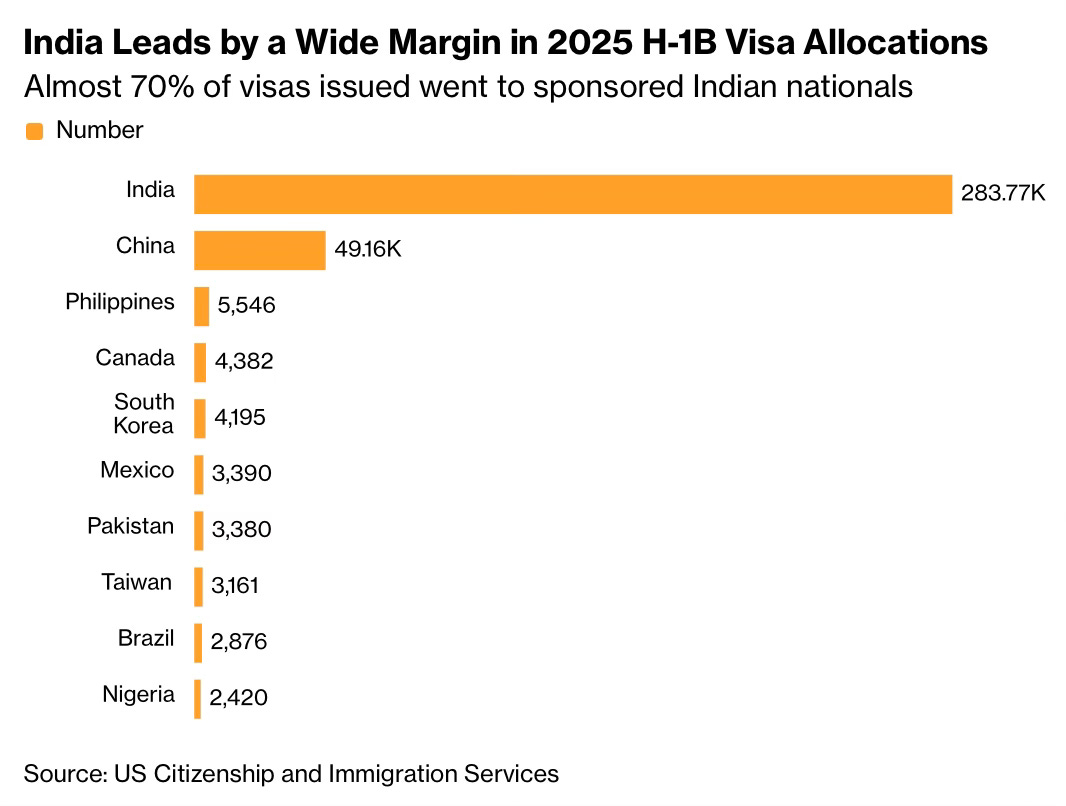
Source: US Citizenship and Immigration Services via Bloomberg