
India Last Week #92
A round-up of research & reportage on India across climate, energy, foreign policy, politics & more over the last week

Climate, Energy & Environment:
“The green energy revolution has a special urgency in developing countries. As countries grow, green energy serves both to head off increases in emissions and to meet rapid growth in energy demand… growing, to meet rising demand. I conjecture that hold-up—foregone investment due to contractual risk—might hinder the green energy revolution. When contract enforcement is weak, firms may be reluctant to invest in specific assets for fear of hold-up… This paper studies the possible hold-up of green energy in the context of procurement auctions for solar power in India… I use novel data on the universe of large-scale solar procurement auctions in India from 2012 to early 2020, basically the entire history of the Indian solar industry. In solar auctions, firms compete to be awarded long-term (typically 25-year) contracts to supply solar power to state utilities. The data depict a solar boom, in which prices fell by a factor of three and capacity exploded: India installed 32 GW of utility-scale solar capacity, more than a hundred-fold increase, to approach the level of utility-scale solar in the United States (37 GW, circa 2019)… First, the counterparty risk of an average state increases solar bid prices by 10% over what the central government would have paid. This risk premium is as large as the mean mark-up of bid prices over cost among all bidders (11%) and two-thirds as large as the mean mark-up among winning bidders (16%)… Second, central intermediation mitigates counterparty risk. I find that solar bid prices are 6% lower in central auctions relative to comparable state auctions.2 Lower prices in central auctions are consistent with intermediation mitigating risk, but this estimate is not dispositive, since it is possible that central auctions have some other advantage in cost or competitiveness, not having to do with risk.” Read more: Nicholas Ryan, Econometrica
“India has more heat action plans than any other country in the world. Across 23 states, there are a total of 304 heat action plans, with 64 approved, and hundreds more still being developed to combat the heat down to the district and municipal levels. But as the country is in the midst of prolonged heatwaves— 95 of the world’s top 100 hottest cities are now in India— these plans seem to only exist on paper. The problem isn’t a lack of planning, it is the lack of funding. The country needs dedicated financial mechanisms to help implement these plans on ground… Unlike floods and cyclones, heat has not been notified in the National Disaster Management Act. This means that states cannot rely on disaster funds to tackle extreme heat crises… According to experts, the problem runs far deeper than just a lack of resources. “Heat as an issue is diffused across the department, it cuts across health, labour, urban development, environment, and disaster management — each with different priorities, mandates, and budget lines. It is difficult to put them together,” said Bhasker Padigala, Climate and Environment Adviser, British High Commission in India… The challenge is particularly acute for urban local bodies and district administrations, which are often responsible for implementing heat action plans, but have limited fiscal autonomy. Municipal corporations are expected to create cooling centres, improve water access, expand green cover and strengthen early warning systems, yet many lack dedicated revenue streams for climate adaptation.” Read more: Paridhi Choudhary, CarbonCopy
“India’s largest conglomerates are laying the groundwork for a major push into nuclear energy as the government opens up the industry to the private sector and moves to loosen regulations. Tata Power, the utility arm of India’s biggest conglomerate, and the Adani Group, owned by Asia’s richest man, Gautam Adani, are among the companies seeking approval for nuclear power plant construction… The world’s most populous nation is the third-largest carbon emitter, with its expanding economy and electricity demand resting on a bedrock of coal. But the country wants to bolster its supply of uninterrupted low-carbon power, with an eye towards nuclear. Globally, the energy crisis sparked by the war in Iran has accelerated many governments’ efforts to revive atomic power… India’s push predates the war. Last year, parliament passed legislation paving the way for greater private participation in the sector. Although India’s first nuclear reactor became operational in 1956, the government had maintained a tight grip and monopoly on the industry… Last month, Maharashtra, the country’s richest state, said it had received investment pledges totalling $67bn for 25.4GW of nuclear power projects involving Adani, Mukesh Ambani’s Reliance Industries and the state-owned National Thermal Power Corporation… Despite parliament approving the new nuclear power law, final rules are still being drafted, including potentially sensitive changes aimed at easing project development.” Read more: Chris Kay and Krishn Kaushik, Financial Times
“Vietnamese electric-vehicle maker VinFast is attempting something few foreign carmakers have achieved in India: building a complete mobility ecosystem rather than simply selling cars… In its home market, the company has built an electric mobility ecosystem few automakers globally have attempted… In less than a decade, VinFast has become one of Vietnam’s best-known industrial successes and is now trying to export that model overseas to India. It has invested $500 million in a 400-acre manufacturing plant at Thoothukudi, formerly Tuticorin, in Tamil Nadu. The plant can produce 50,000 vehicles annually and has room for expansion… Beyond selling cars, VinFast hopes to replicate the multi-segment strategy that’s helped drive its Vietnam growth. Its electric tax service, Green SM, plans to deploy 1,000 vehicles in Delhi and Gurugram in coming months… The taxi business is only one element of an even wider plan. VinFast is exploring developing an extensive charging network, looking at local electric bus production and is expected to introduce electric scooters and motorcycles later.” Read more: Paran Balakrishnan, The Hindu Businessline
Economy:
“I recently had the opportunity to spend some time in the United States, meeting with the chief executive officers of several large companies and interacting with other global investors… On India, the mood remains sombre, even bleak. Zero interest. Even 6,000 basis basis points of underperformance versus EM equities over the last 12 months has failed to stir interest. India has now underperformed EM equities even over a 10-year horizon. Nobody seemed to care that TSMC alone carries a higher index weight than India in the EM index… Why does India get such a valuation premium over EM equities? This was a question many asked. On growth, return on equity (RoE), scale of profits, and long-term performance, it does not stand out from the EM pack, so why the premium?… India is not cheap enough for value investors and lacks enough growth to attract growth investors. We are seen as the biggest loser of the AI boom, given our reliance on white-collar service exports… The weakness of the rupee has scared many. The irritation and complexity of capital gains taxes for foreign portfolio investors have been well-flagged… Most investors no longer take it as a given that India can grow at a minimum of 6 per cent for at least a decade. There is much more debate about our true structural growth outlook, with many investors believing that our best years of growth are behind us.” Read more: Akash Prakash, Business Standard
“India’s once-booming stock market has lost ground to Asian rivals this year as AI-hungry investors are put off by the country’s lack of businesses able to capitalise on the sector’s boom. Foreign investors have pulled a net $26.4bn from Indian stocks this year, including a record $2.3bn on Monday, according to securities depository NSDL, pushing the market down to seventh place globally by market value from fifth place just a week ago… India’s stock market capitalisation was overtaken in the past week first by Taiwan and then by South Korea, as the value of Indian equities held by foreign investors slumped to a 10-year low of 7.3tn rupees ($76bn) on June 1. The value of Indian stocks was more than double that of Taiwanese stocks and roughly 3.5 times that of South Korean stocks 18 months ago, analysts at Bernstein said this week. “Fast forward just five months into 2026, and that lead has evaporated,” they added… India has no presence in large language models such as ChatGPT or Claude and has no chipmaking industry. Adding to its troubles, the south Asian nation, which imports 90 per cent of its energy, is one of the worst affected by disruption to global oil and gas supplies as a result of the US-Israel war against Iran… Analysts at Morgan Stanley wrote this week that India’s “lack of a direct AI play” represented “the most persistent challenge to the equity market, with potential AI disruption for Indian services exports aggravating matters”.” Read more: Krishn Kaushik, Financial Times
“A majority of global emerging-market (EM) investors continue to remain underweight on India despite the recent rebound in domestic equities, suggesting there is still room for foreign inflows if valuations become more attractive, according to a report by Jefferies. The brokerage analysed 70 large emerging-market funds managing assets of about $320 billion as of March 2026 and found that 61% of them were underweight India relative to benchmark allocations. On average, these funds were underweight by 0.4 percentage points, a positioning that Jefferies believes may have become even more pronounced during the June quarter… While investors remain constructive on the country’s long-term growth prospects, many continue to be deterred by valuations that remain significantly richer than those of other emerging markets… The brokerage noted that while corporate earnings growth is expected to improve over FY27 and FY28, it is still likely to trail that of the broader EM basket. Factors weighing on earnings include the impact of rupee weakness, the effect of elevated oil prices earlier in the year and concerns around a potential El Niño-induced disruption to the monsoon… The underweight positioning is significant because foreign portfolio flows have historically played an important role in driving Indian equity market performance. Any improvement in earnings visibility, moderation in valuations or acceleration in economic growth could encourage global investors to raise allocations towards benchmark levels.” Read more: Financial Express
Foreign Policy & Security:
“External affairs minister S Jaishankar dialled US secretary of state Marco Rubio to raise the death of three Indian seafarers in US attacks on ships in the Gulf of Oman, and asserted that “lethal actions” against commercial vessels are not justified. According to a US state department readout on Friday’s conversation between the two leaders, Rubio emphasised that commercial vessels should comply with orders from US forces, and violations of an American blockade of Iranian ports “will not be tolerated”… The US attack on MT Settebello on June 9 killed three Indian seafarers. “Spoke to US Secretary of State Marco Rubio this [Friday] evening. I reiterated India’s strong protest at the attacks by the US Navy in the Gulf that killed three Indian mariners,” Jaishankar said in a brief social media post early on Saturday morning… The terse readout on the conversation issued by US state department spokesperson Tommy Pigott did not acknowledge India’s concerns or the deaths of the Indian seafarers. It emphasised US efforts to enforce the blockade of Iranian ports and to act against vessels attempting to break it. Pigott said the two leaders discussed “recent events in the Strait of Hormuz” and said Rubio “stressed that all commercial vessels should immediately comply with orders from US forces as they seek to uphold peace and security in the Strait”.” Read more: Rezaul Laskar, Hindustan Times
“Government-owned IREL is in talks with Rosneft to source rare earth samples from Tomtor, the Siberian deposit acquired by the Russian oil producer last year, as New Delhi seeks to secure supplies of critical minerals dominated by China, a source said. The talks are taking place through government channels, said the source, adding that the samples would be processed in Russia before being shipped to India... State-backed IREL is at the forefront of India’s global outreach to secure rare earth supplies to meet rising domestic demand and wean itself off dependence on China, with ties between the two neighbours remaining frosty. IREL, India’s Department of Atomic Energy, which oversees the state miner, the foreign ministry, the mines ministry and Rosneft did not respond to Reuters’ requests for comment… In November, New Delhi approved a 73 billion rupees ($770.77 million) programme to support rare earth magnet manufacturing. India lacks commercial-scale facilities capable of refining and separating the full range of rare earth elements to high purity levels… IREL is also in talks with Japanese and South Korean companies on plans to manufacture rare earth magnets commercially, Reuters reported last year. The company is also exploring rare earth mining opportunities in Argentina, Australia and Malawi, and plans to begin rare earth magnet production in 2029 to 2030, the source said.” Read more: Money Control
“It is not clear how the Iran-US deal will unfold over the next several months. The announced ceasefire and framework are more of a mechanism to postpone resolving deeper divides that still pose risks… In India, there is much hand-wringing over the fact that it was an irrelevant player in this entire conflict. But India’s diagnosis of this irrelevance, and what the world needs now, is deeply mistaken. Any mature power should not worry about who gets to mediate. India did not have the leverage, alliance relationships, or, frankly, the diplomatic ability to mediate… In a nutshell, the problem with India’s diagnosis of its irrelevance is that it is asking the wrong question. We need to understand a basic fact about the current global situation. We have been consistently framing every war - Ukraine, Gaza, Iran - as if these were bilateral or limited regional affairs. There is a sense in which, of course, they are not our wars. But collectively, these wars have brought the world to unprecedented risks… Where does India come into this? First of all, we spoke with forked tongues about our own positions. We were not, as they say, multi-aligned as we claimed to be… But the sense of being a supplicant in the face of the US, and too cowardly to name any crime in the international order, is palpably visible for the world to see. The problem is that we are seen as incapable of defending any principle whatsoever… What India lost in the last couple of years was not its power to mediate it was the sense that no one had any idea what India stood for.” Read more: Pratap Bhanu Mehta, Indian Express
“India’s strategy of managing its relationship with China diplomatically in the wake of the 2020 crisis achieved a breakthrough when, on 21 October 2024, the two countries announced a joint patrolling arrangement that would lead to disengagement of forces at the Depsang Bulge and the Charding-Ninglung Nala junction near Demchok… Since the 2000s, Chinese intrusions across the LAC had been increasing, resulting in minor crises in 2008, 2013, and 2014. In 2020, however, China adopted a more serious variant… India was caught off guard but responded through a measured policy, which involved confronting the Chinese forces at the blockade points and reinforcing the strength of the Indian Army to match the Chinese build up… Formal dialogue between the two countries came to a halt. There would be no meetings at the apex level for the next four years after the Chennai summit in 2019, until the 2024 bilateral meeting between PM Modi and President Xi on the sidelines of the BRICS Summit at Kazan, Russia… From 2020 to 2024, India and China had little substantive political dialogue between them. Talks at the official level focused largely on resolving the standoff that arose in 2020… India displayed strategic patience in dealing with China—strengthening its military positions while also making clear that it was willing to use military steps to strengthen its hand, as evidenced during the Kailash range operation… In retrospect, the deliberate decision not to hold apex-level meetings between PM Modi and President Xi served an important signalling function. It underscored the seriousness of India’s position and its steadfastness in insisting that status quo ante was the minimum condition for normalisation of the Sino-Indian discourse.” Read more: Manoj Joshi, Observer Research Foundation
People & Politics:
“India is on the cusp of a demographic upheaval. Fertility rates across the country have been falling for decades and are now on or below replacement levels. We will soon have to shift from the challenges of finding jobs for the youth bulge to preparing to care for an ageing population. You would not think so looking at the Terms of Reference (ToRs) of the High-Level Committee on Demographic Change that the government constituted at the end of May. The ToRs are peppered with the need to address “illegal immigration” and border management… It is no wonder that the committee does not have a single demographer to guide its work. Its chairperson is a retired Supreme Court of India judge; it has a retired IAS officer and a retired IPS officer, the Census Commissioner and an economist… from Bangladesh? It is revealing that the only kind of official evidence we have so far of “demographic change” (i.e., immigration from Bangladesh affecting population size and composition) are observations by the Home Minister of large increases in the population of a few of the border districts. Highlighting such increases without reference to domestic migration or differential fertility behaviour among communities is not proof of undocumented immigration… Of course, all this is not about undocumented migration. All this is really a code for the place of Muslims in India and an acceleration of the social, economic and political discrimination of this community of Indian citizens that has taken place over the past 12 years… To speak then about Muslim fertility “deviating from broad trends”, as one of the ToRs of the committee indicates, is to ignore the facts on the ground and fall back on familiar tropes about the behaviour of this minority, giving official validation of age-old misinformation.” Read more: C. Rammanohar Reddy, The Hindu
“The only survivor of the Air India plane crash that killed 260 people in June 2025 has called for “honesty, transparency and answers” a year on from the disaster, and spoken about his “significant psychological scars” and financial hardship. Vishwash Kumar Ramesh, a British national, has previously described his fate as a “miracle” after being the only person to survive the incident, in which a Boeing 787 Dreamliner struck a medical college shortly after taking off from Ahmedabad airport… Ramesh, who lost his brother in the crash, demanded answers as investigators are yet to publish their findings. Last month, India’s civil aviation minister said the investigation was in the “last stage” and the report would “mostly” be finished by the anniversary of the crash, on 12 June. Exactly 30 days after the crash last year, the Indian authorities released a preliminary report, which was in line with standard procedure. It found both of the plane’s fuel switches had moved to the “cut-off” position “immediately” after take-off, stopping fuel supply to the engine… “I know those questions are not just on my mind; they are on the minds of every affected family. More than anything, people need honesty, transparency and answers. Nothing will ever change what happened, but families deserve clarity”… Paul McClorry at Hudgell Solicitors said civil claims were being considered against a number of potential defendants. “We are awaiting the findings of the investigations, and we should finally start to see some clarity as to how and why this awful disaster happened, and, crucially, how it could have been avoided,” he said.” Read more: Aneesa Ahmed, The Guardian
“Andhra Pradesh chief minister Chandrababu Naidu has said that the Union government will reintroduce the Delimitation Bill by adding a point about a 50% proportional increase of seats across states soon. In an interview with Economic Times, Naidu, who is a key member of the Bharatiya Janata Party (BJP)-led National Democratic Alliance (NDA), said that he fully supports the move of reintroducing the Delimitation Bill… In April this year, for the first time in 12 years, the Narendra Modi government had failed to get a constitutional amendment Bill passed. In a major setback to it, a united opposition had defeated the constitutional amendment Bill that sought to increase the strength of the Lok Sabha to 850 seats to “operationalise” women’s reservation. The Wire has reported that the Constitution (131st Amendment) Bill, 2026, along with its accompanying delimitation Bill, sought to bring in large-scale changes that would not just increase the strength of the Lok Sabha to 850 but result in a fundamentally altered parliamentary arithmetic and change Union-state relations… Naidu said that the Union government will now be able to pass the legislative package including Delimitation because “political circumstances have changed” (in West Bengal and Tamil Nadu). At the moment, while the Dravida Munnetra Kazhagam (DMK) has left the INDIA Alliance after the Congress decided to support the Tamilaga Vettri Kazhagam (TVK) following the Tamil Nadu assembly elections and formed the coalition government with the TVK supremo Vijay as the chief minister.” Read more: The Wire
Tech:
“Semiconductor manufacturing company GlobalFoundries will produce radio frequency (RF) chips for government-backed Fermionic under a partnership, agreement joint statement said on Thursday. Fermionic’s RF chips will be the first Indian semiconductors to be manufactured by GlobalFoundries, which has been producing chips for global majors such as Qualcomm, Mediatek, Broadcom etc. “GlobalFoundries Engineering Private Limited (GF India) and Fermionic, an Indian fabless semiconductor startup focused on advanced radio frequency (RF) solutions, announced a commercial partnership under which GF will manufacture Fermionic’s RF chips,” the statement said… Fermionic is developing high-performance RF and millimeter-wave (mmWave) chips for radar, satellite communications, telecom infrastructure, and adjacent applications. The company’s product roadmap includes beamformers, phased-array transceivers, RF switches, high-linearity power amplifier chains, and integrated front-end ICs optimized for intelligent sensing, adaptive communications, and AI-enabled RF systems.” Read more: Economic Times
“India has temporarily blocked the Telegram app over concerns it may be used for cheating, days before a crucial medical entrance exam is set to be reheld. Millions of students will retake the National Eligibility cum Entrance Test - Undergraduate (NEET-UG) on 21 June after the exam held in May was cancelled over allegations of a paper leak. The National Testing Agency (NTA), which conducts the exam, welcomed the move, saying that it was taken in response to the “organised use of the platform [Telegram] by cheating rackets to defraud candidates”. But internet users and rights activists have criticised the ban, calling it a “band-aid solution” to tackle a much larger problem of exam fraud… The platform was still available to users in India hours after the government’s announcement, and it is not clear yet how the curb will be enforced. But it has brought the NEET-UG exam - the gateway to joining medical colleges in India - and the recent controversy surrounding it back into the headlines. Nearly 2.28 million candidates took the exam on 3 May at more than 5,000 centres across India. But within days, the NTA scrapped the exam after allegations of a paper leak led to widespread protests… On Tuesday, NTA said that India’s Ministry of Electronics and Information Technology had directed Telegram to restrict access to the app in India until 22 June, the day after the retest.” Read more: Cherylann Mollan, BBC
Chart of the Week:
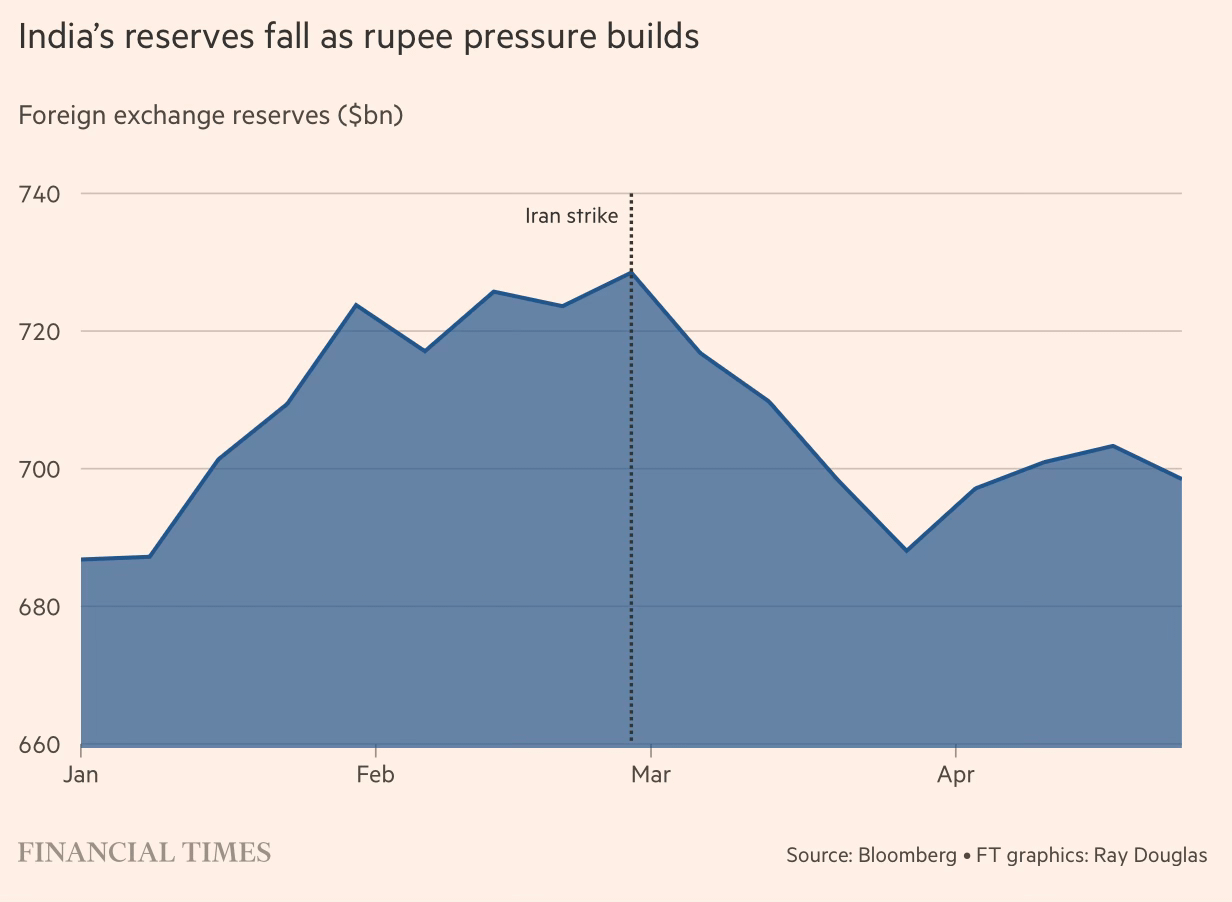
India’s foreign exchange reserves
Source: Financial Times