
India Last Week #91
A round-up of research & reportage on India across climate, energy, foreign policy, politics & more over the last week

Climate, Energy & Environment:
“On a single day in late April, India captured an unwanted record: all fifty of the world’s hottest cities were within its borders. By May, that figure had climbed to ninety-seven out of the top 100, with Balangir in Odisha registering a staggering 48 degrees Celsius… The word appearing in official statements and media coverage is invariably “unprecedented.” But India’s 2022 heatwave was called unprecedented, as was 2024’s and 2025’s… What is happening in 2026 is not unprecedented—but it is a warning for others. Heatwaves strike segments of society very differently, especially in India. Those who can move through the crisis in air-conditioned cocoons—homes, cars, offices, malls—can escape some of the worst effects. Roughly three-quarters of India’s workforce—about 380 million people—labors in heat-exposed sectors, agriculture and construction above all… The 2026 heatwave is also being shaped by an alarming humidity surge. High humidity prevents the body from cooling through sweat evaporation—the last line of physiological defense—meaning that conditions that once carried manageable risk are now deadly… India’s city-level Heat Action Plans are also being tested to their limits. These frameworks deploy early warning systems, cooling centers, water distribution, and mandatory rest breaks to try to mitigate the heat’s dangers. But, as researchers have noted, the plans are structurally calibrated to reach people already inside formal systems: those with registered employers, those connected to municipal services, and those reachable by public health messaging.” Read more: Kayly Ober, Carnegie Endowment for International Peace
“A sea of solar panels is rapidly engulfing one of the world’s largest salt deserts. By 2029, nearly 60 million panels will cover 280 square miles of India’s Rann of Kutch, extending right up to the border with Pakistan. The Khavda solar park is set to be the world’s largest and most powerful supplier of electricity from the sun, with a generating capacity of 30 gigawatts — 30 times the size of a typical coal or nuclear power station and enough to power Austria… Analysts say the world’s most populous nation is on the verge of becoming the first major country to power its industrialization predominantly with solar energy. Cheap solar is “enabling India to develop without the long fossil-fuel detour taken by the West and China,” says Kingsmill Bond, energy strategist and director at Ember, a U.K.-based think tank that tracks the world’s transition to renewable energy… India still has a long way to go to break its dependence on fossil fuels. Coal still delivers most of the country’s baseload and fuels about 70 percent of total power generation. It helps make India the world’s third largest carbon dioxide emitter, after China and the U.S, and is a major cause of the country’s urban smogs, which are the worst in the world… The Indian government is working to address this reliance on its northern neighbor for the supply chain for its renewables technologies by boosting domestic manufacture. A more long-lasting constraint may be land.” Read more: Fred Pearce, Yale Environment 360
“There is one figure that should command the attention of every policymaker, banker, and financial expert in India. India will require INR 162.5 trillion - roughly $2.5 trillion - by 2030 to meet its Nationally Determined Contributions. Over the longer term, the cost of achieving net-zero emissions by 2070 is estimated at $10.1 trillion, nearly three times India’s current GDP… Decarbonising just four sectors - steel, cement, power, and road transport, which together account for more than half of India’s carbon emissions - will require $467 billion in additional capital expenditure between 2022 and 2030, roughly $54 billion annually, or 1.3% of GFP. These are sectors where the private sector will not lead without strong regulatory incentives, because the economics of green steel and green cement simply do not yet work without policy support… The international community will not fill this gap on India’s behalf. The honest answer is that India must mobilise most of it from within. India is not starting from zero. By the end of 2024, India had issued $55.9 billion in green, social, sustainability, and sustainability-linked debt - a 186% rise since 2021. Green debt leads, making up 83% of the total, with most funds directed by clean energy and transport… The instruments exist. The challenge is deploying them at scale. India already has green bonds, sovereign green bonds, sustainability-linked bonds, blended finance structures, transition finance instruments and infrastructure investment trusts.” Read more: Balakrishna Pisupati, The Hindu
“Electric vehicle (EV) penetration in the domestic retail market surpassed the double-digit milestone in May 2026, reaching an all time high of 10.7%. According to industry data, EV sales rose to 271,116 units during the month, out of total vehicle sales of 2.53 million units. In comparison, EV penetration stood at 8.1% in May 2025, when 186,922 EVs were sold from an overall industry volume of 2.32 million units… However, growth remains heavily concentrated in the two-wheeler segment. Electric two-wheelers accounted for 62.9% of total EV sales in May 2026, up from 56.1% in the corresponding month last year, underscoring their growing role in driving market expansion. In absolute terms, electric two-wheeler sales surged to 170,535 units from 104,902 units a year earlier. Electric three-wheelers remained a key contributor to the EV market, although their share declined to 26.5% in May 2026 from 35.4% a year earlier. Despite the lower share, sales volumes increased to 71,860 units from 66,186 units. Meanwhile, electric passenger vehicles strengthened their position, accounting for 9.7% of total EV sales compared with 7.9% in May 2025, with volumes rising to 26,291 units from 14,699 units… Petrol’s share declined 2.8 percentage points over the past year broadly matched by gains in EVs and CNG vehicles. Together, alternative powertrains accounted for 15.8% of total retail sales in May 2026, up from 12.5% a year earlier, indicating a steady shift away from conventional fuels.” Read more: Nitin Kumar, Financial Express
Economy:
“Market concentration in India is often not the result of private collusion, but of intentional industrial policy design. Industrial policy often through tools like taxation structures, import tariffs, anti-dumping duties, Quality Control Orders (QCOs), production-linked incentives, licensing layers and procedural compliance burdens is steadily reshaping markets in ways that favour and protect large incumbents while squeezing out the small players. This is not favourably to economic growth as the country is targeting the achievement of Viksit Bharat by 2047… The distortions are not accidental; they are structural and intentional. In FY25, the average Herfindahl-Hirschmann Index (HHI), economic formula to assess concentration, across eight major Indian sectors such as telecom, paints, two-wheelers, aviation etc. rose to 2,532 crossing into the “highly concentrated” zone for the first time in over a decade, up from 1,980 in FY15 and 2,167 in FY20. Industrial policy often functions as a powerful gatekeeper, quietly anointing winners, shielding incumbents, and narrowing the space for new challengers to emerge. Firstly, a high or complex taxation regime disproportionately burdens smaller firms that lack the scale and advisory capacity to optimise compliance, while large corporations are better placed to absorb or strategically minimise tax liabilities. Secondly, import tariffs and trade restrictions, often justified as protective measures, can entrench incumbency when domestic capacity is already concentrated.” Read more: Pradeep S. Mehta, Economic Times
“The tide of US-led globalisation was spreading outward in 1991. Now, it is shrinking inward. It may have made sense in 1991 to use trade as the strategy for economic growth rather than industrial development; not in 2026. In 1991, India switched from the difficult route of building its own high-value adding manufacturing industries to the easier route of imports. Most Indian businesses took this route and became assemblers and marketeers of foreign goods. China, however, continued to build its domestic industries… India also finds itself squeezed in the geopolitical competition between the US and China. The statistics are revealing. India’s exports to the US were $3 billion in 1991 and imports from that country were $2 billion. India’s exports to the US increased to $86 billion by 2025, and imports to $46 billion — a surplus of $40 billion in India’s favour… Many Indian economists, in and outside the government, admit the Indian economy must be reformed boldly. Most of them, whether supporters or opponents of the present government, say India has not implemented the 1991 reform agenda boldly enough… An export-led strategy will not work for India. It helped the Asian tigers (Japan, Korea, and Taiwan), and China because they implemented vigorous policies to build domestic industries, without which they could not have generated their huge trade surpluses… Economists on both sides of India’s socio-political divide continue to say India must implement the 1991 reform agenda more boldly. This, however, cannot be the right strategy for India any longer. India must build depth in its own industrial base. It cannot rely any longer on free trade.” Read more: Arun Maira, Hindustan Times
“India today stands at a critical inflection point. Global buyers are not charmed by improvisation… India’s performance on competitiveness and innovation underscores the urgency of this shift. In World Competitiveness Index 2025, India ranks 41st out of 69 economies, far behind China (5th) and the US (1st). In Global Innovation Index 2025, India is placed 38th out of 139 economies, leading South Asia but trailing innovation leaders like Switzerland, Sweden and the US… The paradox is stark: India excels in ICT exports and startup valuations, yet struggles to embed quality and reliability into manufacturing at scale. R&D expenditure remains at 0.65% of GFP, far below the OECD average of 2.5%… The world is moving towards precision manufacturing ecosystems where reliability is the currency of trust. India can’t afford to be seen as the land of clever hacks when competitors are building reputations on uncompromising quality… Policymakers must incentivise precision infrastructure - testing labs, certification systems, and R&D spending. Industry leaders must champion zero-defect cultures, embedding structured, measurable improvement across boardrooms and shop floors… Large enterprises and MSMEs must recognise that quality transformation is not a segmented agenda but a shared national mission. India’s industrial future depends on the symbiosis between scale and agility: large corporations bring global exposure, capital and process discipline, flexibility and employment depth.” Read more: Soumitro Bhattacharya, Economic Times
“There have been calls for ‘reforms’ to make India attractive for FDI. But criticism has often been unclear and non-targeted as to what ‘reforms’ are being recommended. More to the point, even if every possible reform is implemented, is the global market conducive to rapid FDI inflows? Demand tepidness and uncertain business environment have made capital conservation a pressing imperative. This is true for nations, companies and families alike. The trend line was apparent even before February 28. Since then, it has accentuated… The only sectors drawing money are the AI ecosystem, including the semiconductor stack, and commodities, driven by critical minerals and metals. India offers limited opportunities here… Finally, there is the elephant in the room: the 1991 model is, if not dead, on life support. The promise and principles of the liberalisation moment are not fit for purpose today. It could be argued that the 1991 reforms were never implemented in their truest social and economic expanse. Nevertheless, the essential bet that the state would build infrastructure, undertake factor market reforms, and construct an enabling environment for Indian and international companies to compete, industrialise and manufacture for an export market, in a world marked by trade idealism, no longer holds… If industrial policy and taxpayer subsidies, such as through the PLI scheme, are an undeniable feature of the contemporary economy, shouldn’t the public exchequer take some of the equity and, thereby, a more direct stake? When even the US government is acquiring a strategic shareholding in critical corporations, this is a workable proposition.” Read more: Ashok Malik, Times of India
Foreign Policy & Security:
“We develop a theory of dyadic reactive proliferation and demonstrate its validity through two case studies: India's response to China's nuclear development from 1964 to 1974, and India's response to Pakistan's nuclear pursuit and acquisition from 1972 to 1987. The literature treats the China-India-Pakistan sequence as a paradigmatic proliferation cascade and thus presents a hard case for our theory. Through extensive multi-archival research (including recently declassified documents) and interviews with former decision-makers, we find that there was, in fact, no cascade. Based on assessments of aims and relative conventional capabilities, Indian leaders did not view China as a nuclear threat but formed the opposite view about Pakistan. Consequently, India responded to China with weak nuclear exploration (to satisfy domestic constituencies), whereas Pakistan's nuclear acquisition drove India to build deliverable nuclear weapons… The widely prevalent notion of nuclear dominoes or proliferation cascades is based on the logic that nuclear acquisition by a rival will trigger a state to pursue its own nuclear weapons capability. Variation in reactive proliferation outcomes is typically explained by the cost of pursuing the bomb, which includes material constraints such as resource inadequacy, technological incapacity, the fear of preventive action by rivals, and the antiproliferation efforts of more powerful states. We show that this view is incomplete because it ignores prior causal variables that influence a state's very willingness to explore or pursue nuclear weapons.” Read more: Yogesh Joshi and Rohan Mukherjee, International Security
“As BRICS chair in 2026, India aims to redefine it as “Building Resilience and Innovation for Cooperation and Sustainability,” anchored in a people-centric and humanity-first vision… As the group becomes increasingly heterogenous, New Delhi has inherited a presidency that confronts several unresolved challenges—mounting tariff pressures, stalled currency diversification mechanisms, an undercapitalized New Development Bank (NDB), and a membership process without defined rules… The expansion of BRICS could strengthen the bloc to operate beyond Western-dominated global financial frameworks, particularly, by reducing dependence on the U.S. dollar. However, this has been a continued point of contention among member nations. Critically, the criteria for membership are undefined… Saudi Arabia’s inclusion in BRICS has been the most protracted case. It was officially invited to join in 2023, along with Argentina (which declined the invitation), Egypt, Ethiopia, Iran, and the United Arab Emirates. Though it has not formally accepted the invitation, Saudi Arabia has steadily participated in the bloc’s discussions, including at the Rio Summit in 2025… Expectations from within and outside the bloc often exceed what the grouping can realistically deliver. With increasing visibility, BRICS remains a complex and heterogeneous grouping, lacking clearly defined mechanisms for membership, consensus-building, and credible financial procedures. The current crisis in West Asia is reshaping the landscape for the BRICS, creating a new normal where internal coherence is increasingly difficult to achieve.” Read more: Vrinda Sahai, Carnegie India
“To understand the limitations of the present moment, it is necessary to situate it within the longer arc of India–China relations since 2020. The Galwan clash marked a decisive rupture… However, the years that followed did not produce a clear strategic reorientation. Instead, India’s response evolved in a piecemeal fashion, shaped by immediate pressures rather than a coherent long-term framework. By 2024 and 2025, a gradual shift toward stabilisation became evident. Agreements on disengagement and patrolling mechanisms reduced immediate tensions along the LAC… The disengagement process, for instance, has not restored the status quo ante. Instead, it has produced a new operational reality in which buffer zones have been established in contested areas, effectively limiting Indian patrol access in regions that were previously accessible. While these arrangements are officially described as temporary, their long-term status remains uncertain… This asymmetry is a defining feature of the current phase. The visible “gives” in the relationship, whether in terms of easing economic restrictions or facilitating renewed engagement, have largely come from the Indian side. In contrast, China has shown little inclination to make reciprocal concessions. China’s approach has been characterised by consistency rather than flexibility, maintaining its positions while benefiting from India’s desire for stabilisation… Beyond the territorial dimension, the relationship is shaped by a broader asymmetry of power. China’s economic scale, industrial capacity, and military modernisation provide it with significant advantages. These advantages are not merely quantitative but also institutional.” Read more: Jabin T. Jacob, Stepwell Centre for Asian Futures
“India on Wednesday (June 10) summoned the United States’ chargé d’affaires in New Delhi to protest an attack on the Palau-flagged tanker Settebello off the coast of Oman, as three Indian crew members remained missing after the vessel was reportedly struck by a missile. While there has been no official statement on the diplomatic demarche, it is understood that additional secretary (Americas) in the external affairs ministry Nagaraj Naidu summoned Jason Meeks, the US embassy’s deputy chief of mission, just as New Delhi condemned the attack on the commercial vessel and renewed its call for de-escalation in the region… India said the continuing attacks on shipping in the region were “deeply worrisome” and a direct result of the ongoing conflict… The attack occurred around 20 nautical miles northeast of Sohar, Oman. Initially, the United Kingdom Maritime Trade Operations (UKMTO) said local authorities had reported that a tanker experienced a fire in its engine room and that emergency responders were assisting with the evacuation of the crew… Maritime security firm Vanguard Tech identified the vessel as the Settebelloand said it had transmitted a distress call stating that its engine room had been struck by a missile, resulting in a fire on board… The move marks only the second time since the outbreak of the US-Iran conflict that India has formally summoned a foreign envoy over an attack on commercial shipping in the region. In April, foreign secretary Vikram Misri summoned Iran’s ambassador to India, Mohammad Fathali, after two Indian-flagged vessels came under fire in the Strait of Hormuz.” Read more: The Wire
People & Politics:
“It didn’t take Mythos, the superseding AI that India got access to this week, to find flaws that the whole government machinery apparently could not. That job was done by a bunch of bright, tenacious teenagers, whose searing audits of CBSE’s new on-screen making (OSM) system led to the top two bureaucrats in India’s largest national education board - chairman Rahul Singh and secretary Himanshu Gupta - being transferred this week as an embarrassed government sought to fix accountability. The audits didn’t stop at CBSE’s OSM — a botched attempt by the board to embrace the right technology — and re-evaluation blunders. They also exposed technical frailties of National Testing Agency (NTA), which is already battling an ineptitude perception with medical entrance NEET headed for a retest after a paper leak, and around 3,700 candidates being forced to take CUET, the national exam for undergraduate admissions, again after they encountered glitches the first time… While the student community voiced its anger online, a 19-year-old cybersecurity researcher in Bengaluru had known this was coming for months. Driven by curiosity after completing his Class 12 boards, Nisarga Adhikary had examined CBSE’s portal this Feb and found holes that could allow unauthorised users to bypass authentication and alter marks.” Read more: Kritika Sharma, Meghna Dhulia, ASRP Mukesh and Avantika Pal, Times of India
““The more you torture us in Bengal, the more problems you will face in Delhi,” former West Bengal Chief Minister Mamata Banerjee had warned the Bharatiya Janata Party on May 24. The Trinamool Congress chairperson was making her first public comments after her party lost West Bengal to the BJP as workers of her organisation were bearing the brunt of post-poll violence. In the two weeks since then, though, it is the Trinamool whose problems have compounded, both in Bengal and Delhi. A majority of the party’s 80 MLAs defied Banerjee last week by choosing their own leader of opposition in the West Bengal Assembly… MP Kakoli Ghosh Dastidar, a veteran leader of the party, told reporters in Delhi that as many as 20 of the Trinamool’s 28 Lok Sabha MPs had decided to ally with the BJP-led National Democratic Alliance to work for the state’s “development”… The leading faces of this rebellion within the Trinamool have trained their guns on the party’s national general secretary, Abhishek Banerjee, who is the nephew of Mamata Banerjee. They blame him for killing inner-party democracy and accuse him of large-scale corruption that supposedly made the Trinamool unpopular… Both sides might be understating the importance of a third factor behind the collapse: the gradual decline of the party’s organisational structure.” Read more: Anant Gupta, Scroll
“Prime Minister Narendra Modi attacked the Congress party for leaving the country in “an abyss of helplessness, destitution and inferiority complex” due to sluggish economic growth when it was in power from the 1950s to the 1980s. Modi, while addressing the NDA leaders’ meeting at Bharat Mandapam in Delhi, said that although Congress was responsible for India’s slow growth for years, the country’s vast Hindu population was instead blamed for it… The Prime Minister said that the country’s growth picked up pace only when Atal Bihari Vajpayee-led NDA government came into power… “In reality, this phenomenon should have been named “Congress Growth Rate.” This “Congress Growth Rate” was characterised by a complete absence of governance, policy, intent, and decisiveness. It was under Atal ji’s leadership that the NDA government first came to power; only then did we catch a glimpse of what accelerated development looks like. Unfortunately, however, in 2004, the country was once again caught in a vortex of instability and the stranglehold of the Congress,” he added… Modi said India has made massive progress on the manufacturing front and has undertaken significant work for farmers and specially abled people, ensuring that no one was left behind over the last 12 years.” Read more: Shubham Pandey, Hindustan Times
“An 18-year-old Dalit youngster was brutally assaulted to death, allegedly over an inter-caste relationship with a 15-year-old girl, in Pratap Nagar block of Uttarakhand’s Tehri district on June 8. Police are investigating if the young man was killed by the family of the girl, who belongs to an ‘upper’ caste family, and have taken her father and grandfather into custody… Angry residents staged a demonstration outside the hospital, with his family refusing to accept the body for last rites until the accused were arrested… According to the complaint, the boy’s father received a phone call at around 5 am on Monday (June 8) asking him about his son’s whereabouts. After Dhanpal said Ketan was not home, the caller said his son and his friend had been beaten up, and that Ketan’s body had been thrown into a stream, reported Indian Express. After reaching the spot, Dhanpal found his son critically injured… Describing the incident as a egregious injustice against a member of the Scheduled Caste community, Ketan’s family has called for stringent action against those responsible… A 19-year-old Dalit youth died in Uttar Pradesh’s Firozabad on June 8 – the same day as Ketan Lal – days after he and his 18-year-old friend were allegedly set on fire. The boy’s mother, Times of India reports, has lodged a police complaint which has been registered as an FIR, alleging that the girl’s family were opposed to their inter-caste affair.” Read more: The Wire
Tech:
“India has effectively frozen approvals for Elon Musk’s space-based internet service Starlink to begin commercial operations, due to concerns over the use of its satellite terminals in the Iran war, according to people familiar with the matter. Security agencies under India’s Ministry of Home Affairs have withheld the final clearances Starlink needs to launch, the people said, requesting not to be identified discussing information that is private… The setback lands just days before SpaceX is expected to price what could be the largest initial public offering in history — a June 12 Nasdaq listing targeting a $1.75 trillion valuation. As the company’s primary revenue engine, Starlink is central to that valuation, and the delay highlights a risk investors may have overlooked: its global expansion is far from uniform… The impasse has also stalled a satellite-spectrum pricing proposal required for any commercial launch, whether by Starlink or its Indian competitors. India’s Department of Telecommunications has finalized the framework, but it has not been sent to the federal cabinet for approval, the people said. Starlink secured a Global Mobile Personal Communication by Satellite license in India nearly a year ago, allowing it to enter agreements and prepare for operations — which had been expected months ago. But the license was only one step in a broader regulatory process that has since ground to a halt.” Read more: Alisha Sachdev and Santosh Kumar, Bloomberg
“Last month, the High Court of Delhi held Google liable for trademark infringement in a judgment that is expected to transform the online advertising market for big technology companies and social media platforms… Selling keywords is central to the business of online advertising and a significant source of revenue for companies such as Google, Meta and even Apple on its App Store. Platforms typically allow the highest bidder to purchase any keyword they choose. Companies are therefore often forced to spend considerable sums buying the keywords to their own brand names simply to prevent competitors from snapping them up. Either way, the platforms profit… Google said the company had a “clear and stated policy that does not allow competitor advertisers to use trademarked terms in the ad-text of an ad. This policy is consistently applied globally and is in accordance with the Indian trademark law”. The statement is telling. The policy, as stated, prohibits competitors from using trademarked terms in the text of an advertisement — not from buying those terms as keywords in the first place. The ruling is significant because it recognises registered trademark keywords as a form of commercial trademark violation, even when the advertisement itself makes no mention of the trademark. The court also directed Google to pay almost $32,000 in damages to Hindware.” Read more: Veena Venugopal, Financial Times
“Meta and Reliance are building an AI-enabled data center in Jamnagar, Gujarat, with a capacity of 168 megawatts. When compared to Google-Adani’s 1 Giga Watt AI Data center in Andhra Pradesh, Meta-Reliance’s data center is six times smaller. “Meta will cover the full cost of the energy and water supporting the facility,” it says. The press release claims that it is “powered by renewable energy and desalinated seawater as a coolant”. This is part of Meta’s global AI infrastructure expansion, connected to the Project Waterworth subsea cable system… Meta will lease to Reliance. But what exactly? “As part of the agreement, Reliance will build a data center with 168 MW capacity, which Meta will lease, with options to scale,” reads the announcement. However, the press release doesn’t explain what Meta is leasing exactly, how much of it and for how long…Google’s AI data center in Andhra Pradesh (under construction): Google plans a 1-GW hyperscale AI data center across 601.4 acres in three Andhra Pradesh locations, partnering with AdaniConneX and Airtel. The $15 billion investment (2026–2030) will support businesses, developers, and researchers while establishing a subsea gateway complementing existing Mumbai and Chennai landings.” Read more: Azdhan, Medianama
https://www.bloomberg.com/news/features/2026-06-02/modi-wants-india-to-join-japan-uk-in-ai-superpower-race-to-rival-us-china
Chart of the Week:
Heatmap of gender gaps in employment
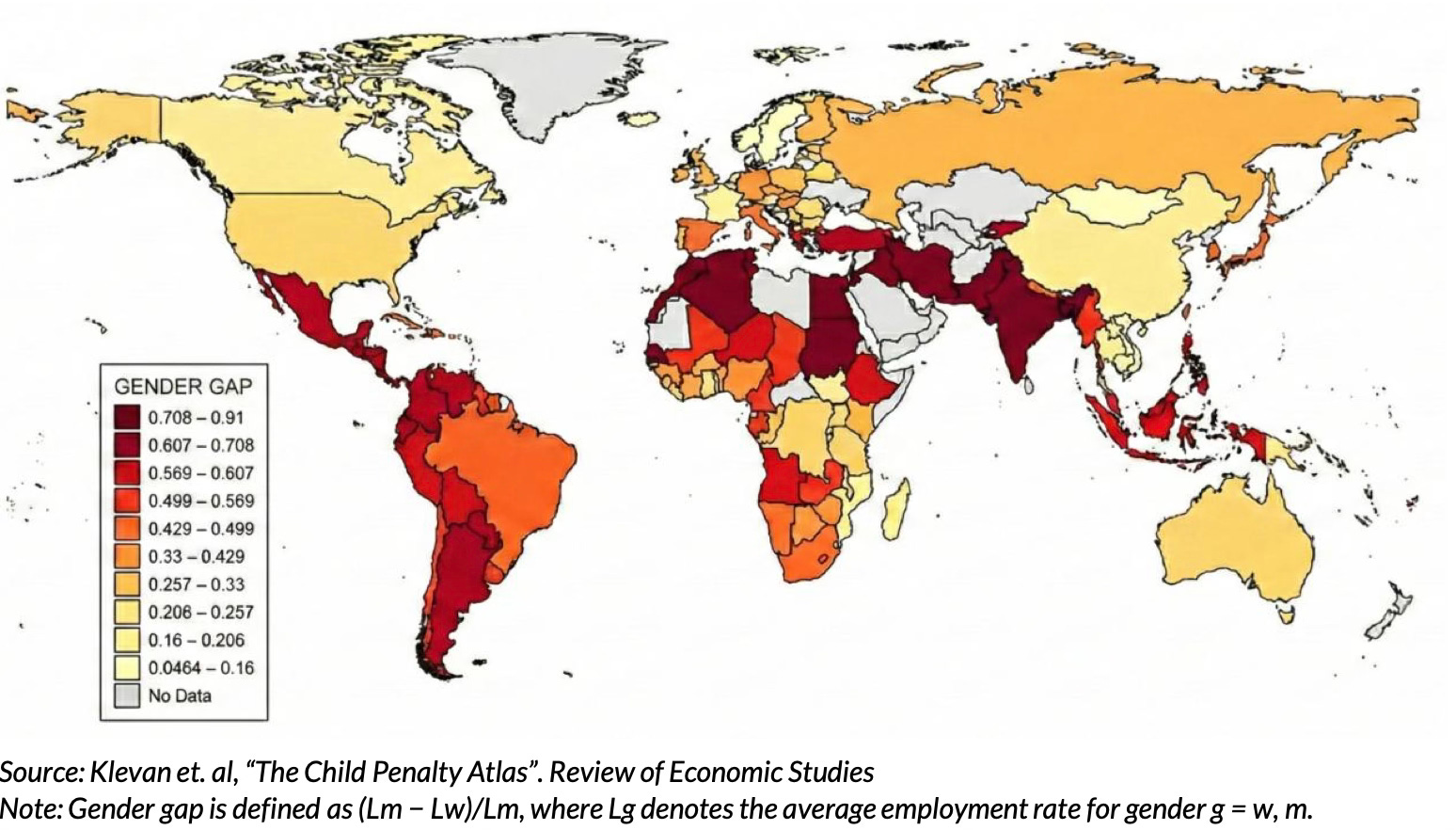
Source: Klevan et al via Axis Capital
Listen/Watch:
What Do Indians Think About the World? | Paul Staniland and Aidan Milliff in conversation with Milan Vaishnav | Grand Tamasha | Carnegie Endowment for International Peace
Over 150 Houses Demolished in Delhi’s Shalimar Bagh | The Wire