
India Last Week #90
A round-up of research & reportage on India across climate, energy, foreign policy, politics & more over the last week

Climate, Energy & Environment:
“Across administrations—regardless of party—governments have consistently maintained that there is no “conclusive evidence” establishing a causal link between air pollution and mortality. This stance flies in the face of peer-reviewed literature on the subject but has appeared in parliamentary discourse from as early as 2006 to as recently as January 2026. At times, the denial has also taken subtler forms, such as alleging that global air quality indices that rank Indian cities among the most polluted are biased or not based on representative data, and seeking an ever-larger base of “indigenous/local studies” to establish health impacts. This sustained posture shapes—and constrains—policymaking, and dissuades scientists and researchers from advancing proposals they believe are unlikely to secure legislative backing… For the longest time, politicians and the policymakers who work with them have called for “indigenous/local studies”, arguing that studies done elsewhere in the world do not capture Indian conditions. The same argument is made in meetings held by the NAAQS revision committee as well… Sometimes suggestions that run counter to evidence-based policymaking are shot down in the NAAQS revision meetings… In another instance during the NAAQS meetings, there are discussions on discontinuing the monitoring of sulfur dioxide, the concentration of which remains high in India. Peer-reviewed studies have conclusively linked acute and persistent exposure to SO2 to a range of cardiovascular and respiratory impacts. It remains unclear whether the suggestion to discontinue monitoring was accepted.” Read more: Rishika Pardikar, Drilled
“Oil marketing companies’ (OMCs) strong March-quarter (Q4FY26) results hide the heavy losses they are incurring due to higher crude oil prices. Brent crude now trades over $100 per barrel, up from about $70 per barrel before the West Asia war began. Efforts to soften the blow are still not enough to cushion the impact of crude price surge. The government reduced excise duty on petrol and diesel by INR10 per litre on 27 March. It has also allowed two prices increases over the past week, totalling about INR 4 per litre… Apart from auto fuels, OMCs’ cost of procurement of LPG has also increased sharply to about $1,000 per tonne, against $520 per tonne before the war, as per a 17 May Nomura Global Market Research report… But OMCs may get some more relief as the huge anticipated under-recoveries may mean further hikes in retail petrol and diesel prices can be expected. Recall that retail prices were increased by INR 10 per litre in 2022 in response to the flare-up after the Russia-Ukraine war… Shares of OMCs are down 11-25% since the start of the war, though there is little comfort on valuations. Nomura noted that despite a sharp dip in fuel marketing margins to INR 25 a litre and highest-ever LPG loss at INR 680 a cylinder, OMCs are trading at a premium to the valuations seen during the early days of the Ukraine war.” Read more: Ashish Agrawal, Mint
“The country has had a crisis-prone history associated with oil price shocks, one that is worth a brief recount in order to underline the need to avoid repeating that history. For, ever oil price spurt so far has led to an economic criss that, in turn, has provoked political change. This was true of the first oil shock of 1973, which quadrupled oil prices almost overnight, from $3 per barrel to $12. Inflation soared to 30 per cent, and the Opposition was able to force Indira Gandhi on to the back foot. The chain of events led to India’s only experience with dictatorial “Emergency” rule. The second oil shock, in 1979, saw oil prices double to $23.50 per barrel, with prices in the spot market surging to $40. India’s shell-shocked economy shrank by an unprecedented 5 per cent… Finally, the oil shock of 2012 saw oil prices reach $125 per barrel and stay above $100 till 2014… Now, for the first time in our history, solar and wind energy offer an alternative solution, not just because of their enormous generation potential, but also because they are now competitive when compared to new coal-based power plants… In broad terms, India should aim to become an electro-state… India needs to be made a more attractive destination. A more hydrocarbon-proof economy will take the country a big step closer to that goal.” Read more: T. N. Ninan, Business Standard
“India’s imports of refined petroleum products declined to an average of 765,000 barrels per day (b/d) in March 2026 as closure of the Strait of Hormuz (SoH) impacted LPG supplies, pulling down the overall import volume to its lowest since 2018. OPEC in its May monthly oil market report (MOMR) said “Product imports into India fell to the lowest level since 2018 due to a sharp drop in LPG, which India primarily sources from the Middle East.” According to the Petroleum Planning and Analysis Cell (PPAC), India’s refined petroleum product imports fell by 25.5 per cent Y-o-Y in March 2026… India’s crude oil imports fell to an eight-month low of 4.5 mb/d in March 2026, due to trade flow disruptions and despite a temporary suspension of sanctions. M-o-m, crude imports into India declined by 775,000 b/d or almost 15 per cent, the OPEC MOMR said… The impact of supply side disruptions on liquefied petroleum gas (LPG) imports by India also reflected in consumption of the commodity—the key cooking fuel for more than 33.50 crore households. The OPEC report pointed out that LPG consumption witnessed the largest decline in March 2026 of about 120,000 b/d y-o-y, in March, down from a y-o-y increase of 100,000 b/d in February 2026… However, India’s cumulative LPG consumption in FY26 rose by 6 per cent y-o-y to 33.21 mt on a provisional basis, which is the highest annual growth in usage since FY19.” Read more: Rishi Ranjan Kala, The Hindu Businessline
Economy:
“The recovery in India’s private sector activity appears to have lost some momentum in May, with the latest HSBC Flash PMI showing softer growth in output, new orders, exports and employment. Data released by S&P Global on Thursday suggests that while business activity continued to expand, the rebound after March’s sharp slowdown did not strengthen further. The HSBC Flash India Composite PMI Output Index came in at 58.1 in May from 58.2 in April. The Services PMI Business Activity Index edged up to 58.9 from 58.8, but this was offset by weaker manufacturing activity. The Manufacturing PMI Output Index slipped to 56.6 from 56.9, while the headline Manufacturing PMI fell from 54.7 to 54.3… The loss of momentum was most visible in demand conditions. New business at manufacturers and service providers grew at a softer pace, pulling down growth at the composite level. For manufacturers, new orders expanded at the second-weakest rate in nearly four years… Manufacturing, which led the rebound in April, lost some pace in May. Factory output continued to grow, but at its second-slowest pace since mid-2022, ahead only of March. “Manufacturing activity eased marginally as the rates of expansion in output and new orders moderated, while growth of new export orders softened markedly. Yet, the Manufacturing PMI remained broadly in line with its long-run average, supported by continued inventory building,” said Pranjul Bhandari, chief India economist at HSBC.” Read more: Sreedev Krishnakumar, Hindustan Times
“Currency in circulation (CiC) continued to rise at a sharp pace, increasing 11.5 per cent year-on-year to a record high of Rs 42.86 trillion as on May 15, according to the latest data released by the Reserve Bank of India. In absolute terms, CiC expanded by Rs 1.15 trillion during the first one and a half months of FY27, indicating sustained demand for cash despite continued growth in digital payments. CiC was Rs 41.47 trillion as on March 31, 2026, compared to Rs 32.24 trillion a year ago — a growth of 11.9 per cent… “The increase in currency in circulation over the past few months appears to be driven by multiple factors. Cash continues to remain the preferred mode for a large section of transactions, while election-related spending also typically leads to a build-up in currency demand ahead of polling periods,” said Madan Sabnavis, chief economist at Bank of Baroda… Analysts also pointed to improving rural incomes and stronger rural demand trends as factors supporting higher cash usage… According to economists, the increase in government cash transfer schemes may also be adding to cash leakage from the banking system. “Currency in circulation has been rising steadily since last year, when it increased by around Rs 4.4 trillion, and the current financial year is tracking at an even faster pace,” said Gaura Sen Gupta, chief economist at IDFC FIRST Bank.” Read more: Anjali Kumari, Business Standard
“A resounding endorsement for Narendra Modi in 2029 is the only way the party can exceed the electoral peak it’s attained in Bengal. At the same time, the BJP’s handling of the economy has hit a low with no guarantee that it cannot go lower. The burning question is: Are the two events coincidental, or simultaneously determined? The latter — details follow. Four agents are responsible for the economic derailment. The first and most important is the government itself. It recognises the problem but is satisfied with blaming others for the crisis — in this case, the second agent: Major industry. The third agent is the Congress party, which is so comfortable being led by the Gandhis that a BJP one-party democratic rule is all but guaranteed. The fourth agent is the puppeteer controlling the top three: The Deep State… For the period of BJP rule from 2014 onwards, India’s rank in terms of GDP growth is ninth, in terms of per capita GDP growth, the rank is eighth, and it’s placed 16th in terms of per capita growth in US dollars… India has also moved from being one of five “Fragile Five” economies in 2013 to possibly becoming one of just two (along with Turkey). The Indian rupee has depreciated approximately 12 per cent against the US dollar in the last year, the seventh consecutive year of decline, and was ranked among Asia’s worst-performing currencies in 2025… And the incentive for investors today is to leave India, or not enter it. Why? For starters, there is the much-discussed “business climate”: Domestic firms are deeply uncertain about government policy.” Read more: Surjit S. Bhalla, Indian Express
Foreign Policy & Security:
“The closure of the Strait of Hormuz has sent the vast Asian chemicals industry into a tailspin. Deprived of the likes of Qatari natural gas and Saudi Arabian oil, the region’s fertilizer and plastics plants are slowing production or even shutting down. Everywhere but China, that is. In petrochemicals, China is unique. As well as a traditional industry that uses oil and gas as feedstock, it has parallel output that relies on its abundant domestic coal. Unsurprisingly, India and other regional powers want to copy and paste the Chinese method. This won’t be easy — or climate friendly… Despite its massive scale, this Chinese industry has gone largely under the radar. Yet it consumes about 380 million metric tons of coal as a feedstock… India has pledged nearly $4 billion to quickly start up a coal-to-chemicals business, aiming to process as much as 75 million tons of the fossil fuel into fertilizers, plastics and other synthetic products by 2030. The New Delhi government will cover 20% of the building cost for new plants and will help earmark coal reserves for forthcoming projects, guaranteeing long-term supply. The nascent industry offers India the same advantages that attracted China decades ago. First, it enhances energy security. India is rich in coal, so every ton of petrochemicals it produces this way is one that doesn’t need foreign oil and gas. Second, using coal to make fertilizers improves the country’s food security, another government priority… Still, replicating the Chinese model won’t be easy. New Delhi’s first problem is the feedstock itself: Domestic Indian coal has too much ash to be easily converted into chemicals.” Read more: Javier Blas, Bloomberg
“Tariff uncertainty and duties in the US have crushed India’s solar module exports, erasing a multi-billion-dollar high-margin export opportunity at a time when India is trying to reduce its trade deficit. All but one of India’s top listed solar module companies reported nil exports during the quarter ended 31 March. Market leader Warree Energies Ltd, which had so far managed to protect its exports to the US, also reported fewer out-bound shipments during the fourth quarter of FY26. The companies attributed the decline largely to the tariffs and duties levied by the US, which have surged to upwards of 230% per an estimate by analyst… For context, India exported a peak of $2 billion worth of solar modules in FY24, majorly to the US. The North American country has barred module imports from China, becoming one of the few large markets where Indian solar manufacturers were competitive… Modules to the US were supplied at an estimated price of 25-30 cents per watt-peak. The same modules fetch 16-24 cents per watt-peak in India depending on whether they’re made from cells produced domestically or imported, with the former costing more.” Read more: Nehal Chaliawala, Mint
“Secretary of State Marco Rubio visited New Delhi this week to reassure India of its importance, but analysts mostly saw the trip as little more than a salve applied to deep wounds inflicted by the Trump administration’s policies on trade and immigration, and the war in Iran… India, which imports 90 percent of its crude oil, had come under pressure last summer after Mr. Trump slapped a punitive 25 percent tariff on India for buying Russian oil. It was lifted in February after India agreed to limit purchases of Russian oil… Mr. Trump has upended many of India’s assumptions about the nature of its relationship with the United States: The bedrock was an economic partnership, with a marginal role for Pakistan and cooperation in the Indo-Pacific region. Mr. Trump’s tariffs, his close relationship with Pakistan’s leaders and his seeming desire to cultivate stronger ties with China have called all of those assumptions into question… Its students and workers have been hurt by the Trump administration’s immigration restrictions. Mr. Rubio defended the policies at a news conference, insisting that they are “not a policy targeted at Indians.” Beyond the reassuring talk, analysts said, it’s been hard to distill what India secured from America from Mr. Rubio’s visit.” Read more: Anupreeta Das, New York Times
“A Norwegian journalist, Helle Lyng, asked Sibi George, Secretary (West) in the Ministry of External Affairs, three questions during his media briefing in Oslo on May 18 — Why should India be trusted? Can India promise to try to stop human rights violations in the country? Will Prime Minister Narendra Modi start taking critical questions from the Indian press? George did well not to answer the query regarding the PM. It is not for a diplomat to dwell on a political leader’s way of dealing with the domestic and foreign media… Sibi George responded to Helle Lyng’s first question — Why should Norway trust India? — with a peroration that spelt out the characteristics of a modern state… George is an experienced diplomat. Surely, he would have known that he did not have to give such a long response to the “trust” question at a press conference. This is because the Norwegian media, let alone the Scandinavian media, could not have carried it in their reportage of PM Modi’s visit. Hence, the inescapable conclusion is that George was trying to show to certain sections in India that he was giving a fitting reply to an impertinent Western journalist who was asking disrespectful questions about the country… A politician may seek popularity, but that cannot be the purpose of Indian diplomacy. Its purpose is to reach out to foreign opinion-makers through responses during media conferences and other means. Catering to sympathisers of the ruling dispensation in India can never be the primary object of Indian diplomacy.” Read more: Vivek Katju, Tribune
People & Politics:
“For a long time, it has been clear that there is something fundamentally broken about the operation of the Unlawful Activities Prevention Act (UAPA). Ostensibly designed to effectively prosecute people accused of terrorist offences, the Act has, instead, become a tool for indefinite pre-trial incarceration of people against whom no charges have been proven. Two things contribute to this. The first is the general malaise of India’s criminal justice system, where criminal trials take years (or even decades) to complete… The second is that the UAPA sets the threshold for the grant of bail extremely high, requiring judges to deny bail if they feel that the police has made out a prima facie case against the accused (that is, going by only the materials provided by the police)… Unfortunately, the basic architecture of the UAPA — which itself is borrowed from previous anti-terror statutes such as the infamous TADA, which, in turn, borrowed it from colonial-era Emergency laws — has largely been sustained by the courts. Within this overall architecture, however, there has emerged a further tussle within the judiciary. One set of decisions attempts to, at the very least, mitigate some of the worst effects of the UAPA, and provide the constitutional guarantees of life and personal liberty some minimal room to breathe.” Read more: Gautam Bhatia, Hindustan Times
Malviya Nagar Fire: Court Orders Ignored, Delhi B&B Violated Several Fire Safety Norms, Find Reports
“Nearly five months before the building in South Delhi’s Malviya Nagar was gutted in a massive fire that claimed 21 lives on Wednesday (June 3), the Delhi high court had asked Delhi authorities to urgently address concerns around fire safety regulations in hotels, restaurants and other hospitality establishments across the capital city. However, an investigation into the fire at Flourish Stays B&B revealed that it was operating with multiple violations, including unauthorised construction, inadequate fire-proofing and only one entry-exit stairway… According to the police, the hotel was licensed to operate as a six-room establishment but had illegally expanded into a 25-room hotel. The Delhi Police has detained the owner, Luv Kesh Bajaj, after reportedly making attempts to evade authorities… Among the deceased, there were nine African nationals and two from Turkmenistan. Tens others were Indians. The death toll could rise as several injured were in a critical condition… On May 27, the Delhi government proposed a new fire safety framework, as per a Hindustan Times report, under which building owners can obtain fire clearances through private fire auditors – they will be empaneled, said the policy – rather than relying solely on inspections by Delhi Fire Services (DFS). While the government argued this will reduce delays and improve efficiency, experts opined that the push can compromise independence of the mechanism.” Read more: The Wire
“Two guards who police said were associated with educator and YouTuber Faizal Khan’s coaching institute, Khan Global Studies (KGS), were detained for questioning after a video of the June 2 attack on the institute allegedly showed “two persons” firing into the air. Following the attack, Khan had claimed that “eight to 10 rounds of gunfire were fired outside the institute” and alleged that individuals linked to a rival coaching centre were behind the attack. In a press release issued on Thursday, the Office of the City Superintendent of Police (SP) Central, said that investigators had obtained a video in the course of the probe into the attack on the coaching institute in the Kadamkuan police station area. According to the statement, the footage showed “two persons” firing shots into the air after the incident… The attack took place at around 10.10 pm on June 2 at Khan Global Studies in Patna’s Musallahpur area under the jurisdiction of Kadamkuan police station. Police said a group of 15 to 20 persons allegedly associated with another coaching institute was involved in stone-pelting and vandalism at the premises. He had also suggested that tensions stemmed from his institute’s low-fee model and its performance in the recently declared Bihar Police constable recruitment examination results… One of the institute’s guards, identified by police as Chun Chun, was allegedly assaulted during the attack and suffered a head injury. He was admitted to Patna Medical College and Hospital (PMCH) for treatment.” Read more: Himanshu Harsh, Indian Express
Tech:
“NITI Aayog’s Frontier Tech Hub released a report last week that had two main messages: first, that India faces steep challenges in developing world-class semiconductor manufacturing capabilities, and second, that national interest necessitated pursuing this field doggedly regardless of those difficulties. The Union government has made chipmaking a priority, since semiconductors are a part of nearly all electronics, from consumer gadgets to defence gear. Yet, India does not have a single fabrication unit, with the first expected to open in Dholera, Gujarat by 2028, with a total of ten in various stages of development. Multiple semiconductor packaging and testing facilities have been generously subsidised and supported by the Union government (as well as some State governments), through initiatives like the India Semiconductor Mission (ISM)… The report points to several challenges in this indigenisation process, not least of which is the time involved… While the details on the second phase of the India Semiconductor Mission are yet to be revealed, the report pegs the necessary capital expenditure from the state at $45-60 billion over a period of ten years.” Read more: Aroon Deep, The Hindu
“Tata Electronics and ASML on Saturday signed an agreement to build India’s first front-end semiconductor fabrication plant in the state of Gujarat, as the country accelerates efforts to develop a domestic chip industry. The Dutch chipmaking equipment maker’s technology will support Tata Electronics’ planned 300-millimetre semiconductor fabrication plant in Gujarat, the companies said in a joint statement. “India’s rapidly expanding semiconductor sector represents many compelling opportunities, and we are committed to establishing long-term partnerships in the region,” ASML CEO Christophe Fouquet said… The deal was signed in the presence of Indian Prime Minister Narendra Modi and Dutch Prime Minister Rob Jetten, India’s Ministry of External Affairs said, adding the two leaders also met chief executives from leading Dutch companies across sectors including energy, ports and technology… India has pledged billions of dollars in subsidies to attract semiconductor fabrication plants and related manufacturing, with eight projects underway including a $14 billion Tata Electronics facility in Gujarat. Meanwhile, Dutch semiconductor firms are seeking new markets and geographical diversification amid export controls and trade restrictions linked to U.S.-China technology rivalry.” Read more: Reuters
Chart of the Week:
Total electricity generation in India - Data by generation source, January 2019-April 2026
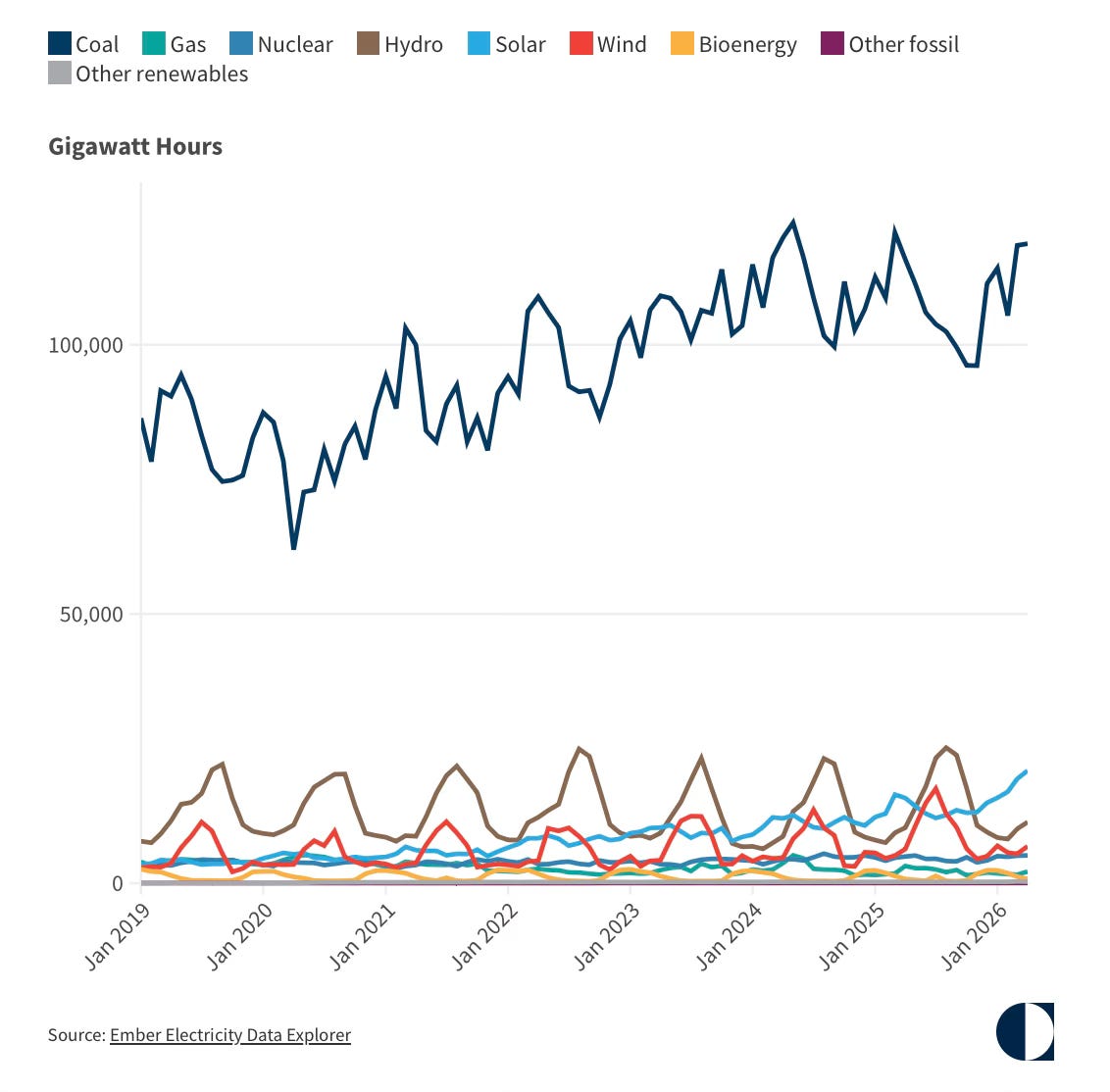
Source: Ember Electricity via Carnegie Endowment
Bonus:
“The Bandung Conference of 1955—it’s hard to think of another event on which so much ink has been spilled in exchange for such little knowledge. Ten years after the Conference, the Indian diplomat G.H. Jansen lamented that much of what we know of Bandung is based on what people think happened at this conference rather than what actually happened there… My aim here is to reveal snippets from the archival traces of this conference and provide a flavor of the goings on through a fleeting glimpse into the mind of one of the chief protagonists of this conference: Indian Prime Minister Jawaharlal Nehru. I rely on an unusual historical artifact: Nehru’s note pad from the conference… Nehru was received with much deference in this first-of-its-kind gathering of leaders from across Asia and Africa. Several of those present looked up to him as an inspiring anti-colonial nationalist and prominent world leader… Of more serious nature, however, are the insights one gains about Nehru’s impressions of the main committee discussions. He takes extensive notes from various speeches which reflect the contentious nature of these discussions. Nehru often notes down the names of the speakers, which even the official proceedings of the conference do not do. So, it is through Nehru’s diary, we now know for certain, that the main intervention on the Palestine issue at this conference was made by Ahmed al Shukeiri.” Read more: Vineet Thakur, Center for the Advanced Study of India
Listen/Watch:
India’s manufacturing is broken. There’s only one way to fix it, says Dr. Rajiv Kumar | Puja Mehra in conversation with Rajiv Kumar | How India’s Economy Works
Good compilation. Two numbers stood out.
LPG loss at Rs 680 per cylinder. 33.5 crore households cook on this. That is a welfare crisis wearing an energy label.
India’s solar exports to the US – $2 billion built on China being locked out. One tariff move. Gone in a quarter. That was never a real export strategy