
India Last Week #87
A round-up of research & reportage on India across climate, energy, foreign policy, politics & more over the last week

Climate, Energy & Environment:
“Achieving net-zero emissions by 2070 demands maintaining a steady-state path of declining emissions intensity. Sectoral growth will both depend on and increase electricity demand, which is expected to go up about 15 times by 2070, while GDP might grow about 17 times during the same period, according to our macroeconomic model. Such a rise in electricity demand would require continued use of coal in the generation mix, particularly in the absence of storage facilities and the concomitant infrastructure to support a renewables-led sectoral growth of the Indian economy… A realistic assessment of coal demand is crucial to assess how far India’s present policies and business practices are conducive to a rapid energy transition… The Ashoka Centre for a People-centric Energy Transition (ACPET) has developed a framework that estimates India’s thermal coal demand until 2070 based on the causal relationships between GDP growth, sectoral electricity demand, and the resultant demand for coal… Based on the above framework and assumptions, it can be observed that thermal coal demand peaks at about 1680 MT only around 2060, even with very ambitious assumptions about the progress of the renewable energy sector… The CEA has estimated coal demand in two documents. The first is the National Electricity Plan (NEP) for 2022-2032. The second is the cost minimization report (CMR), which covers the period from 2023-30. Both show no peak in coal demand for thermal power plants during this period.” Read more: Anvesha Adhikari, Navya, Anjali Goyal, Anandajit Goswami and Rakesh Kacker, Money Control
“Amid the disruptions caused by the conflict in West Asia and the accompanying risk that climate action will be pushed down the global agenda, India has reaffirmed its commitment to climate goals by updating its Nationally Determined Contributions (NDC). In March 2026, the Union Cabinet approved NDC 3.0 for submission to the United Nations Framework Convention on Climate Change (UNFCCC) for the 2031–2035 period… Achieving these goals will require every Indian state to play a role, as most power procurement decisions are made at the state level… India achieved the milestone of 50% non-fossil fuel-based installed capacity in October 2025, five years ahead of schedule. This progress was driven largely by Rajasthan, Gujarat, Maharashtra, Tamil Nadu, and Karnataka, which together account for more than 60% of the total non-fossil fuel installed capacity as of February 2026… The Indian States’ Electricity Transition (SET) 2026 report by the Institute for Energy Economics and Financial Analysis (IEEFA) and Ember highlights that while states have advanced on multiple fronts, the pace and depth of their progress vary significantly across several parameters… States like Bihar, Kerala, Odisha, Telangana, and Uttar Pradesh are yet to accelerate renewable capacity deployment. Encouragingly, though, they have begun adding energy storage and preparing their grids for higher renewable penetration.” Read more: Tanya Rana and Ruchita Shah, Mongabay
“India's electricity demand has been growing rapidly, at 9% per annum since 2021. Meeting this demand by 2030 would require around 777 GW of installed capacity, as estimated by the Central Electricity Authority (CEA)… A study by CEEW (2025) finds that meeting this target would require adding around 56 GW of non-fossil capacity every year between 2025 and 2030, failing which India would need an additional 10 GW of coal-based capacity to meet future demand… However, the next phase of the transition is likely to be more complex. India is now facing new challenges regarding grid integration and transmission infrastructure, leading to delays in commissioning projects and curtailment of operational projects… In this backdrop, our paper Evaluating India's Energy Ambitions: Evidence from Electricity Generation Project-Level Data studies how electricity generation projects evolve from announcement to completion. Using project-level data from the Centre for Monitoring Indian Economy (CMIE) CapEx database, we analyse 8,540 projects announced between January 1957 and December 2024 to understand how project size, cost, ownership, energy technology and location influence project timelines… We find a significant divergence between projects announced and completed: of the total announced conventional (CE) and renewable (RE) capacity, only 15% and 9% have been completed, respectively… If the current completion trends continue, total installed capacity would fall short of the 777 GW target by around 56 GW for CE and 45 GW for RE. Similarly, for the 500 GW non-fossil target, the projected shortfall is around 77 GW. It is important to note that our analysis does not include new projects that may be announced after 2024.” Read more: Upasa Borah, Akshay Jaitly and Renuka Sane, The Leap Blog
“For the past 25 years, energy analysts, investors, planners, and policymakers have been fixated on China… But for the next quarter century, it is India’s energy decisions that will most likely be most impactful for the world economy… What makes India the most interesting energy story of the coming decades is not the inevitability and relevance of its size; it is the uncertainty of where it lands and which direction it will choose… For all that is said about China being the world’s largest oil and natural gas importer, it is also among the Top 5 producers of oil and gas. Because India has had very limited success in increasing its hydrocarbon production, it depends more on imports… Furthermore, India has far greater cooling and air conditioning needs than China, driven by its climate and its rapidly urbanising population. It has less heavy manufacturing. As such, its energy demands will skew more residential and less industrial, which changes load profiles, grid design, price expectations, and the consequences of grid failures or energy shortages… India today consumes only about 35% of the global average per-capita primary energy. That is not a sign of efficiency but a measure of unmet demand... The question is not whether India will grow. The question is what kind of energy system it builds as it does. The choices made over the next five years on grid infrastructure, industrial policy, clean technology deployment, and carbon pricing will shape not just India’s future but the trajectory of global emissions for decades.” Read more: Kaushik Deb and Michael Webber, Fortune
Economy:
“India this week signed the latest in what’s been a run of rapid-fire free trade agreements. The deal, with New Zealand, is far from the South Asian country’s largest, but like others over the past year it marked a swift conclusion to what had been a drawn-out process… This all amounts to a striking reversal of Prime Minister Narendra Modi’s earlier turn toward protectionism, and a resumption of what had been a long-term trend of declining tariffs… But the shift also reflects a deeper realization for India: There is no durable alternative to export-led growth. Modi’s original protectionist pivot rested on prioritizing domestic demand and economic self-reliance over exports… The bet was that higher trade barriers also would lure global firms to relocate production to India. That template now is being cast aside… Between 2017 and 2020, India’s average tariff rate rose from roughly 13% to roughly 18%. Modi’s protectionist tilt included an increase in quality control orders (QCOs), which effectively served as non-tariff barriers aimed at low-cost imports, primarily from China… But India’s domestic demand, although large in absolute terms, isn’t deep enough to sustain the high growth needed to match the ambition of achieving developed-nation status by 2047… The numbers tell the story: Manufacturing’s share of India GDP has slipped from 16% to 13% in the last decade and job creation remains Modi’s Achilles heel. High tariffs also hurt India’s exports, which are import intensive — in other words, they depend on intermediate items made elsewhere.” Read more: Chetna Kumar, Bloomberg
“Days after Prime Minister Narendra Modi urged citizens to defer gold purchases for a year as part of a broader national effort to conserve foreign exchange, the government on Wednesday sharply increased import duty on precious metals amid concerns over the external sector and the impact of the West Asia crisis on India’s import bill. A Finance Ministry notification said import duty on gold and silver has been increased to 15 per cent from 6 per cent, while duty on platinum has been raised to 15.4 per cent from 6.4 per cent… “This has been done as a policy measure aimed at safeguarding macroeconomic stability, conserving foreign exchange, and moderating non-essential imports during a period of heightened global uncertainty arising from the ongoing West Asia crisis,” an official said… The government has simultaneously tightened the concessional import route available under the India-UAE Comprehensive Economic Partnership Agreement (CEPA), raising the duty on gold imported under the tariff rate quota to 14 per cent from 5 per cent… Economists said the higher tariffs could moderate gold demand and offer some relief to the CAD, though part of the gains may be offset by smuggling. Chief Economist at CareEdge Rajani Sinha said a cumulative 9 percentage point increase in duty could reduce gold demand by 50-60 tonnes annually, lowering imports worth $6-9 billion at current international prices.” Read more: Shishir Sinha, The Hindu Businessline
“Indian stocks tanked on Tuesday, wiping off about $115 billion from the market value of firms listed on the National Stock Exchange, as fading hopes for a U.S.-Iran deal worsened the outlook for Asia's third-largest economy… The rupee, Asia’s worst-performing currency in 2026 so far, fell to a record low as crude hovered near $107 per barrel and outflows continued unabated, hammering stocks across sectors. “The pressure on equities is now being amplified by a macro ‘triple hit’ of higher crude prices, rupee slipping to record low and continued aggressive foreign outflows,” said Hariprasad K, founder of Livelong Wealth… India, the world’s third-largest oil importer and consumer, meets more than 90% of its crude oil needs and about half of its natural gas demand through imports. The country has yet to raise prices of fuels used by the public, but the oil minister said on Tuesday the government would at some stage need to assess how long state-run refiners can sustain losses from selling fuels below market prices… Shares of Indian IT firms fell 3.7% to a three‑year low over concerns of AI disrupting their traditional business models, and ahead of U.S. inflation data that could revive rate‑hike concerns. All 16 major sectors declined, while small-caps and mid-caps dropped 3.2% and 2.5%, respectively.” Read more: Bharath Rajeswaran, Reuters
“Within a week in early 2026, the government of India performed a veritable miracle by agreeing to bilateral free trade agreements (FTAs) with the two largest economies, the United States and the European Union (EU)… However, as of now, the two FTAs are headed in different directions. The EU-India FTA is following the official procedures that are laid down for the 27-member bloc. The draft chapters of the FTA have been published in keeping with the transparency policy of the European Commission (EC)… At the conclusion of the EU-India FTA negotiations, the most protracted ever for a bilateral trade deal, both governments are optimistic about the expected benefits… India’s hopes of increasing its merchandise exports to one of its largest trade partners, hinges on the EU’s decision to eliminate its tariffs on 99% of its exports terms of trade value. Of India’s current exports to the EU, 90.7% by value (or 70.4% of tariff lines at the 6-digit level) would attract no import duties once the FTA comes into effect… The EU-India FTA is the first bilateral trade agreement negotiated by India that not only recognises Indian traditional medicine (ITM) services as health and wellness-related services but also facilitates trade in such services… Though the Government of India is optimistic about its gains from this FTA, the realisation of expected benefits may not be as straightforward as it appears, given that the EU is an extensive user of regulatory standards, or NTMs… Compliance with the EU’s complex regulatory standards will be critical for Indian businesses seeking to realise the expected gains from this FTA.” Read more: Biswajit Dhar, The India Forum
Foreign Policy & Security:
“With various versions still in play, the precise circumstances remain murky but the fact is clear that India and Pakistan agreed on a ceasefire at around noon on May 10 last year. There is, however, a major unanswered question: Just why did India, by its own account, “accede to the request of Pakistan” for a ceasefire?… The premature ceasefire actually enabled Pakistan to wriggle out of a sticky spot that the escalation of hostilities had created and ride on US shoulders towards diplomatic rehabilitation. As a result, the terrible terrorist act at Pahalgam lost its resonance and India’s campaign to isolate Pakistan failed. In short, India was unable to convert its claimed military victory into a durable strategic reality… So, the question is, yes, India wiped out nine terrorist camps across Pakistan. But what did its action achieve with regard to the state sponsorship of terrorism? And thus brings back the issue of whether India agreed to the ceasefire prematurely. The issue becomes even more pertinent given the fact that Pakistan was able to snatch diplomatic victory from the jaws of military defeat thereafter… This is why it is important to understand the role of the United States here and to ask whether or not India undertook the ceasefire on account of American pressure. The bald fact is that the announcement of the ceasefire was made first in the US, by president Trump through a Truth Social post and not by any spokesman in New Delhi or Rawalpindi… The issue here is not the need for a ceasefire to prevent the conflict between two nuclear armed countries from escalating. But the judgment as to the extent of punishment that Pakistan needed in order to be deterred, at least for a while. Here, the Indian decision may have fallen short of the mark.” Read more: Manoj Joshi, The Wire
“Since establishing diplomatic relations in 1973, India and South Korea have maintained defense ties. .Their first formal agreement, the 2005 MoU on Defense Industry and Logistics, promoted cooperation in production, research and development, and procurement… On April 20, 2026, at the India-South Korea Summit between Prime Minister Narendra Modi and President Lee Jae Myung, a new defense innovation platform called the Korea-India Defense Accelerator (KIND-X) was announced. As part of the Joint Strategic Vision, KIND-X aims to connect businesses, incubators, investors, defense start-ups, and universities from both sides… What can KIND-X unlock? KIND-X can emerge as the “defense innovation bridge”, expanding defense R&D, innovation, co-development and co-production, involving startups, investors, universities, academia, and think tanks, essentially creating a joint defense innovation and industrial ecosystem from both countries…. It may facilitate access to testing facilities through universities and laboratories in both countries, promote joint certification and standardisation processes, and support accelerator and incubator programmes connecting investors and innovators from both sides… The success of KIND-X will depend on leveraging existing co-production ventures such as the K9 Vajra-T howitzers by L&T and Hanwha Aerospace to create templates for future defense projects… The onus is now upon both defense ministries to curate tangible deliverables under KIND-X, clarifying its steering template, funding mechanisms and areas of joint innovation.” Read more: Tejas Bharadwaj and Mugdha Satpute, The Hindu
“The India–Middle East–Europe Economic Corridor (IMEC) was unveiled at the G20 Summit in September 2023 by a coalition including India, the European Union, the United States, Saudi Arabia, and the United Arab Emirates. Two years hence, 2025 exemplified geopolitical tensions, shifting alliances, protectionist trade realignments, supply chain shocks, and Red Sea disruptions that spiked Asia–Europe shipping costs by five times early in the year… Yet, amid ongoing conflicts, IMEC continues to be at the heart of current debates on robust alternatives to traditional economic corridors and strategic partnerships… Despite geopolitical turbulence, the economic logic of India–Middle East–Europe convergence remains. The 16th India-EU Summit in January 2026, held alongside the Republic Day visit of EU leaders, concluded FTA negotiations and endorsed a new strategic agenda, while the EU connectivity policy under Global Gateway aligns with IMEC’s broader goals of resilient trade and supply-chain diversification… Yet, Middle East instabilities have cast doubts on IMEC’s viability. Furthermore, while President Trump initially emphasised IMEC’s importance as a partnership against unfair practices in trade and export control in February 2025, his America First Trade Policy, and subsequent tariff strategies through broad unilateral instruments suggest diverging priorities… The rollout of IMEC is shaped by the absence of a unified Indo–Mediterranean strategy and the diverse priorities of its stakeholders. While IMEC marks a significant step toward deeper India–Mediterranean linkages, both New Delhi and Brussels are yet to elevate it into a fully codified regional vision.” Read more: Abhishek Agarwal, Centre for Social and Economic Progress
People & Politics:
“After Narendra Modi’s Bharatiya Janata Party won a historic landslide victory in the opposition stronghold of West Bengal, India’s prime minister donned a traditional Bengali dhoti trouser cloth for his victory speech at the BJP’s New Delhi headquarters… Just two years after the shock loss of the BJP’s majority in India’s national parliament, Modi and his party are as dominant as ever. As well as winning West Bengal, the biggest prize in this year’s state elections, the BJP increased its majority in the north-eastern state of Assam and won joint control with allies of the territory of Puducherry… The BJP and its allies now control states and territories containing more than 70 per cent of India’s population — a high-water mark comparable to that achieved by the Indian National Congress party with Indira Gandhi as prime minister in the 1970s. Key to Modi’s revival, analysts say, is a relentless focus on grassroots campaigning, increased use of welfare handouts and determination to stay close to voter concerns… Opposition parties have cried foul, saying the deletion of more than 9mn voters from West Bengal’s electoral rolls, ostensibly to remove duplicate entries and illegal residents, tainted the result… The BJP also took advantage of opposition parties accused of complacency and a lack of unity. Parliamentary opposition leader Rahul Gandhi, a grandson of Indira, publicly accused Banerjee on the eve of the vote of not running a clean government, an allegation the BJP took up with glee.” Read more: Andres Schipani and Michael Stott, Financial Times
“For the past two years, Manas Sharma’s life revolved around one goal - cracking the tough exam that would get him admission to a medical college in India so he could become a doctor. But the exam - the National Eligibility Entrance Test (Undergraduate), known as NEET-UG - has been at the centre of a controversy this year following allegations that the question paper was leaked. On Tuesday, the federal government’s National Testing Agency (NTA), which conducts the exam, cancelled the test that took place on 3 May because of an investigation into the allegations. The agency also said that a new date for a retest would be announced next week… Nearly 2.28 million candidates sat the exam on 3 May at more than 5,000 centres across India. The NTA's announcement has left most of them devastated… “Becoming a doctor has always been the plan for me,” says Sumi (who goes only by her first name), a 20-year-old aspirant from the northeastern state of Assam. When she heard that the exam was cancelled, her first thought was that it could not be true… The cancellation has renewed scrutiny of India’s examination system, which has faced repeated allegations of leaks and irregularities in recent years. The NEET itself faced a major controversy in 2024 after allegations of paper leaks, fraud and irregularities. The claims triggered nationwide protests after thousands of candidates received unusually high scores.” Read more: Abhishek Day and Nikita Yadav, BBC
“‘A person will die just furnishing proof of their existence through documents; in death, we will have to furnish documents too.’ This is what an exasperated Hindu woman we met in the slums of Titagarh, West Bengal, had to say about the onerous demands of the Special Intensive Revision of the electoral rolls. Her daughters’ names had been struck off the rolls and she was now scrambling to assemble documents to ‘prove’ their existence… The election is over. The verdict is in and West Bengal, along with Tamil Nadu and Kerala, is ushering in a new government. But the dark cloud of the SIR will continue to loom large. Did the SIR with its deletions and active disenfranchisement of over 27 lakh voters propel the Bharatiya Janata Party to power in West Bengal? This is the question that is dominating the political debate. To understand the full effects — and dangers — of the SIR, we must look beyond electoral math. Its real impact and its most enduring consequence lie in the countless stories of State harassment: the endless chase for documents to ‘prove’ one’s identity; the callousness of algorithmic decisions; and the sharply differentiated ways in which this burden of proving identity are experienced across religious lines — differences that were unmistakable in the voices we heard during our travels… The true danger of the SIR lies in this systematic Othering of fellow citizens. It must be recognised for what it is — a tool through which the seeds of deep exclusion are sown using routine bureaucratic practices that in the eyes of the majority citizens carry within them a veneer of legitimacy.” Read more: Yamini Aiyar, The Telegraph
“At least 111 people were killed and 72 injured after a strong storm and heavy rain pounded several districts of Uttar Pradesh, uprooting trees and damaging houses, an official statement said on Thursday. Chief Minister Yogi Adityanath took cognisance of the loss of lives and damage caused by the unseasonal rain, thunderstorms and lightning on Wednesday and directed officials to ensure relief reaches the affected families within 24 hours. In a statement, the Relief Commissioner's office said, "Due to bad weather on May 13, including storms, rain, hailstorm and lightning, reports of 111 deaths were received from 26 districts. 72 persons were injured, 170 livestock losses and damage to 227 houses have been reported in the state”… According to a list issued by the Prayagraj district administration, till morning, 17 deaths were reported due to the storm and rain. As reports pour in from other areas, the district administration said that a total of 24 deaths have come to the fore in Wednesday's incidents. In Bhadohi, district administration sources said at least 16 people died in storm-related incidents… Additional District Magistrate (Finance and Revenue) Dushyant Kumar said reports regarding human and livestock losses have been sought from local officials, and financial assistance will be provided as per government rules.” Read more: Deccan Herald
Tech:
“The U.S.–India semiconductor cooperation story is well-stocked with top-level strategic intent. What remains unresolved, however, are some underlying challenges that will determine whether the cooperation actually functions. Three such friction points stand out. First, the state of export control regimes on both sides. Second, the absence of a clearly articulated economic case for U.S.–India semiconductor cooperation. Third, a newly articulated anxiety on the U.S. side about India becoming a China-like strategic risk… The U.S. export control regime is not without its own complexities and is also facing new challenges. For example, the Bureau of Industry and Security (BIS) is under-resourced and appears to be directing significant capacity towards enforcement in response to broader geopolitical pressures… A second friction point, perhaps less visible but more consequential, concerns the economic logic underpinning U.S.–India semiconductor cooperation… The India Semiconductor Mission’s (ISM) first phase provided a commercial rationale for U.S. firms to treat India as an attractive investment destination. But as these firms weigh further expansion, the final contours of a successor incentive scheme will determine their top-up amounts and next tranches of investment, and those contours remain unsettled… Finally, a concern that has surfaced with some regularity in recent U.S.–India discussions, including semiconductor-focused ones, is the notion that India could eventually mirror China’s trajectory as a technology-acquiring, supply chain-dominating strategic competitor.” Read more: Shruti Mittal, Carnegie India
“Motorola wants social media platforms to take down “defamatory” reviews of its devices in India. But the way it’s doing this has digital rights activists alarmed. In March, Motorola’s India arm sued major companies and their platforms — Google, Meta, X, YouTube, Instagram, Facebook, and Threads— over more than 360 posts by users that allegedly portray its devices as unsafe… What sets this case apart is Motorola’s decision to name platforms as co-defendants rather than pursuing standard requests to take down specific posts… “Motorola could have filed takedown requests with the social media platforms. … Instead, it bypassed that and chose to name them as co-defendants,” said Jayshree Bajoria, Asia associate director at watchdog Human Rights Watch… On April 17, an Indian court issued a temporary injunction ordering the removal of all existing defamatory content about Motorola — including negative campaigns, abusive remarks, and boycott campaigns — until the next hearing in June… Saurabh Gupta, a content creator who has made videos on Motorola’s durability and service, called out the company in a post on X, saying its legal action was a “direct killing” of freedom of speech… Legal experts are particularly concerned about the inclusion of a “John Doe” provision in the complaint, which allows action against unidentified future creators.” Read more: Ananya Bhattacharya, Rest of World
Chart of the Week:
FPI outflows from domestic markets surpass 2025 annual record highs (in $ billion)
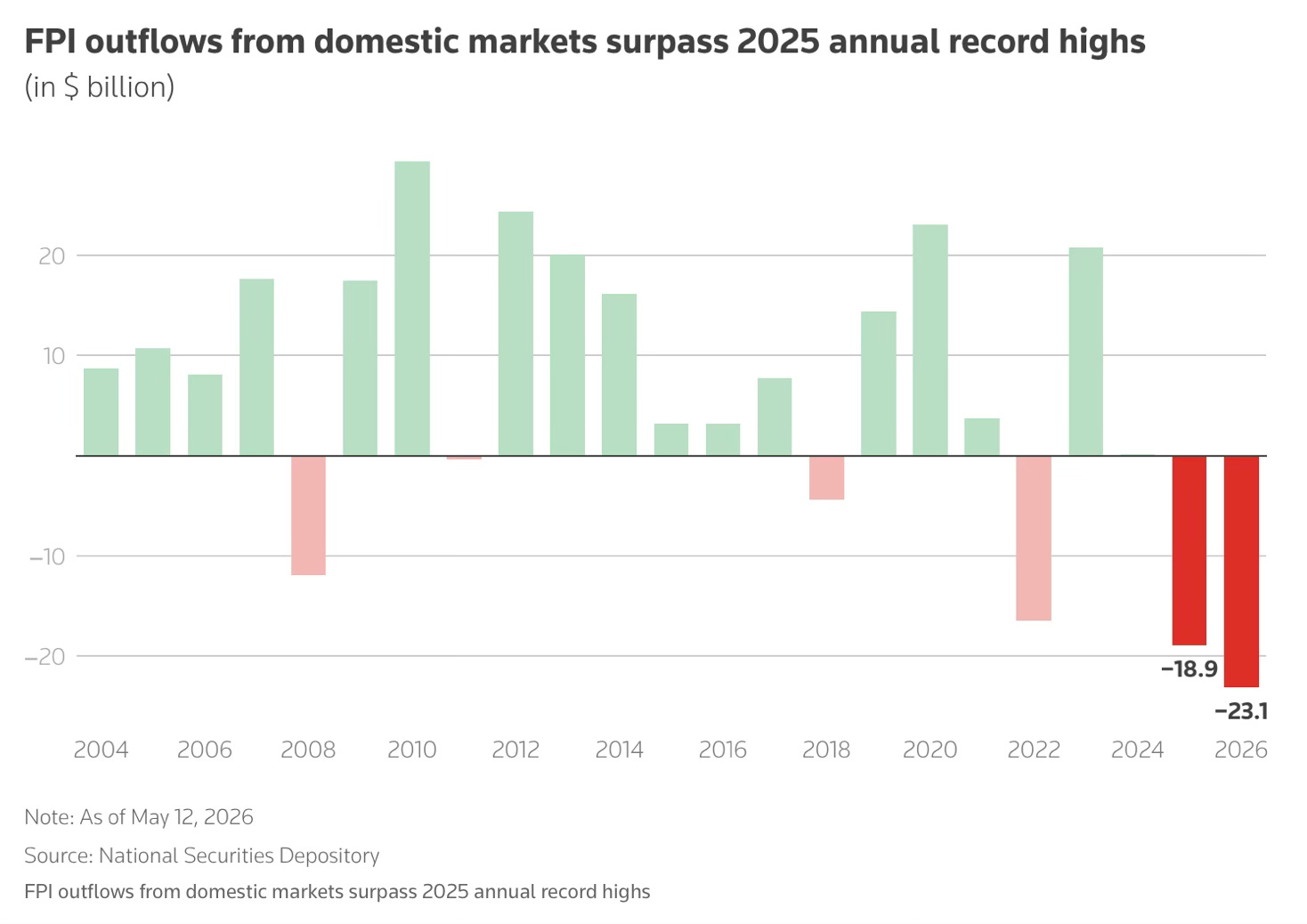
Source: National Securities Depository via Reuters
Bonus:
“A genetic atlas emerging from India’s most extensive genomic sequencing exercise has revealed vast diversity in the population, with nearly 130 million genetic variants, almost a third of which have not been reported previously. The GenomeIndia project analysed the whole genomes of 9,768 healthy people from 83 populations, uncovering 44 million variants absent from global scientific databases, including gnomAD, 1000 Genomes Project and GenomeAsia… Funded by India’s Department of Biotechnology through a consortium of 20 research institutions, the map opens up a path for investigations into human ancestry, disease genetics, pharmacogenetics and precision medicine across South Asia. Aiming to scale to a million genomes and disease-specific cohorts, the project seeks to fill gaps in global databases skewed toward populations of European descent… The atlas captures many rare variants from the DNA of specific communities, reflecting a long history of migration, isolation, and marriage within a group (endogamy), says Kumarasamy Thangaraj, a population geneticist and joint national coordinator of the exercise… The dataset flags other such loss-of-function (LoF) variants linked to metabolic disorders — genetic alterations that inactivate or reduce a gene’s functional capacity — such as in LPA and CD36, both central to lipid metabolism and cardiovascular risk. In all, it reports 15,849 high-confidence LoF variants across more than 7,000 genes, some of which heighten disease risk, while others may be neutral or even protective.” Read more: Sahana Ghosh, Nature
Watch/listen:
India’s 2026 Elections Explained | Yamini Aiyar and Neelanjan Sircar in conversation with Milan Vaishnav | Grand Tamasha | Carnegie Endowment for International Peace
What does Trump’s China visit mean for India and the world? | Nirupama Rao in conversation with Karan Thapar | The Wire