
India Last Week #86
A round-up of research & reportage on India across climate, energy, foreign policy, politics & more over the last week

Climate, Energy & Environment:
“India’s industrial sector could cut 51% of its carbon emissions, reduce energy consumption by over 22% and prevent nearly 7,94,000 pre-mature deaths every year by shifting to electrified heat, according to a new study, positioning clean electricity as a cost-effective shift against volatile global fuel markets. The findings come at a time when rising global oil and gas prices, driven by geopolitical tensions, are increasing cost pressures for Indian manufacturers dependent on imported fuels… The scale of this opportunity is significant. Industry, India’s largest energy consumer accounts for nearly 47% of total final energy use, with over 40% met by coal and another 27% by petroleum and natural gas, leaving the sector highly exposed to global price shocks and import dependence… The report also highlights a strong economic case. “Electrifying industrial heat is already cheaper than producing heat with biomass, natural gas, or petroleum across all temperatures needed by industry,” it said, adding that electrified heat is cheaper than coal in three our of five temperature ranges, covering 55% of industrial heat demand.” Read more: Saurav Anand, Financial Express
“Keeping 1.4 billion people cool in 47 degree Celsius (116 degree Fahrenheit) heat was never going to be easy. In India, it’s about to get a whole lot harder. A heat wave that’s baking the subcontinent sent electricity demand soaring last week, as tens of millions of air conditioners cranked up to take the edge off intolerable temperatures… As recently as 2006, there were just two million AC units in the entire country. Only 10% of homes have one installed at present. With incomes rising and temperatures soaring, that’s changing fast. Last year, 15.4 million were sold, and volumes will almost double to 28 million by 2030… To give you a sense of the scale of that: Accommodating the rise of Indian air conditioners over the coming decade will require twice as much generation capacity as will be needed for new US data centers. If this sounds daunting, there’s good news: A relatively simple tweak to AC design could slash those numbers, while also lowering costs for Indian households and reducing the impact of climate-warming gases. The hitch? Right now, it’s effectively outlawed… Propane — the same stuff you find in a gas bottle for domestic heaters, stoves or barbecues — can also be used as an AC refrigerant, where it’s known as R290. It’s a far less damaging greenhouse gas, equivalent to just three tons of CO2, and is drastically cheaper to buy… Why, then, isn’t it more widely used? Propane is highly flammable, and standards in India have forced it to be used in such small quantities that it can’t counter the intense heat of the South Asian summer… The claimed safety risks of propane in AC, meanwhile, are largely theoretical. With more than 10 million R290 units already installed, we’re yet to see cases of fire outbreaks. One 2024 study estimated that you’d get just one every three years from a fleet of 10 billion R290 air conditioners — five times more than all the AC units on the planet right now.” Read more: David Fickling, Bloomberg
“Chief economic adviser V Anantha Nageswaran on Saturday said India needs to create strategic buffers in the face of the “most difficult” energy shock that the country is facing amid the West Asia crisis. Nageswaran also said that the rising prices of fertiliser and petroleum products globally due to the crisis will make it challenging to achieve the 4.3 per cent fiscal deficit target for the current fiscal, while below normal monsoon and pass-through of higher energy prices could lead to “potential inflation spike”… Speaking at the ICPP Growth Conference organized by the Ashoka University, Nageswaran said the current account deficit (CAD) in the current fiscal could rise to over 2 per cent of GDP, from less than 1 per cent in FY’26… “And we also need to use this occasion to think about other areas where we are vulnerable in terms of import dependence, nickel, tin, and copper. We need to build strategic buffers if we have to make a shot at manufacturing and becoming indispensable,” Nageswaran said.” Read more: Business Standard
“In Himachal Pradesh, the influence of traditional beliefs, religion and cultural practices continues to shape the conservation of forest land. Dev Vans, or sacred groves, are forest patches revered as the domain of local deities (devtas). Village customs strictly prohibit tree-felling, leaf collection, and the entry of alcohol or meat within its boundaries… For generations, in Himachal Pradesh, it was faith, not legislation, that determined which forests would remain untouched… The sacred groves continue to remain at the centre of community life, where rituals and festivals reinforce connections between people and nature, particularly in Himachal’s remote and elevated zones… These belief-based practices have also helped preserve forest patches across generations, outside of formal conservation efforts. Cultural researcher Rahul Bhushan, who studies Himalayan communities, says sacred groves reflect an earlier worldview where forests were looked at as living, inhabited spaces rather than unclaimed land… This restraint, he contends, operated as an unwritten environmental governance system. “It was not conservation by modern definition, but it worked,” he says. Bhushan says these systems are weakening as tourism and migration enter mountain communities… As road networks expand and tourism enters previously isolated areas, land is more often viewed through the lens of economic opportunities.” Read more: Amir Bin Ragi, Mongabay India
Economy:
“Should the government’s think tank and the Prime Minister’s advisory body also follow this principle of providing guidance on the Indian economy’s growth and inflation trajectory?… But more analyses and forecasts on how the Indian economy is going to fare can surely be of immense help. Not only markets, but even the government’s policymakers would benefit from such early assessments. At present, such guidance comes principally from the Reserve Bank of India (RBI) and the annual Economic Survey from the Union finance ministry. The RBI’s assessment is more frequent, coming every two months along with the monetary policy reviews. The annual Economic Survey’s outlook for the economy is comprehensive but it can quickly become outdated, as recent developments show. For instance, the Economic Survey for 2025-26 was presented on January 29, almost a month before the war began in West Asia. It had, therefore, forecast an economic growth rate of 6.8 to 7.2 per cent for the Indian economy in 2026-27, which is not what anyone is expecting now… There is no reason for the EAC-PM or the NITI Aayog not to issue a quarterly or a half-yearly report on the state of the Indian economy and the measures they believe the government should consider. In the past, EAC-PM did produce such reviews of the Indian economy, igniting a healthy debate over how the economy should be managed. In its earlier avatar as the Planning Commission, NITI Aayog was also engaged in producing such reviews to supplement the work done by the RBI or the finance ministry..” Read more: A. K. Bhattacharya, ThePrint
“India’s central bank is weighing a plan for state lenders to sell foreign-currency bonds, mulling a tool last used nearly three decades ago to draw capital inflows and shore up the beleaguered rupee, according to people familiar with the matter. Reserve Bank of India officials discussed a proposal that would see lenders issue foreign-currency bonds, potentially with five-year maturities, the people said, asking not to be named as the talks are private. Discussions are preliminary and no decision has been made, they said… The central bank also considered offering foreign-exchange swaps to participating lenders to hedge currency risk, allowing them to offer more attractive yields to investors, the people said… An RBI spokesperson didn’t immediately respond to an email seeking comment on the matter. State-owned lenders report to the finance ministry, which often coordinates with the central bank on policies and measures to stabilize the currency… The rupee has weakened close to 6% against the dollar this year, the worst performance in Asia. While anti-speculative measures rolled out by the central bank in March and April briefly helped the currency, pressure is building up again as oil prices remain elevated, exerting strain on the fuel-importing nation’s trade deficit. Stock outflows also exceeded $5 billion last month.” Read more: Bhaskar Dutta, Bloomberg
“Sustained economic growth accompanied by structural transformation is a necessary condition for India to achieve its developmental goals over the next few decades. While the Indian economy has consistently been among the fastest growing large economies over the past few decades, this growth has not been accompanied by adequate structural transformation… A large share of the workforce remains concentrated in agriculture and low-productivity services, alongside a relatively small but highly productive modern sector comprising parts of manufacturing and high-value-added services… Against this backdrop, recent developments in India are striking. Since 2018, employment levels have increased, female labour force participation has risen, and India has emerged from the Covid-19 pandemic as the fastest-growing large economy in the world, combining robust output growth with relatively low inflation. In a macroeconomic sense, India’s recent performance appears enviable, especially when viewed against a global environment marked by repeated shocks. However, sustained output growth has been accompanied by a dramatic slowdown in labour productivity growth. In this paper we argue that this pattern represents a departure even from India’s historically distinctive trajectory. Rather than combining output growth with gradual structural transformation, India has experienced what we describe as structural retrogression. By structural retrogression we mean a sustained reversal in the direction of labour reallocation. Employment expansion has coincided with stagnant or declining labour productivity, indicating a growth process increasingly reliant on the extensive margin—more people working, more earners per household, and greater labour mobilisation—rather than improvements in output per worker or firm-level efficiency. While segments of the modern sector have continued to expand impressively, the bulk of employment growth has occurred in surplus labour sectors. In a historically unusual development, agriculture has absorbed more labour in recent years than it did half a decade earlier. This has persisted post Covid.” Read more: Amit Basile and Arjun Jayadev, Centre for the Study of the Indian Economy
“Axis Bank Ltd, India’s third-largest private lender, has signed a $500 million offshore loan with Mitsubishi UFJ Financial Group Inc., according to people familiar with the matter, underscoring rising demand for bank credit. The three-year facility will be priced based on the secured overnight financing rate (SOFR) plus 85-basis point interest margin, the people said, asking not to be identified as the details are private. The bank plans to use the funds for lending and general business purposes, they said… The fundraising comes at a time when banks in India are facing challenges because loans are growing significantly faster than deposits. For instance, Axis Bank’s loans expanded 19% to 12.3 trillion rupees ($130 billion) in the year ended March, while its deposits grew by only 14%, according to its data. Axis Bank has secured the loan facility, with MUFG acting as the sole mandated lead arranger and bookrunner, Girish Vasnani, director in the capital markets group at the Japanese lender, said by email.” Read more: Saikat Das, Bloomberg
Foreign Policy & Security:
“India and Vietnam agreed to strengthen economic and defense ties as both sides seek to deepen their partnership while tensions persist in the Middle East. Indian Prime Minister Narendra Modi held talks with Vietnam President To Lam in New Delhi on Wednesday, with agreements signed across sectors ranging from rare earths to payment systems. The two countries aim to boost bilateral trade to $25 billion by 2030, Modi said at a joint press briefing after the meeting… The visit is Lam’s second overseas trip since securing the presidency last month, and he is accompanied by key ministers and a business delegation. He met India’s National Security Adviser Ajit Doval on Tuesday, and the two sides agreed to expand cooperation in areas such as security, artificial intelligence and energy, according to a statement on the Vietnamese government’s website… Vietnam is seen as a key partner in India’s “Act East” policy, underpinned by growing defense and economic ties, while the South Asian country is Vietnam’s eighth largest trade partner. Indian companies have invested in 473 projects in Vietnam with a total registered capital of $1.1 billion. Vietnamese investment in India has also accelerated, highlighted by VinFast’s electric vehicle factory in Tamil Nadu state and Vingroup’s plan to invest about $6.5 billion in Maharashtra state. Defense cooperation has increased in recent years through expanded maritime cooperation, joint exercises and capacity-building support. The Indian Navy transferred the indigenously-built missile corvette INS Kirpan to Vietnam in 2023.” Read more: Sudhi Ranjan Sen and Nguyen Dieu Tu Uyen, Bloomberg
“As part of efforts to intensify Modi govt’s ‘Act East Policy,’ Navy chief Admiral Dinesh K. Tripathi has held a meeting with Myanmar Navy’s commander-in-chief Admiral Htien Win in Naypyitaw and discussed growing bilateral ties and enhancing maritime security in the Bay of Bengal region. Their meeting also focused on advancing naval engagements between both countries, including on maritime engagement opportunities, capacity building, training exchanges and mobile training teams (MTTs), hydrography and greater interoperability… On Monday, Admiral Tripahit met Myanmar’s defense minister General Htun Aung and discussed the current canvas of bilateral ties. During the visit, Myanmar Navy will host the crew of IOS Sagar for an official interaction.” Read more: Surendra Singh, Times of India
“Service veterans have expressed unease over a senior Indian Army officer’s meeting with Union road and transport minister Nitin Gadkari in Nagpur last Friday (May 1), during which he sought support for expanding NCC infrastructure and training capabilities across Maharashtra – an interaction they claimed sat uneasily with established institutional channels for such requests. They further contended that the Press Information Bureau’s (PIB) projection of the May 1 meeting between Major General Vivek Tyagi, additional director general, NCC Maharashtra Directorate and Gadkari, went well beyond a routine recording of official engagements… The PIB’s 320-word press note stated that during an ‘inspection-cum-review visit’ to Nagpur, General Tyagi had sought Gadkari’s assistance for developing “dedicated infrastructure” for the NCC in Mumbai and Kolhapur, including the establishment of a State Academy for it in Nagpur. “What is revealing is not the meeting itself, but the phrasing and tone of the PIB note, which point to a steady politicisation of the military’s relationship with the civilian executive,” a three-star Army veteran said. Speaking on condition of anonymity, he remonstrated that there was “no basis or precedent” for a serving two-star officer to be “seeking assistance” from an individual minister, as though the Army were operating within a patronage system.” Read more: Rahul Bedi, The Wire
“The May 2025 crisis, in which the neighbors exchanged intense cross-border fire for four days, was the most serious fighting between two nuclear powers in decades. It marked a significant expansion of conventional conflict below the nuclear threshold, with drones, missiles, and artillery striking an unprecedented number of sensitive targets, including military bases and urban centers. Far from being chastened by the scale of the fighting, military planners in India and Pakistan have instead spent the last year drawing lessons about how to inflict greater damage on each other in future conflicts. Both sides have concluded that the next major clash will turn on their ability to strike faster, farther, and in greater volume than they have in the past… They also appear increasingly convinced that, should the conflict erupt again, more intense conventional fighting would not risk nuclear escalation… Yet despite their confidence and bluster, the continued risk of escalation in a region home to a quarter of the world’s population should not be underestimated… If and when it comes, the next crisis between India and Pakistan is likely to prove more dangerous, more destructive, and more difficult for Washington to manage. Both sides have historically shown considerable caution in managing crises and avoiding uncontrolled escalation. But India and Pakistan climbed new rungs of the escalation ladder in the last conflict without serious repercussions, emerging both more determined to exact meaningful costs on the battlefield and more confident in their ability to do so.” Read more: Elizabeth Threlkeld, Foreign Affairs
People & Politics:
“The streetfighter has been beaten. For the first time in many years, some people on the ground in West Bengal saw weakness in Mamata Banerjee’s Trinamool Congress (TMC). Voters complained of cut money, the violence of local workers, a lack of jobs, a desire for poriborton (change) — ironically the same tagline on which Banerjee swept to power in 2011. The TMC had pinned its hopes of holding on to power to the “Bengal model” it used five years ago, a combination of winning Muslim voters and counteracting Hindu-Muslim polarisation by appealing to female voters across the spectrum… Since its drubbing in 2021, the BJP had revamped its strategy in West Bengal. Knowing that it had a weaker party organisation, it sought to simultaneously dent TMC’s welfarism advantage (by promising ₹3,000 to women — double of Lakshmir Bhandar), while seeking to find a narrative that would allow it start winning more in Greater Kolkata, hitherto TMC’s stronghold, by painting the TMC as a party incapable of bringing economic development. But the BJP was also helped by the Special Intensive Revision (SIR) of electoral rolls. Its impact was far greater than mere cuts and additions. As I documented with Bhanu Joshi, the real impact came in the murkiness of how it was being applied. When Hindus saw Muslims in neighbouring localities and villages being struck off the electoral rolls in a charged atmosphere, it gave way to a series of rumours to sow greater division between the Hindu and Muslim communities.” Read more: Neelanjan Sircar, Hindustan Times
“The landslide victory of the Bharatiya Janata Party and its allies in the Assam assembly elections came as no surprise to Chief Minister Himanta Biswa Sarma. One of the reasons, he told reporters after the result, was the delimitation exercise carried out in 2023, which ensured that Muslim voters would play a decisive role only in 23 of the state’s 126 constituencies… As Scroll had reported, the delimitation exercise in Assam had been conducted ostensibly to protect the political rights of the state’s indigenous people. But the manner in which constituency borders were redrawn effectively reduced Muslim representation in the state. Sarma was not far off the mark. The BJP ended up with 82 seats, and its allies, the Bodo Peoples Front and the Asom Gana Parishad, won ten seats each, taking the tally of the alliance to 102… How much was delimitation a factor in this boost? Scroll’s analysis shows that the BJP-led alliance benefited from the exercise in 19 seats. This includes five new seats created in the tribal areas of the state, two erstwhile Muslim-majority seats that were reserved for Scheduled Caste and Scheduled Tribe groups and 12 other seats that saw a significant restructuring of demography. Opposition leaders have described the delimitation exercise in Assam as gerrymandering – redrawing the boundaries of constituencies to give an advantage to a particular political party.” Read more: Rokibuz Zaman, Scroll
“The short answer: Likely not… The question above is the most polarising one to ask vis-à-vis the West Bengal results. Of the 14 states and union territories where the Election Commission of India (ECI) has conducted the Special Intensive Revision (SIR) or special revision (SR) of electoral rolls since last year, six states/UTs have had elections after the exercise. SIR was the most contentious and potentially disenfranchising in nature in West Bengal, where 2.7 million electors were removed from the rolls under the adjudication process (and were awaiting their fate even on the day of election) over and above the 6.2 million who were deleted in SIR apart from the adjudication category… The BJP and the All India Trinamool Congress (TMC) (both are taken along with any allies throughout this analysis) have vote shares of 45.8% and 41.1% respectively in the 2026 assembly elections as of 10pm. The BJP has gained 7.1 percentage points in vote share and the TMC has lost 4.7 percentage points compared to the 2024 Lok Sabha elections, the latest pre-SIR poll in the state. In absolute terms, the BJP has polled 5.6 million more votes while the TMC has polled 1.7 million less votes compared to the 2024 elections (according to ECI data as of 10pm)… The BJP, won 121, 77, and 90 ACs in the 2019, 2021 and 2024 elections, if one were to break up 2019 and 2024 Lok Sabha results into AC-segments. It won 54 ACs in all of these elections. In 2026, the BJP has won all of the 54 ACs it won in 2019, 2021 and 2024 elections. It won 100% of the 142 ACs it won in any of these elections. And it added another 65 ACs to its kitty which it had never won.” Read more: Abhishek Jha and Roshan Kishore, Hindustan Times
Tech:
“Karnataka’s tech industry raised $868 million in the first quarter of this year, registering a 16 per cent decline from the preceding three months but a 7% rise annually, according to a report by market intelligence firm Tracxn. Deal volume fell 38% to 117 rounds, yet total capital raised remained nearly steady, indicating that investors are concentrating their bets by writing fewer but larger cheques rather than retreating from the market. Bengaluru accounted for 98% of the capital flow across these rounds at $848 million, followed by Tiptur, which accounted for the remaining 2% at $19.3 million, driven absolutely by Akshayakalpa’s Series D funding… “What is notable is that all four of the largest rounds went to companies founded before 2020 - mature businesses continuing to scale rather than new entrants breaking through,” Tracxn said. Three Karnataka-based companies - Amagi, at a market cap of $858 million; Shadowfax, at $782 million; and e2E Rail, at $33.3 million, all went public in the first quarter of 2026.” Read more: Economic Times
Chart of the week:
Trade volume passing through Strait of Hormuz
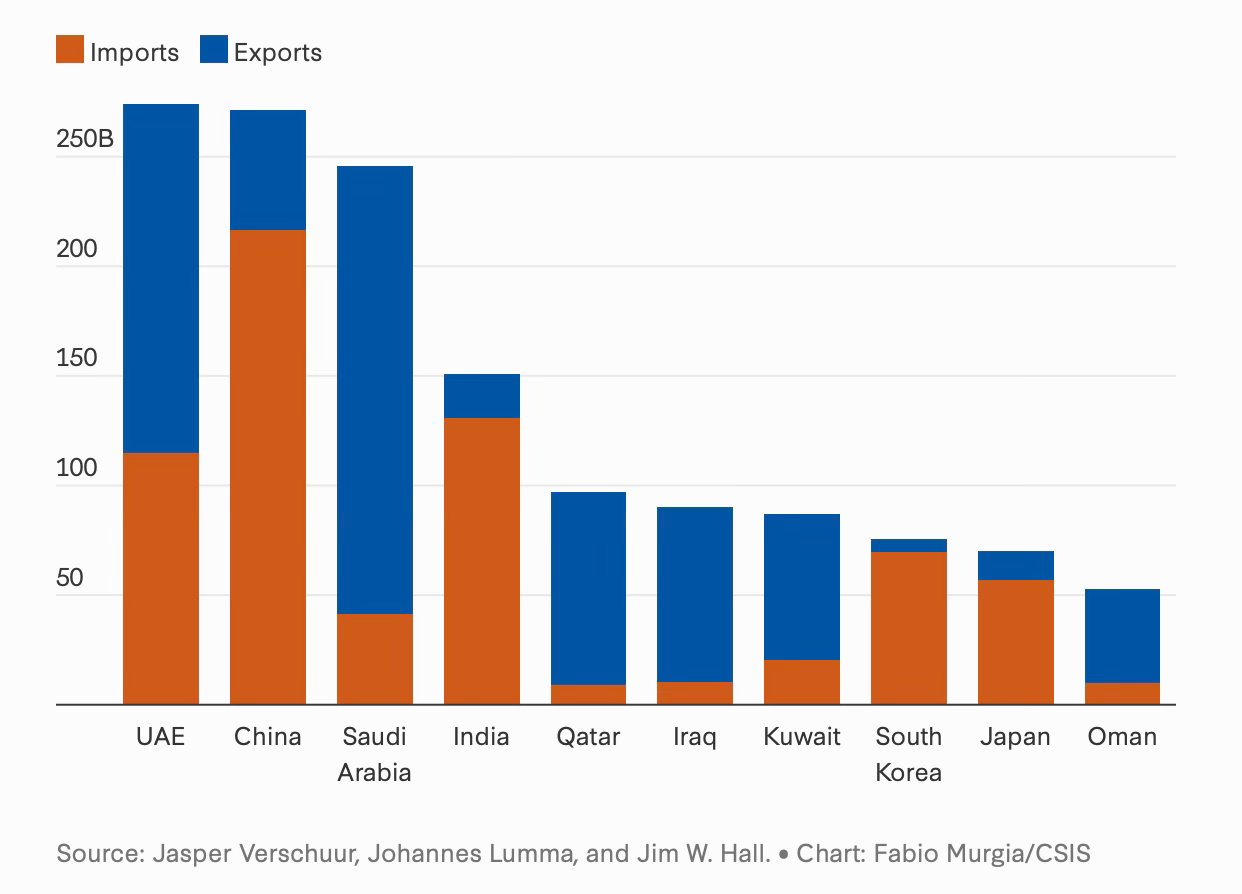
Source: Fabio Murgia, Matthew P. Funaiole, Harrison Prétat, Aidan Powers-Riggs, and Jasper Verschuur, Center for Strategic & International Studies